House hacking is a plain idea with an awkward name: you buy a home and arrange for part of it to generate income that offsets your mortgage. When rates are high and payments are painful, that offset can be the deciding factor between owning and continuing to rent. It is not passive and it is not for everyone, but for the right person it turns an unaffordable payment into a manageable one — and can jump-start real estate investing.
Renting a spare room
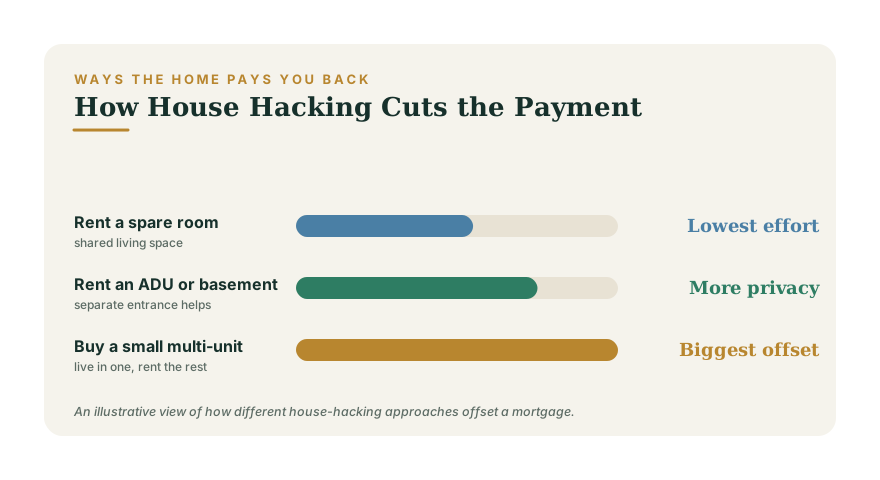
The simplest version is taking on a housemate. You buy a home with an extra bedroom and rent it out, applying the rent to your payment. The advantages are low cost and flexibility — no construction, and you can stop anytime. The obvious downside is that you share your living space, kitchen, and bathrooms with someone. For many young buyers, a year or two of a housemate is a fair trade for owning sooner and building equity instead of paying a landlord.
Renting a separate unit: basements and ADUs
A step up in both offset and privacy is a home with a separable living area: a basement apartment, an in-law suite, or an accessory dwelling unit with its own entrance and kitchen. A tenant there pays more than a housemate because they get real privacy, and you keep the main home to yourself. Building or converting an ADU costs money upfront and depends heavily on local zoning, but it can permanently lower your housing cost and add value to the property. The rules, costs, and payback are covered in Accessory Dwelling Units, Explained.
Buying a small multi-unit and living in one part
The most powerful version is buying a two-to-four-unit property, living in one unit, and renting the others. Because you occupy one unit, you can often finance the whole building with a low-down-payment owner-occupied loan rather than a pricier investment-property loan — a real advantage. The rental units can cover a large share of the mortgage, sometimes most of it. The trade-off is that you are now a landlord living on-site, with the maintenance calls and tenant management that come with it. The realities of that role are in Becoming a Landlord 101, and the broader question of whether the numbers work is in Is a Rental Property Worth It?.
Short-term rentals: higher income, higher hassle
Some house hackers rent a room or unit on short-term platforms instead of to a long-term tenant, aiming for higher nightly income. It can pay more, but it is closer to running a small business — cleaning, turnover, guest communication, and local regulation that is tightening in many cities. The honest economics are in Short-Term Rentals: The Real Math. Treat projected income conservatively, because occupancy is never as high as the optimistic spreadsheets assume.
The trade-offs to respect
House hacking is not free money. Weigh these honestly:
- Reduced privacy and added work. A tenant in your home changes daily life; a multi-unit makes you a landlord.
- Income is not guaranteed. Vacancies, late payers, and repairs happen. Never buy a home you can only afford if the rental income never stops. Budget for months with no tenant.
- Taxes and insurance change. Rental income is taxable, you can deduct related expenses, and you will need appropriate landlord coverage rather than a standard policy.
Make the numbers work first
The right way to evaluate a house hack is to ask whether you could carry the payment even with conservative rental income, then treat the rent as the buffer that makes it comfortable. Run the base payment through the Home Affordability Calculator and stress-test it, and compare buying-with-offset against renting in Rent vs Buy When Rates Are High. House hacking is one of the strongest levers in the high-rate playbook laid out in Strategies for Buying When Rates Are High.
A serious tool, not a shortcut
Done well, house hacking lets an ordinary buyer afford a home a high-rate market would otherwise put out of reach — and start building equity and landlord experience at the same time. Done carelessly, it turns a home into a stressful second job with thin margins. Pick the version that matches your tolerance for sharing space and managing tenants, keep a cushion, and plan the whole purchase at the planning hub after checking your footing with the Mortgage Readiness assessment.