Owning a rental property is one of the classic paths to building wealth, and it can genuinely work. But the people who lose money on rentals usually made the same mistake: they bought based on the purchase price and a hope, not on the actual numbers. A rental is a business. Before you buy, you have to run it like one.
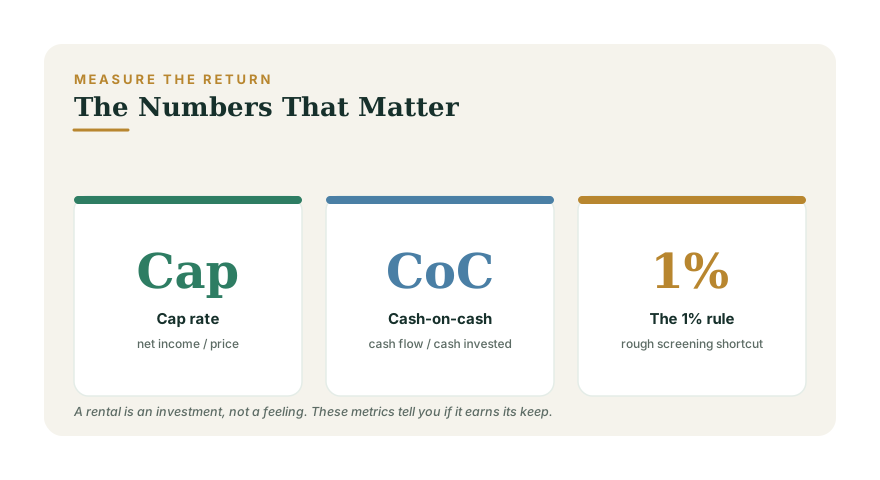
Start with net operating income, not rent
The rent a property collects is the top line, not the bottom line. What matters is net operating income (NOI) — the rent left after operating expenses but before your mortgage. Operating expenses include property taxes, insurance, maintenance, property management, and an allowance for vacancy. If a unit rents for $1,800 a month ($21,600 a year) and operating expenses run $8,000 a year, the NOI is $13,600.
Cap rate: the return ignoring the loan
The capitalization rate, or cap rate, measures the property's return independent of how you finance it:
- Cap rate = net operating income / purchase price.
On a $200,000 property with $13,600 of NOI, the cap rate is $13,600 / $200,000 = 6.8%. Cap rate is useful for comparing properties on equal footing and against local norms — a "good" cap rate varies widely by market, so compare to similar properties in the same area rather than to a national number.
Cash-on-cash return: the return on your actual money
Because most rentals are bought with a mortgage, cap rate alone misses how leverage affects your real return. Cash-on-cash return measures the annual cash flow against the cash you actually put in:
- Cash-on-cash = annual pre-tax cash flow / total cash invested.
Suppose you put $50,000 down (plus closing costs and initial repairs totaling $60,000 of cash in), and after paying the mortgage your property nets $4,800 of cash flow a year. Your cash-on-cash return is $4,800 / $60,000 = 8%. This is the number that tells you how hard your invested dollars are working compared to alternatives like an index fund.
The 1% rule: a fast screen, not a verdict
Investors use the 1% rule as a quick filter: monthly rent should be at least 1% of the purchase price. A $200,000 property should rent for around $2,000 a month to clear the bar. It is a rough screening shortcut to decide which listings deserve a full analysis — not a guarantee. In many expensive markets almost nothing meets it, while in cheaper markets a property can pass the 1% rule and still be a poor investment once you account for repairs and vacancy. Treat it as a starting filter, then run the real numbers.
The costs new landlords forget
Optimistic spreadsheets are where rental dreams go to die. Build in the costs that are easy to ignore:
- Vacancy. No property is rented 100% of the time. Budget for empty months between tenants — a common assumption is 5% to 10% of annual rent.
- Maintenance and repairs. Roofs, water heaters, and HVAC units fail. A frequent rule of thumb sets aside 1% of the property value per year for upkeep.
- Capital expenditures. Big-ticket replacements deserve their own reserve, separate from routine maintenance.
- Property management. If you hire a manager, expect to pay a meaningful share of the rent — and if you do not, you are the manager.
Leave these out and a property that looks cash-flow positive can quietly lose money.
The part the numbers do not show: the workload
A rental is not a passive investment unless you pay someone to make it one. As a landlord you screen tenants, sign leases, handle the 11 p.m. call about a burst pipe, chase late rent, coordinate repairs, and navigate landlord-tenant law. Some people enjoy it; many underestimate it badly. If the appeal of real estate is the returns rather than the work, a more hands-off route may suit you better — see REITs: real estate without a landlord.
Funding the purchase
Most investors finance rentals with a down payment that is larger than for a primary home, and some tap equity from another property — weigh that carefully against the trade-offs in home equity loans versus HELOCs. Whatever the source, your carrying costs must include taxes and insurance, which is why understanding how property taxes are calculated matters to the math.
Decide with a model, not a hunch
Before you make an offer, build a full model: realistic rent, every operating expense, vacancy, reserves, and financing. Then compute cap rate and cash-on-cash and compare them honestly to a simple portfolio. The opportunity cost calculator helps you weigh a rental against investing the same money elsewhere, and the buy versus rent calculator sharpens the housing math. If the numbers only work when everything goes perfectly, they do not work.