Almost every personal-finance struggle is really a willpower problem, and willpower is unreliable. You start the month intending to save, then a hundred small decisions wear you down and the money is gone. The fix is not to try harder. It is to design a system where the good decision is the default — where saving, paying, and investing happen automatically, before you ever get a vote.
This is the single highest-leverage thing you can do with your money, because it converts a recurring choice into a one-time setup. Spend an afternoon wiring it up, and it keeps working for years.
Pay yourself first — automatically
"Pay yourself first" is the oldest advice in personal finance, and automation is what finally makes it real. The principle: the moment money arrives, a portion goes to savings before any of it is available to spend. You are not saving what is left after spending; you are spending what is left after saving. Done by hand, this rarely survives a busy month. Done automatically, it never fails. Every method below is just a way to make "pay yourself first" run on its own.
Layer one: split your direct deposit
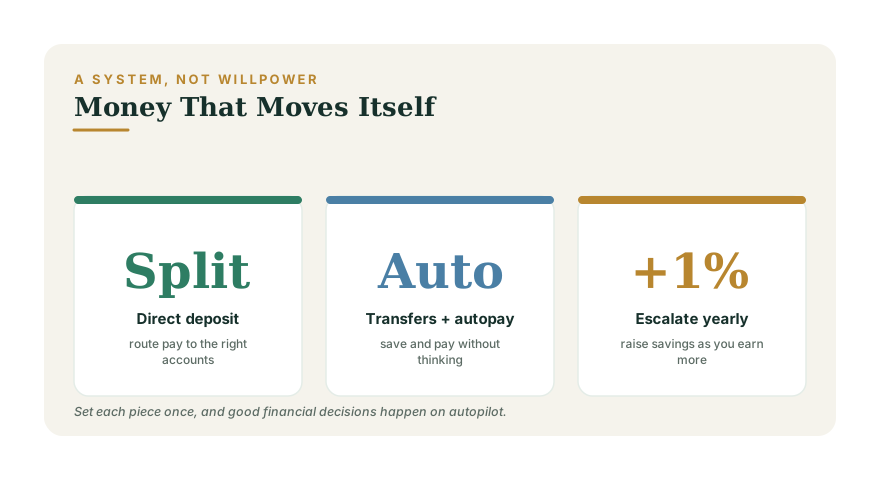
The cleanest place to automate is the source. Most employers let you split your direct deposit across more than one account. You can send most of your pay to checking and route a fixed slice straight into savings — so the savings portion never touches your spending account at all. Money you never see in checking is money you never plan to spend. If your employer allows it, this is the most powerful single setting in your financial life.
Layer two: automatic transfers
If you cannot split your deposit, the next-best thing is a recurring automatic transfer scheduled for the day after payday. Set it to move a fixed amount from checking to savings on a repeating schedule that matches your pay cycle. Timing it right after payday means the money leaves while the account is full, before other spending claims it. Give different goals their own labeled buckets — emergency fund, vacation, car — so you can watch each one fill. This is the engine behind sinking funds, and the core move in How to Save Your First $10,000.
Layer three: autopay your bills
Late fees and missed payments are pure waste, and they also quietly damage your credit. Putting recurring bills on autopay removes both risks. A sensible approach:
- Fixed bills (rent, insurance, subscriptions, loan payments) — set to autopay in full on their due dates.
- Credit cards — autopay the statement balance in full each month, not just the minimum. This avoids interest entirely while never missing a payment. Paying only the minimum is how banks profit from you.
One caution: automation is not the same as ignoring. Glance at your statements monthly so a billing error or a sneaky price increase does not run on autopilot too.
Layer four: automate investing and retirement
The same principle powers long-term wealth. Your 401(k) is automation by design — contributions come out of your paycheck before you see them, which is exactly why it works so well. Set your contribution to at least capture the full employer match, then automate contributions to an IRA or brokerage on top. The order of operations is covered in How to Start Investing.
The secret weapon: escalating savings
A static automatic plan is good. An escalating one is great. The idea is to increase your savings rate slightly on a schedule — many 401(k) plans offer an "auto-escalation" setting that bumps your contribution by one percentage point each year automatically. Because the increase is small and tied to time, you barely feel it, yet over a decade it transforms your savings rate. The best moment to escalate is right after a raise: redirect part of the raise to savings before lifestyle creep absorbs it. That single habit is the antidote to lifestyle creep.
Build it once, then let it run
A complete automated system looks like this: pay is split or transferred to savings on day one; bills and credit cards pay themselves in full; retirement and investing contributions happen before you see the money; and your savings rate ratchets up a little each year. After setup, your only job is a monthly five-minute review.
The reason this works is behavioral, not mathematical: it makes the responsible choice require zero effort and the irresponsible one require active intervention. To map out which transfers and contributions to set up first, and in what order, walk through the planning hub or check your starting point with the Financial Wellness assessment.