Your credit card statement frames the minimum payment as a helpful floor, the small amount you are "allowed" to pay. It is not a kindness. It is the most profitable number on the page. The minimum payment is carefully calibrated to keep you paying interest for as long as possible while feeling like you are handling your debt responsibly.
Once you see the machinery, it is hard to unsee. And the fix is genuinely simple.
The Honest Truth: The Balance Is the Product
Banks do not make most of their card money from the annual fee or even from the merchant swipe fee. They make it from interest on revolving balances. A customer who pays in full every month is, in industry slang, a "deadbeat," because they generate fees but little interest. The profitable customer is the one who carries a balance month after month.
That is why the minimum payment is so low. A typical minimum is around 1% of the balance plus that month's interest, or a small flat dollar floor. It is set just high enough to feel like progress and just low enough to keep the principal almost untouched.
Follow the Money
Look at how a minimum payment is split. On a $5,000 balance at 20% APR, one month of interest is roughly $83. If your minimum is about $125, only around $42 actually reduces what you owe. Next month the balance is barely lower, the interest is nearly identical, and the cycle repeats. The bank collects $83 of pure revenue every month while you feel like you are paying it down.
This is the design. The longer the principal lingers, the more interest the bank earns. Stretching repayment is not a side effect. It is the goal.
The Math
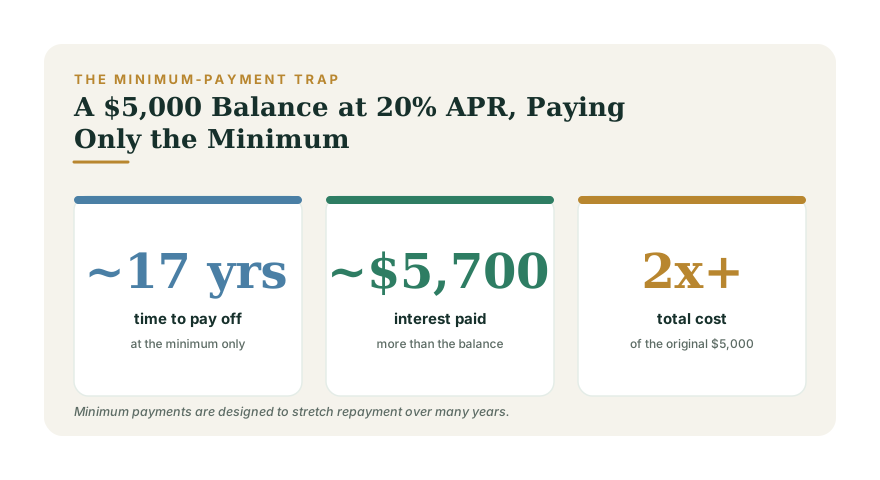
Carry a $5,000 balance at 20% APR and pay only the minimum. Because the minimum shrinks as the balance shrinks, the payoff drags out for roughly 17 years, and you pay somewhere around $5,700 in interest, more than the original purchase. You will have paid over $10,000 for $5,000 of stuff.
Now change one thing. Pay a fixed $250 a month instead of the shrinking minimum. The same $5,000 at 20% is gone in about 24 months, with roughly $1,100 in total interest. Same debt, same rate, one different habit, and you save more than $4,500 and over a decade of your life.
Push to $450 a month and you are debt-free in about 12 months with around $560 of interest. The lever that matters is the fixed payment amount, not the rate.
How to Protect Yourself
The bank's entire model depends on you defaulting to the minimum. So do not.
- Set autopay to pay in full if you can clear the statement each month. This removes interest from your life entirely and turns the card into a free 30-day grace period.
- If you carry a balance, pick a fixed payment well above the minimum and pay it automatically every month, ignoring the shrinking minimum the bank shows you.
- Attack the highest-rate balance first while paying minimums on the rest. That is the avalanche method, and it minimizes total interest.
- Stop adding new charges to a card you are paying off. You cannot bail out a boat while drilling new holes.
- Consider a true 0% balance transfer only if you will clear it before the promo ends and the transfer fee math works.
Your Decision Rule
- If you can pay the statement balance in full, set autopay-in-full and never pay a cent of interest.
- If you carry a balance, choose a fixed monthly payment above the minimum and automate it.
- Never let the printed minimum payment decide how fast you get out of debt.
- Pay off the highest interest rate first.
The Honest Recommendation
Treat the minimum payment as what it is: the bank's preferred outcome, not yours. The single most powerful move in consumer finance is mundane: autopay your card in full, or, if you are climbing out of a balance, lock in a fixed payment that actually retires the principal. The rate matters less than the dollar amount you commit to every month.
Build the payoff plan today. Drop your balance, rate, and a fixed monthly payment into our wealth simulator to see your debt-free date, set the schedule in your plan, and check where high-interest debt is dragging down your financial scores.