The first $10,000 is unlike any money you will save afterward. You are building the habit, the cushion, and the proof that you can do it — all at the same time, often on a tight budget and with no momentum to lean on. That is why the first $10,000 feels disproportionately hard. It is also why it matters more than any later milestone: once you have it, an emergency stops being a catastrophe, and you finally have a base to invest and grow from.
The good news is that you do not need a windfall or a six-figure salary. You need a system that saves before you can spend, a way to break a scary number into reachable steps, and a plan for the lumpy money — bonuses, refunds, gifts — that most people fritter away.
Why the first $10,000 is the hardest
Compounding does almost nothing this early — at the start, your balance grows because you add to it, not because interest does. There is no momentum carrying you forward, so every dollar is a deliberate act. On top of that, $10,000 sounds enormous when your balance is near zero, and a goal that feels impossible is a goal you quietly abandon. The whole strategy below is designed to remove willpower from the equation and shrink the number into pieces your brain accepts.
Break it into milestones
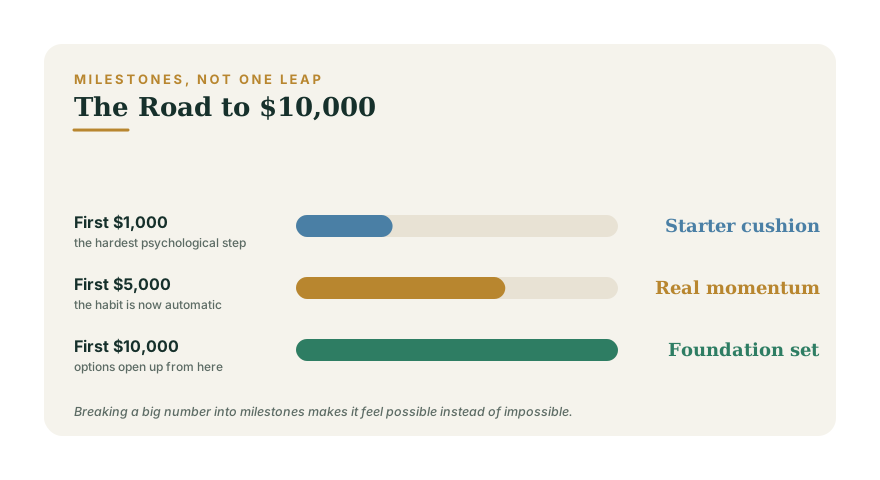
Do not aim at $10,000. Aim at $1,000. Then $2,500. Then $5,000. A milestone you can reach in a couple of months gives you a win, and wins are what keep you going. The first $1,000 is the single most valuable one — it is the difference between a flat tire being an annoyance and being a crisis that goes on a credit card. Treat each milestone as its own finish line, celebrate crossing it, and then move the line.
Automate so saving happens first
The biggest predictor of whether you hit $10,000 is not income — it is whether you saved automatically. When saving depends on willpower at the end of the month, there is rarely anything left. When it happens by automatic transfer on payday, before you can spend it, it happens every time. Set up a recurring transfer into a separate savings account the day after each paycheck lands. Start with an amount that does not hurt, even $50, and raise it when you get a raise. The full mechanics are in Automating Your Finances, which turns this into a system that runs without you.
Find the money: a quick audit
Most people can free up $100–$300 a month without real pain — they just have not looked. A short list of where it usually hides:
- Subscriptions you forgot — streaming, apps, gym memberships you do not use.
- Recurring bills you have not shopped — phone, insurance, internet. A few calls can cut these.
- Convenience spending — delivery fees, daily coffee, impulse buys that add up quietly.
This is not about misery; it is about redirecting money you were not enjoying anyway. If you want a structured way to do it, How to Build a Budget That Actually Works gives every dollar a job, and the Budget Analyzer shows you exactly where your money currently goes.
Direct your windfalls instead of absorbing them
Here is the accelerator most people miss: the lumpy money. A tax refund, a work bonus, a birthday check, a side-gig payment, a rebate. These do not feel like "your" money in the same way a paycheck does, which makes them painless to save — if you have a plan ready before they arrive. Decide in advance that some fixed share, say half, of any windfall goes straight to savings. One average tax refund can move you a quarter of the way to $10,000 in a single transfer. If you tend to over-withhold and get a big refund every year, you are effectively making this windfall on purpose; you could instead keep more in each paycheck and save it deliberately.
Keep it somewhere it can grow — and stay safe
Your first $10,000 should not sit in a checking account earning nothing, and it should not be in the stock market where it could drop right when you need it. The right home is a high-yield savings account: federally insured, fully liquid, and paying meaningfully more than a big-bank account. The separation also helps psychologically — money you have to transfer back is money you are less likely to spend on impulse.
What $10,000 unlocks
Crossing $10,000 changes your financial life out of proportion to the number. It usually means a real emergency fund — three months or so of expenses for many people — which means a job loss or a medical bill stops being a debt spiral. It means you have proven the habit works, so the next $10,000 comes faster on momentum. And it means you can finally turn toward growth: investing, a down payment, bigger goals.
Pick your first milestone, automate a transfer toward it this week, and pre-commit your next windfall. To see how this foundation fits the rest of your plan and what comes after it, start at the planning hub.