You got the raise you wanted. A year later, you are no further ahead. The money came, and somehow it is already gone, absorbed into a nicer apartment, a newer car, more takeout, a few more subscriptions. This is lifestyle creep, and it is the single biggest reason high earners are not automatically wealthy. The cruel trick is that it feels like progress while it quietly cancels every gain.
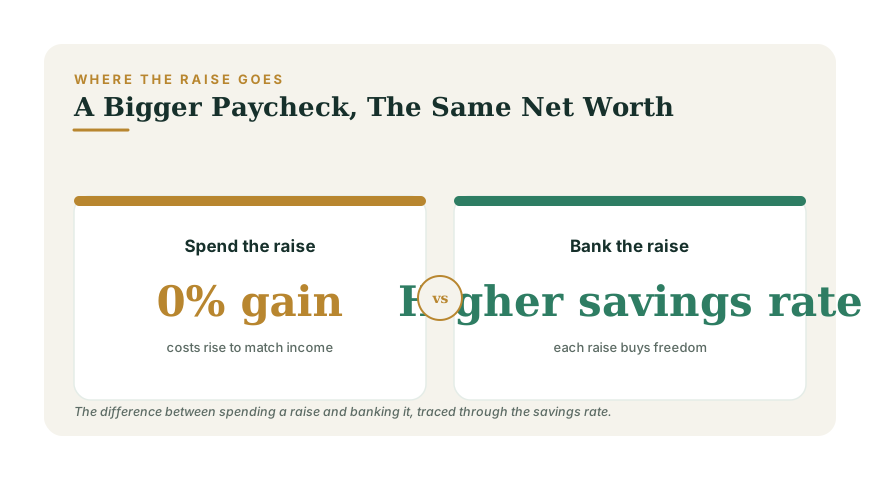
How spending quietly rises with income
Lifestyle creep, sometimes called lifestyle inflation, is the tendency for spending to expand to fill whatever income arrives. A modest raise becomes a slightly bigger rent, a slightly nicer phone, a few more dinners out. Each upgrade feels reasonable on its own and reversible in theory, but together they consume the increase entirely. Today's luxury becomes tomorrow's baseline, and the baseline rarely comes back down.
It is driven by ordinary human wiring. We compare ourselves to peers, we adapt fast to anything new so the thrill fades and we reach for the next upgrade, and we tell ourselves we have earned it. None of that is irrational. It is just expensive, because it means a 30 percent raise can leave you saving exactly what you saved before, only now with higher fixed costs that are harder to unwind.
The savings-rate lens
The clearest way to see lifestyle creep is to stop watching your salary and start watching your savings rate, the share of your income you keep rather than spend. Two people earning very different salaries can have identical futures if they save the same percentage, and a high earner who saves 5 percent is in worse shape than a moderate earner who saves 25 percent.
This is the lens that powers the financial independence movement. Savings rate, more than income, determines how fast you build wealth and how soon you could stop needing a paycheck, because it captures both how much you set aside and how little you require to live. When a raise leaves your savings rate flat, the raise did nothing for your financial trajectory. When a raise lifts your savings rate, that is the only kind of raise that compounds into freedom.
Value-based spending: the antidote that is not deprivation
Fighting lifestyle creep is not about refusing to ever upgrade your life. That is miserable and unsustainable. The better approach is value-based spending: deliberately spending more on the few things that genuinely matter to you, and ruthlessly cutting the things that do not. The problem with creep is that it is undirected; money seeps into everything equally, including categories you do not actually care about.
Pick your priorities on purpose. If travel lights you up, fund travel generously and let your car be boring. If a calm home matters, spend there and skip the status purchases that impress no one but the algorithm. The aim is to spend with intention rather than by default, so that more money buys more of what you value instead of simply more of everything.
Bank the raise
The most effective single tactic is to capture raises before they reach your lifestyle. The mechanics are simple:
- When a raise hits, increase your saving by most of it before adjusting your spending. If you take home an extra 400 dollars a month, route 300 to investing or savings the same week.
- Automate the increase so the money never lands in checking where it can be spent. Bump your 401(k) percentage or your automatic transfer the day the raise starts.
- Allow yourself a small, deliberate upgrade from the remainder, so the raise still feels like a reward without absorbing the whole thing.
- Repeat with every raise and bonus. Treat windfalls the same way: save the majority, enjoy a slice.
Banking even half of each raise, consistently, is enough to pull your savings rate steadily upward over a career, which is exactly the variable that builds wealth.
Why this is the quiet difference between earners and accumulators
Plenty of people earn a great deal and stay broke, living one missed paycheck from trouble, because their spending grew in lockstep with their pay. Others earn ordinary incomes and build real security, because they let raises widen the gap between what they make and what they spend instead of closing it. The difference is rarely income. It is whether the next raise becomes a permanent new cost or a permanent new investment.
Watch your savings rate the way you once watched your salary, decide which upgrades are worth it before the money arrives, and bank the rest. To see what your current savings rate is and how nudging it changes your timeline, run your numbers on the plan.