The dividend is the most emotionally satisfying number in investing and one of the most misunderstood. Cash lands in your account just for holding the stock, so it feels like the company is paying you a thank-you bonus on top of any price gains. It is not a bonus. It is the company handing you back a piece of money you already owned, and on the way it can quietly cost you in taxes.
The honest truth: a dividend is not new money
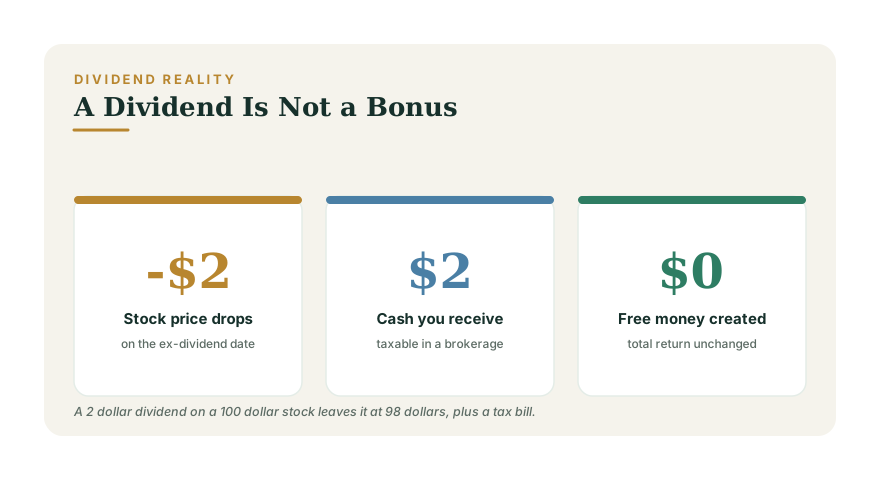
When a company pays a dividend, the cash comes out of the company. The business is now worth exactly that much less, so the share price drops by the dividend amount on the ex-dividend date. This is not a theory or a market mood, it is mechanical and it is why exchanges adjust the opening price down automatically.
Picture a 100 dollar stock that pays a 2 dollar dividend. The morning it goes ex-dividend, the price opens near 98 dollars. You now hold a stock worth 98 dollars plus 2 dollars in cash. You have 100 dollars, the same as before. Nothing was created. You simply converted 2 dollars of stock you owned into 2 dollars of cash, whether you wanted to or not.
What actually matters is total return: price change plus dividends, together. A stock that gains 5% in price and pays nothing has done exactly as well as a stock that gains 3% in price and pays a 2% dividend. Splitting return into "growth" and "income" is a presentation choice, not a difference in how much money you made.
Follow the money
So why is the financial industry so eager to sell you "income" and "high-yield" products? Because "get paid 6% just for holding it" is far easier to market than "focus on your total return after taxes." High-dividend and "dividend aristocrat" funds, covered-call income funds, and yield-chasing newsletters all lean on the same emotional shortcut, and several of them carry higher fees for the privilege. The yield is the hook. The fee is the catch.
The tax problem you did not sign up for
In a 401(k) or IRA, dividends are sheltered, so this part does not bite. In a regular taxable brokerage account, it bites hard. A dividend is a taxable event you do not control. The company decides to pay, and you owe tax that year whether or not you needed the cash.
- Qualified dividends are taxed at long-term capital-gains rates, often 15%. Non-qualified and many high-yield payouts (including a lot of REIT income) are taxed as ordinary income, which can be 22%, 24%, or higher.
- Compare that to a stock or index fund that pays little or no dividend: it lets gains compound untaxed inside the fund until you choose to sell, at which point you control the timing and pay the lower long-term rate.
Run the numbers on a 200,000 dollar taxable account yielding 4%. That is 8,000 dollars of dividends a year. At a 22% rate, you hand over about 1,760 dollars in tax annually for income you may not have wanted, dragging on compounding year after year, even if you reinvest every cent.
Why chasing yield is risky, not safe
A high yield is often a warning light, not a reward. Yield is the dividend divided by the price, so when a company's price falls because the business is in trouble, the yield mechanically spikes. Investors then pile in chasing the fat number, right before the company cuts the dividend it could no longer afford. Reaching for the highest yields also concentrates you into a handful of sectors (utilities, telecom, some financials and REITs), which is the opposite of diversification.
How to protect yourself
- Judge investments by total return, not headline yield. A 7% total return is a 7% total return whether it arrives as price growth, dividends, or both.
- Do not treat a high yield as safety. An unusually high yield often signals a falling price and a dividend at risk of being cut.
- Mind the account type. In a taxable account, prefer broad, tax-efficient index funds with modest yields. Park higher-yielding or REIT holdings in tax-sheltered accounts.
- If you need spending money, sell shares instead of chasing payouts. Selling a sliver of a low-yield fund is economically identical to a dividend and often more tax-efficient, because you only pay on the gain, not the whole distribution.
- Skip the "income" product premium. Do not pay extra fees for a fund whose main selling point is its yield.
The honest recommendation
Stop thinking of dividends as free money and start thinking in total return after taxes. For most investors that means owning broad, low-cost, tax-efficient index funds and letting the mix of growth and modest dividends take care of itself. If you need cash flow in retirement, build it from total return by selling a small amount of shares on your schedule, not by tilting your whole portfolio toward the highest yields you can find and accepting worse diversification and a bigger tax bill in return.
If you currently hold high-yield names in a taxable account, check what those forced distributions are costing you each year, then model a total-return approach in the wealth simulator and review your tax setup against your plan. For more on keeping the IRS out of your compounding, see the tax articles in learn. Chase total return, not the loudest number on the page.