If you have a workplace 401(k) and the option of an IRA, and not enough money to fully fund both, the order you fill them in matters. This is not a coin flip — there is a widely accepted sequence that squeezes the most value out of each dollar. Once you understand the logic behind it, the order is easy to remember and apply.
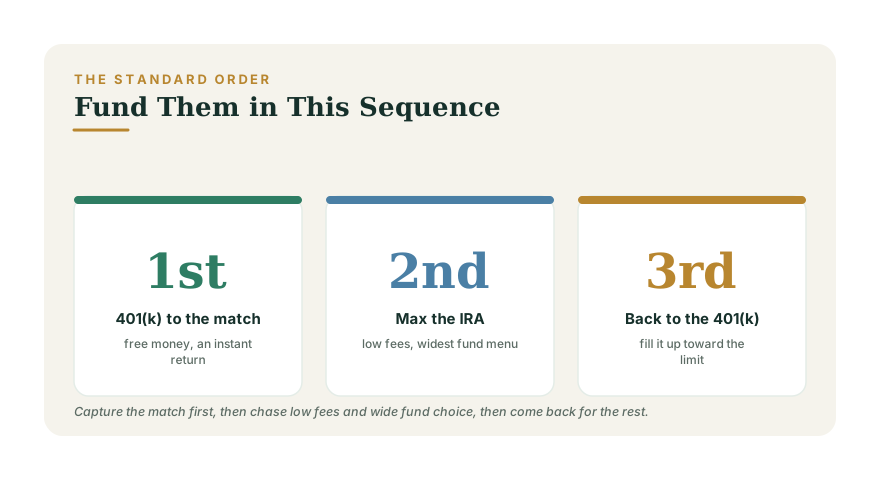
Step 1: Fund the 401(k) up to the full employer match
If your employer matches contributions — say, 50 cents on the dollar up to 6% of pay — that match is the single best return available to you anywhere. It is an immediate, guaranteed gain that no stock, fund, or savings account can reliably beat. Contributing less than the amount needed to capture the full match means voluntarily turning down part of your compensation.
So the first priority is simple: contribute at least enough to your 401(k) to get every dollar of match. This is the cornerstone of the broader how to start investing playbook, and skipping it is one of the most expensive 401(k) errors.
Step 2: Once the match is captured, fund the IRA
After you have the full match, the next dollars usually do better in an IRA than in the 401(k). Why? Two reasons:
- Fund choice. A 401(k) limits you to a fixed menu the plan picked. An IRA at a major brokerage gives you nearly the entire market — including the cheapest broad index funds and ETFs.
- Fees. Many 401(k) plans layer on administrative costs and offer pricier funds than you would choose on your own. In an IRA, you control the fees, and fees compound against you over decades.
You will also choose between a Roth and a traditional IRA here. The choice hinges mostly on whether you expect a higher or lower tax rate in retirement — laid out in Roth vs traditional IRA. Note that IRA contributions have income limits and the deductibility of a traditional IRA can phase out if you are covered by a workplace plan.
Step 3: Go back and fill up the 401(k)
The IRA's annual contribution limit is much smaller than the 401(k)'s. So once you have maxed the IRA — and if you still have money to invest — circle back to the 401(k) and contribute beyond the match, up toward its higher limit. The 401(k) keeps the tax advantage flowing even after the IRA is full.
If you ever hit both limits, you have reached an enviable problem, and the next stops are usually a Health Savings Account (if eligible) and a regular taxable brokerage account.
Comparing the two accounts at a glance
- Contribution limit: the 401(k)'s is roughly three to four times the IRA's, so the 401(k) lets you shelter far more.
- Employer match: only the 401(k) offers it — and it is the whole reason it goes first.
- Fund selection: the IRA wins, with the full market versus a fixed menu.
- Fees: usually lower in an IRA, since you control what you buy.
- Access and rules: the 401(k) allows loans in many plans and has stronger creditor protection; the IRA is simpler and fully portable.
One special case: no match at all
If your employer offers a 401(k) with no match and only expensive funds, the calculus shifts: you might fund the IRA first to get the lower fees and better funds, then return to the 401(k) for its larger limit. The match is what normally puts the 401(k) first — without it, the IRA's advantages move up the line.
The takeaway
For most people the order is: 401(k) to the match, then max the IRA, then back to the 401(k). It captures free money first, keeps your costs low in the middle, and uses the bigger limit to shelter the rest. If you are consolidating an old account at the same time, pair this with what to do with an old 401(k), and use the Retirement Planner to see how the order affects where you land.