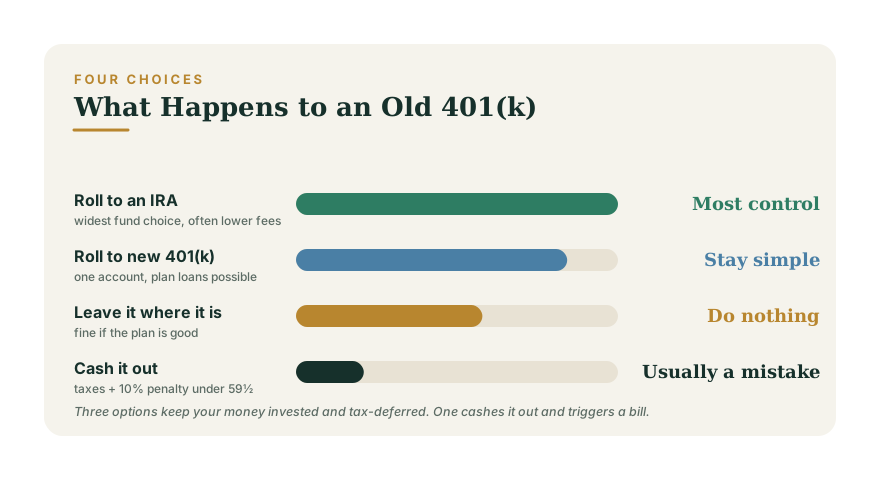
Changing jobs is one of the most common moments people make an expensive money mistake without realizing it. Your old 401(k) does not transfer to your new employer on its own, and it does not disappear — it simply sits where it is, waiting for a decision. You have four real choices, and understanding the trade-offs takes about ten minutes and can be worth thousands of dollars over time.
Option 1: Leave it in the old plan
If your balance is above a certain threshold (often around 5,000 dollars), your former employer generally has to let you leave the money where it is. Nothing is taxed, the money stays invested, and you do nothing. This is a reasonable default when the old plan has excellent, low-cost funds and you would rather not deal with paperwork right now.
The downsides: you cannot add new contributions, you may lose access to a helpful plan website, and small accounts are easy to forget. People genuinely lose track of old 401(k)s across multiple jobs. If you leave it, write down where it is and keep your contact details current with the plan.
Option 2: Roll it into your new employer's 401(k)
If your new job offers a 401(k) that accepts rollovers, you can consolidate the old balance into it. The appeal is simplicity — one account to track instead of two — and 401(k)s offer a couple of features IRAs do not, including the ability to take a plan loan and stronger federal creditor protection. Rolling in also keeps the door open for a backdoor Roth strategy later, since money sitting in a traditional IRA can complicate that.
The catch is that you are limited to the new plan's menu of funds, which may be narrower or pricier than what you would pick yourself.
Option 3: Roll it into an IRA
Moving the balance into an Individual Retirement Account usually gives you the widest choice of low-cost index funds and ETFs and the most control over fees. For many people this is the best long-term home for an old 401(k), especially if the old plan's expense ratios were high — and high fund fees quietly erode returns more than most people realize, as covered in how expense ratios destroy wealth.
To keep the money tax-deferred and avoid a tax bill, you want a direct rollover, where the funds move trustee-to-trustee and never pass through your hands. The mechanics — and the trap to avoid — are spelled out in how to roll over a 401(k) without triggering taxes. One thing to weigh: a Roth 401(k) should roll to a Roth IRA, and a traditional 401(k) to a traditional IRA, to keep the tax treatment matched.
Option 4: Cash it out — almost always a mistake
You can take the money as cash, but this is the choice that quietly costs people the most. If you are under 59½, a cash-out triggers ordinary income tax plus a 10% early-withdrawal penalty, and the plan withholds 20% up front. A 20,000-dollar balance can shrink to roughly 13,000–14,000 dollars after taxes and penalty — and you also lose every future dollar that money would have earned.
Cashing out is one of the most damaging 401(k) mistakes that cost you, precisely because the money is gone before it ever had a chance to compound. Reserve it for a true emergency with no other option.
How to choose
- Old plan has great, cheap funds and you want zero effort? Leaving it is fine.
- You value one simple account and want loan access or stronger protection? Roll into the new 401(k).
- You want the most control and lowest fees? Roll into an IRA.
- Tempted to cash out? Don't, unless it is a genuine emergency.
Whatever you choose, do it deliberately rather than by default. To see how this old balance fits into your overall retirement picture, run the numbers through the Retirement Planner or take the Retirement Readiness assessment before you move anything.