A rollover is supposed to be a non-event: your retirement money moves from one account to another and stays tax-deferred the whole way. Done right, you owe nothing. Done wrong, the IRS can treat the whole balance as a taxable withdrawal — with a 10% penalty on top if you are under 59½. The good news is that avoiding the trap is simple once you know which path to ask for.
Direct rollover: the safe default
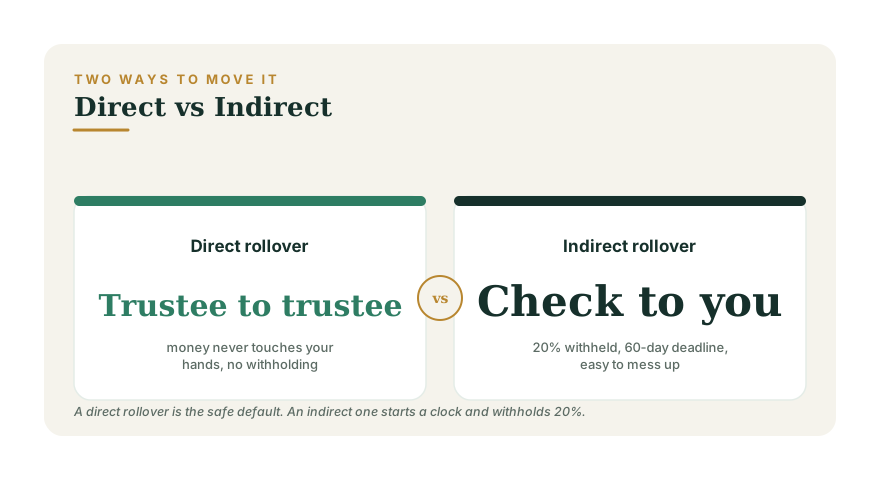
In a direct rollover (also called a trustee-to-trustee transfer), the money goes straight from your old 401(k) to your new account — an IRA or another 401(k) — without ever passing through your personal bank account. If a check is issued, it is made out to the receiving institution "for the benefit of" you, not to you personally.
Because you never take possession of the money, there is no withholding and no 60-day clock. This is the method you want in almost every case. When you call your old plan, the exact phrase to use is, "I want a direct rollover to my IRA" (or new 401(k)).
Indirect rollover: where people get burned
In an indirect rollover, the plan sends the money to you — and two problems appear at once.
First, the plan is required to withhold 20% for federal taxes. So if your balance is 50,000 dollars, you only receive 40,000 dollars; the other 10,000 dollars is sent to the IRS.
Second, you have only 60 days to deposit the full original amount — all 50,000 dollars, not the 40,000 you received — into the new account. To replace the withheld 10,000 dollars, you have to come up with it from your own pocket and wait to recover it as a refund when you file. Miss the 60-day deadline, and any amount not rolled over becomes a taxable distribution, plus the early-withdrawal penalty if you are under 59½.
There is also a once-per-year limit on indirect IRA-to-IRA rollovers. None of this applies to a direct rollover, which is exactly why the direct route is the standard advice.
The step-by-step process
- 1. Open the receiving account first. If you are rolling to an IRA, open it at your chosen brokerage before you start. Confused about which account belongs where? See 401(k) or IRA: which should you fund first.
- 2. Match the tax type. Roll a traditional 401(k) into a traditional IRA, and a Roth 401(k) into a Roth IRA. Mixing them can create a taxable event. Converting traditional money to Roth is a separate, deliberate move — see the Roth conversion strategy guide.
- 3. Call your old plan and request a direct rollover. Give them the receiving account details. Insist the check go to the institution, not to you.
- 4. Confirm and reinvest. Rolled-over money often lands as cash in the new account. It is not invested until you buy funds, so finish the job by choosing your investments.
A few details that trip people up
If you accidentally receive a check made out to you, you can still fix it by depositing the full amount (including replacing the withheld portion) within 60 days. If your old 401(k) holds company stock, special rules called net unrealized appreciation may make a plain rollover suboptimal — that situation is worth a quick check with a tax professional.
Finally, do not forget to actually invest the cash once it arrives. An uninvested rollover earning nothing is a surprisingly common and costly oversight.
The bottom line
Ask for a direct, trustee-to-trustee rollover, match Roth to Roth and traditional to traditional, and reinvest promptly. Do that and the move is genuinely tax-free. If you are weighing this as part of a job change, start with what to do with an old 401(k), then use the Retirement Planner to see how the consolidated balance shapes your retirement timeline.