Look at your pay stub and you will find a line — usually labeled FICA, or split into Social Security and Medicare — taking a steady 7.65% of your pay. Unlike income tax, this amount does not change with your W-4 or your deductions; it is a flat slice off the top. Understanding what it funds, and the part your employer pays that you never see, explains a surprising amount about your paycheck and your future benefits.
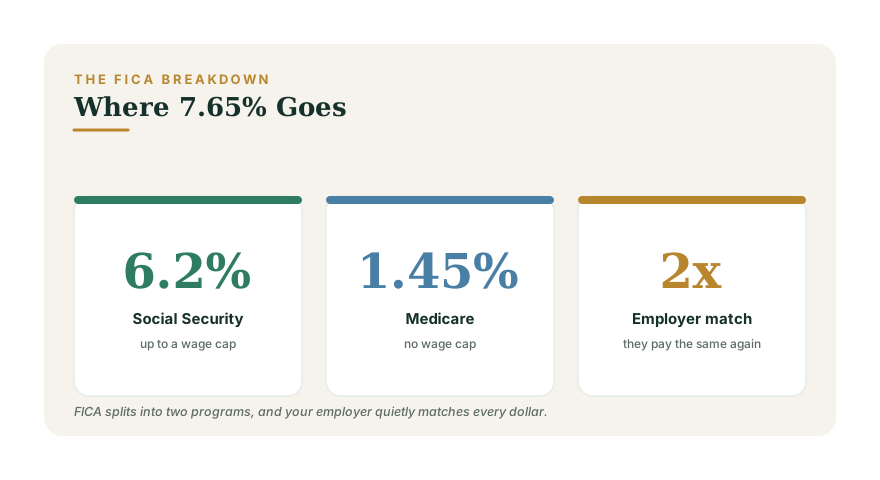
What FICA actually is
FICA stands for the Federal Insurance Contributions Act, and it funds two big federal programs: Social Security and Medicare. This is separate from the federal income tax that comes out of the same check. Income tax is flexible — it depends on your earnings, filing status, and W-4. FICA is flat and automatic. The two together explain most of the gap between your salary and your take-home pay, a gap broken down in Your First Paycheck, Explained.
The two pieces: 6.2% and 1.45%
The 7.65% splits into two parts:
- Social Security — 6.2%. This funds retirement, disability, and survivor benefits. It is the program that will eventually pay you a monthly benefit in retirement, with the amount based on your lifetime earnings.
- Medicare — 1.45%. This funds health coverage for people 65 and older (and some younger people with disabilities). It is the foundation of your future Medicare coverage.
So those payroll taxes are not money vanishing into a void — they are buying you future Social Security and Medicare benefits you will draw on later.
The employer match you never see
Here is the part most people miss: your employer pays the same 7.65% on your wages that you do. You see 7.65% come out of your check, but the government actually collects 15.3% in total — half from you, half from your employer. That employer portion is real compensation spent on your behalf; you simply never see it on your pay stub. It is one reason the "true" cost of employing you is higher than your salary alone.
The Social Security wage base cap
The Social Security portion has a ceiling. Once your wages for the year cross the wage base cap (an amount that rises a little each year), you stop paying the 6.2% Social Security tax for the rest of that year. High earners notice their take-home pay tick up late in the year for exactly this reason. The Medicare portion, by contrast, has no cap — you pay 1.45% on every dollar — and very high earners actually pay an additional Medicare surtax above an income threshold. Because Social Security benefits are tied to the earnings you paid in on, the cap also limits how large your future benefit can grow, which feeds into when and how you claim Social Security.
The self-employment equivalent
If you work for yourself, there is no employer to split FICA with — so you pay both halves. This is self-employment tax, totaling 15.3% (12.4% Social Security up to the wage cap, plus 2.9% Medicare with no cap). It often surprises new freelancers, who budget for income tax but forget this large additional layer.
Two things soften the blow. First, you can deduct half of your self-employment tax as an above-the-line adjustment, which lowers your AGI. Second, the self-employed have access to deductions and retirement plans that employees do not — covered in Self-Employed Tax Deductions. Because no employer withholds for you, you typically have to send this in yourself through quarterly estimated payments.
What this means for you
Payroll taxes are predictable, which makes them easy to plan around: budget on your take-home pay, knowing 7.65% (or 15.3% if self-employed) is already spoken for. If you freelance even on the side, set money aside for self-employment tax as you earn it so the bill does not blindside you. To see your full paycheck and tax picture in one place — including how withholding and FICA interact — run the Tax Health assessment or, if you have self-employment income, explore the Self-Employed hub.