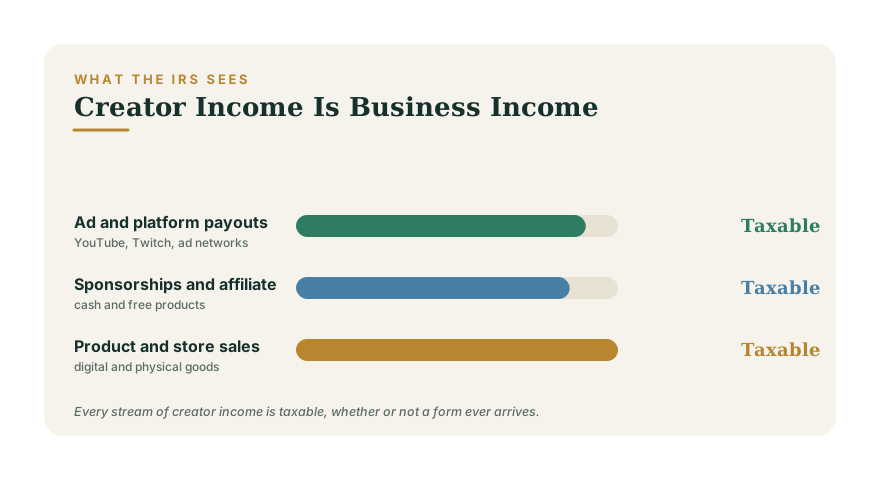
The moment your channel, shop, or newsletter starts making money, the IRS stops seeing a hobby and starts seeing a business. That is not a threat — it is simply the frame you need. Ad revenue, brand deals, affiliate commissions, tips, Patreon and subscription income, digital downloads, and marketplace sales are all taxable, and the responsibility to report them sits with you whether or not a tax form ever lands in your inbox.
The good news is that being treated as a business cuts both ways. Yes, you owe income tax and self-employment tax on your net profit. But you also get to subtract legitimate business expenses first, and profit — not revenue — is what gets taxed. Understanding that trade is the difference between a manageable bill and a painful one.
All of it is income, forms or not
A common myth is that income is only taxable if a platform sends you a form. It is not. The IRS requires you to report all income from your creator or selling activity, including cash tips, foreign platform payouts, and the fair market value of free products you receive in exchange for coverage. That last one surprises people: if a brand sends you a gadget to review and you keep it, the value of that gadget is generally taxable income. Forms like the 1099-NEC and 1099-K are informational copies that also go to the IRS — they help the agency match income, but their absence does not make money tax-free. The rules around one of those forms are changing, which we cover in The 1099-K Reporting Threshold Change.
Two taxes, not one
As a self-employed creator you owe two layers of federal tax on your net profit. First is ordinary income tax at your marginal rate. Second is self-employment tax — the roughly 15.3% that covers Social Security and Medicare, the portion an employer would normally split with you. The IRS lets you deduct half of the self-employment tax when figuring your income tax, which softens the blow slightly, but the combined bite is why so many new creators are shocked at tax time. Budget as if a meaningful slice of every dollar of profit belongs to the government.
Deductions that shrink the bill
Because you are taxed on profit, ordinary and necessary business expenses come off the top. Typical creator and seller deductions include:
- Gear and software — cameras, microphones, lighting, computers, editing subscriptions, and design tools used for the business.
- Home office — a portion of rent, utilities, and internet if you use part of your home regularly and exclusively for work; see The Home Office Deduction.
- Cost of goods — inventory, packaging, and shipping for physical sellers.
- Platform and payment fees — marketplace commissions, processor fees, and hosting.
- Mileage and travel — trips to shoots, conferences, or to source products, tracked carefully.
The catch is documentation. Keep receipts, use a separate business bank account, and log expenses as they happen. A deeper list lives in Self-Employed Tax Deductions, and the Tax Strategies tool can help you spot categories you are missing.
Pay as you go with estimated taxes
Employees have tax withheld from every paycheck. You do not, so the IRS expects you to send quarterly estimated payments throughout the year. Skip them and you can owe an underpayment penalty on top of the tax itself. A rough rule is to set aside 25% to 35% of your net profit in a separate account and pay it in on the quarterly deadlines. The mechanics — who owes, how to calculate, and the dates — are laid out in Quarterly Estimated Taxes, Explained.
Keep clean books from day one
The single habit that makes creator taxes painless is separation: one bank account and one card for the business, everything flowing through them. That turns tax prep from an archaeology dig into a download. When your side income grows into something serious, you may consider forming an entity or electing S-corp status — the trade-offs are covered in LLC vs S-Corp for Small Business.
Get ahead of it
Creator income is exciting, but the tax side rewards the boring stuff: report everything, deduct legitimately, set money aside every month, and pay quarterly. Do that and April becomes a formality rather than a crisis. Estimate your self-employment burden with the Self-Employed Hub, pressure-test your setup with the Tax Health assessment, and build the full picture at the planning hub.