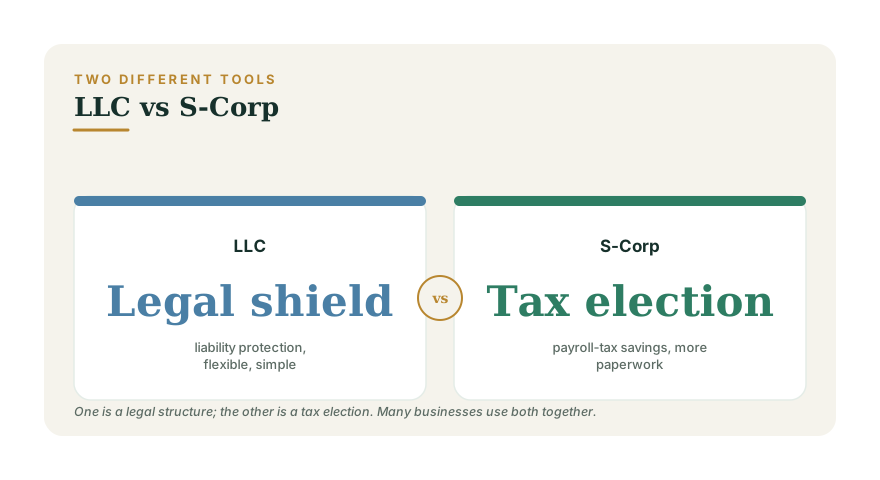
The "LLC vs S-corp" question gets asked constantly, and it is slightly the wrong question — because the two are not really competitors. An LLC is a legal structure you form with your state. An S-corp is a tax election you make with the IRS. A profitable business often ends up as an LLC that has elected to be taxed as an S-corp. Understanding what each piece does separately is the key to choosing well.
What an LLC actually gives you
A limited liability company creates a legal wall between you and the business. If the company is sued or cannot pay its debts, your personal assets — your home, your savings — are generally protected, provided you run the business properly. That protection is the whole point, and for most solo owners and small partnerships it is reason enough to form one.
By default, an LLC is a "pass-through" for taxes: the business itself pays no income tax, and the profit flows onto your personal return. A single-member LLC is taxed like a sole proprietorship; a multi-member LLC is taxed like a partnership. The LLC gives you the legal shield without changing how you are taxed.
Pass-through taxation, and the self-employment tax problem
Pass-through sounds simple, and it is — but it comes with a cost. As a default LLC owner, your share of the profit is hit with self-employment tax (Social Security and Medicare) of roughly 15.3% on top of regular income tax. That is because you are both the employer and the employee, so you owe both halves of the payroll tax. On a healthy profit, that self-employment tax is a large line item — and it is exactly what the S-corp election is designed to reduce.
How the S-corp election saves payroll tax
When an LLC elects S-corp taxation, the IRS lets you split your take into two buckets: a reasonable salary that you pay yourself through payroll, and the remaining profit taken as distributions. Here is the key: payroll tax applies to the salary, but not to the distributions.
- Say the business nets $120,000. As a default LLC, roughly all of it is exposed to self-employment tax.
- As an S-corp, you might pay yourself a $70,000 reasonable salary (payroll tax applies) and take $50,000 as distributions (no payroll tax).
That untaxed-for-payroll distribution is the savings. The mechanics of choosing the salary number are covered in How to Pay Yourself From Your Business, and it matters a great deal — the IRS requires the salary be reasonable for the work you do. Pay yourself a token $10,000 salary on $120,000 of profit and you are inviting an audit.
What the S-corp election costs you
The savings are real, but so are the costs, and they are why an S-corp does not make sense for every business:
- Payroll. You must run formal payroll for yourself, withhold taxes, and file payroll returns — usually through a payroll service that charges a monthly fee.
- A separate tax return. The S-corp files its own return (Form 1120-S) in addition to your personal return, which typically means hiring a tax preparer.
- More bookkeeping discipline. Clean books become non-negotiable, which is its own argument for getting business banking and bookkeeping basics right from day one.
Those extra costs — payroll service, accountant, more administration — often run a few thousand dollars a year. The election only pays off once the payroll-tax savings comfortably exceed them.
When each one fits
A rough rule of thumb many advisors use: an LLC alone is the right call when your business is new, has modest or uneven profit, or you are still finding your footing. The S-corp election starts to make sense once the business is consistently profitable — often cited around the point where net profit clears roughly $40,000 to $80,000 a year and is likely to stay there — because that is when the payroll-tax savings reliably outrun the added cost and hassle.
Two more notes. First, electing S-corp status does not change your legal protection; the LLC is still doing that job. Second, the choice interacts with retirement planning — an S-corp salary affects how much you can put into plans like a solo 401(k), which is its own reason to read self-employed retirement accounts before deciding.
Putting it together
Form the LLC for the legal shield. Take the default pass-through taxation while profit is small or uncertain. Then, once profit is consistent and comfortably above the break-even on the added costs, layer the S-corp election on top to trim payroll tax. The structure should follow the business, not the other way around. To see how the tax piece fits your whole picture, run the numbers in the self-employed tax hub before you file any election paperwork.