The home office deduction has a strange reputation. Half the people who could take it are scared to, convinced it is an audit magnet; the other half take it wrong. The truth is that it is a legitimate, often valuable deduction with clear rules — and the audit fear is largely a myth left over from decades ago. Here is how it actually works.
Who can take it — and who cannot
First, the big catch: under current rules, the home office deduction is generally available only to the self-employed — sole proprietors, freelancers, independent contractors, and owners of pass-through businesses. Regular W-2 employees who work from home generally cannot deduct a home office, even if their employer requires it. So this is a small-business deduction, not a remote-work perk.
The exclusive-use test — the rule everyone trips on
The single most important requirement is the exclusive and regular use test. The space you deduct must be used only for business and used regularly. A spare bedroom that is your full-time office: qualifies. The kitchen table where you work but also eat dinner: does not, because it is not used exclusively for business.
It does not have to be an entire room — a clearly defined area of a room can count — but within that area, business has to be the only thing happening. The space must also generally be your principal place of business, meaning where you regularly conduct your work or its administrative core. A side desk you occasionally check email at while employed elsewhere will not meet the bar. Get this test right and the rest is arithmetic.
Simplified vs actual-expense method
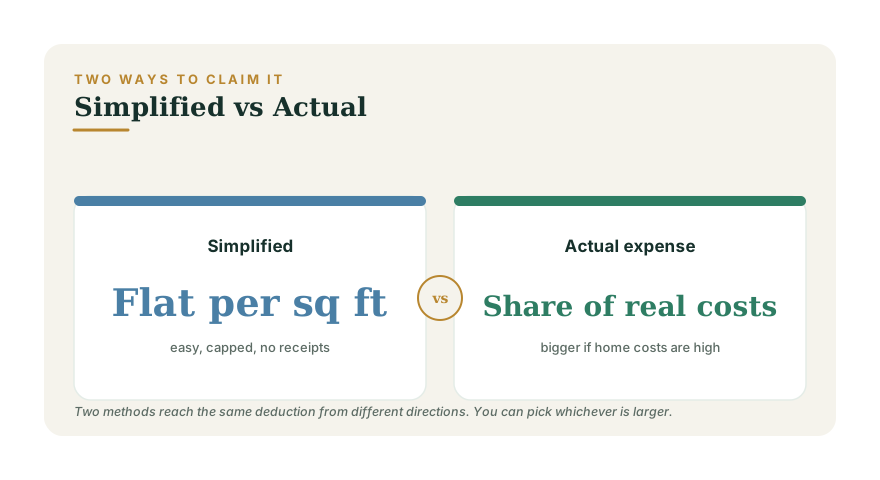
Once you qualify, there are two ways to calculate the deduction, and you can choose whichever gives you more:
- Simplified method. You take a flat dollar amount per square foot of office space, up to a capped number of square feet. No receipts, no math beyond measuring the room. It is fast and audit-friendly, and for a modest office it is often plenty.
- Actual-expense method. You figure the percentage of your home the office occupies (office square footage divided by total home square footage), then deduct that percentage of your real home costs — rent or mortgage interest, utilities, insurance, repairs, and property tax — plus a depreciation component if you own.
The actual-expense method usually produces a larger deduction when your housing costs are high or your office is a big share of the home, but it requires keeping records of every relevant bill. The simplified method trades some deduction size for radically less paperwork. Many owners run the numbers both ways once and pick the winner.
What actually counts
Beyond the office space itself, related business costs can be deductible. Under the actual method, a slice of whole-home expenses flows in based on your business-use percentage. Separately, expenses that are entirely for the business — a dedicated business phone line, a second internet connection used only for work, office furniture, a printer — are deductible in full, independent of which home office method you choose. Keeping these straight is far easier when business spending runs through a separate account, which is the whole argument for business banking and bookkeeping basics.
The home office deduction is also just one of many that self-employed people leave on the table. A fuller list is in self-employed tax deductions and the tax deductions you are missing.
The audit myths
The persistent fear is that claiming a home office "flags" your return. This is outdated. The deduction is ordinary and expected for self-employed people; taking a legitimate one you qualify for does not paint a target on your back. What actually invites scrutiny is taking it improperly — claiming a space that flunks the exclusive-use test, or deducting an implausibly large share of your home. The defense is simple and boring:
- Make sure the space genuinely meets the exclusive-and-regular-use test.
- Measure honestly and keep the calculation.
- If you use the actual method, keep the bills that support it.
- A quick photo of the dedicated workspace is cheap insurance.
Claim what you are entitled to, document it, and the deduction is nothing to fear.
The takeaway
If you are self-employed and have a space used exclusively and regularly for your business, the home office deduction is real money you should be claiming. Confirm you pass the exclusive-use test, choose the method that gives the larger deduction, keep simple records, and ignore the outdated audit folklore. To see how this and your other write-offs change your bottom line, work through the self-employed tax hub.