Walk into any bank or brokerage and someone will offer you an actively managed mutual fund run by experts who study the market full time. The pitch is intuitive: smart professionals should beat a dumb index that just buys everything. The evidence says the opposite, and it has said so consistently for decades. Over 10 to 15 years, roughly 85% to 90% of active US stock funds underperform their benchmark index.
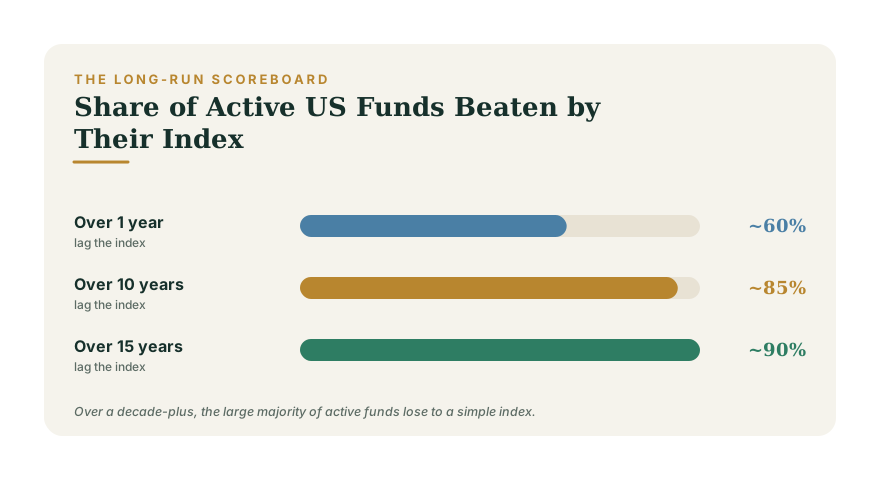
This is one of the most replicated findings in finance, tracked year after year by SPIVA-style scorecards that compare active funds to their proper benchmarks. The number that matters is not whether a fund beat the market last year. It is whether it can do so persistently, and almost none do.
The Honest Truth: This Is Arithmetic, Not Skill
The case against active funds is not "managers are dumb." Many are genuinely talented. The problem is structural, and a famous one-page argument by Nobel laureate William Sharpe lays it out: before costs, the average actively managed dollar must earn exactly the market return, because all investors together are the market. After costs, the average active dollar must therefore underperform the average index dollar by precisely the difference in fees. This is not a theory you can argue with. It is accounting.
Active management is a zero-sum game before fees and a negative-sum game after them. For one manager to beat the index, another must lose to it by the same amount. Layer fees on top and the whole pool drifts below the benchmark.
Follow the Money
The active-fund business is built to extract fees, not to maximize your return. A typical active US equity fund still charges an expense ratio in the neighborhood of 0.6% to 1.0% a year, while a broad index fund charges 0.03% to 0.10%. That gap is a permanent headwind the manager must overcome every single year just to tie.
The fees fund the marketing, the analyst salaries, the advisor commissions, and the bank's profit. The advisor steering you toward an active fund may earn more selling it than you will ever earn from its "outperformance." That is the conflict, and it explains why these funds keep getting recommended despite the scoreboard.
The Math: Four Forces Pulling You Down
- Fees. A 0.8% expense ratio versus 0.05% is a 0.75% annual drag. On a $200,000 portfolio that is $1,500 a year, every year, win or lose.
- The zero-sum arithmetic. The average active dollar cannot beat the index before costs, so after costs it must trail by the fee difference. Most funds are average or worse.
- Turnover. Active funds trade constantly, generating transaction costs and, in taxable accounts, capital-gains distributions that hand you a tax bill even in a flat year.
- Cash drag. Active funds hold cash for redemptions and timing bets. In rising markets that idle cash earns far less than the stocks the index stays fully invested in.
Compound the fee drag alone. Invest $100,000 for 30 years at a 7% gross return. At an index-fund cost of 0.05% you end near $753,000. At an active-fund cost of 0.85% you end near $602,000, assuming identical gross performance. The fund did not even have to underperform; the fee alone cost you about $151,000. And most active funds also underperform the gross return, making the gap worse.
But Some Funds Win, Right?
Yes, in any period a minority beat their index. The trouble is persistence. The funds that win one decade are mostly not the ones that win the next; persistence studies find last period's winners rarely stay on top. By the time a hot fund tops the rankings and attracts your money, its run is usually over. Picking tomorrow's winner in advance is the exact skill the data says almost nobody reliably has.
How to Protect Yourself
- Default to low-cost index or total-market funds. A broad index at 0.03% to 0.10% quietly beats most of the professionals over time.
- Read the expense ratio before anything else. It is the most reliable predictor of long-run net return that you can see in advance.
- Ignore star ratings and recent performance charts. Past returns do not persist; fees do.
- In taxable accounts, value low turnover. Index funds are naturally tax-efficient and generate fewer surprise distributions.
- Ask who gets paid. If your advisor earns a commission on the fund they recommend, weigh the recommendation accordingly.
Your Decision Rule
- If a fund's expense ratio is above roughly 0.20% for broad equity exposure, you need a very strong reason to own it over an index fund.
- If you cannot identify in advance which active fund will beat the market for the next 15 years, and you cannot, own the index.
- Choose total-market or broad index funds as your core, and keep costs as low as possible.
- Never pick a fund on last year's return.
The Honest Recommendation
The boring answer is the right one. For the core of a long-term portfolio, a low-cost total-market index fund will, with high probability, beat the expensive active fund your bank is eager to sell. You do not need to outsmart the market. You need to stop paying someone to try and fail on your behalf.
See what the fee difference does to your own numbers in our wealth simulator, sanity-check your allocation in your plan, and if you want the foundations, our articles on index funds and expense ratios are a good next step.