Until recently, getting crypto exposure meant opening a crypto exchange account, funding it, and figuring out custody yourself. The arrival of spot Bitcoin and Ether exchange-traded funds changed that. Now you can buy a fund in the same brokerage account that holds your index funds, and it tracks the price of the underlying coin. That convenience is real, but it comes with trade-offs. Neither route is automatically better; they suit different investors.
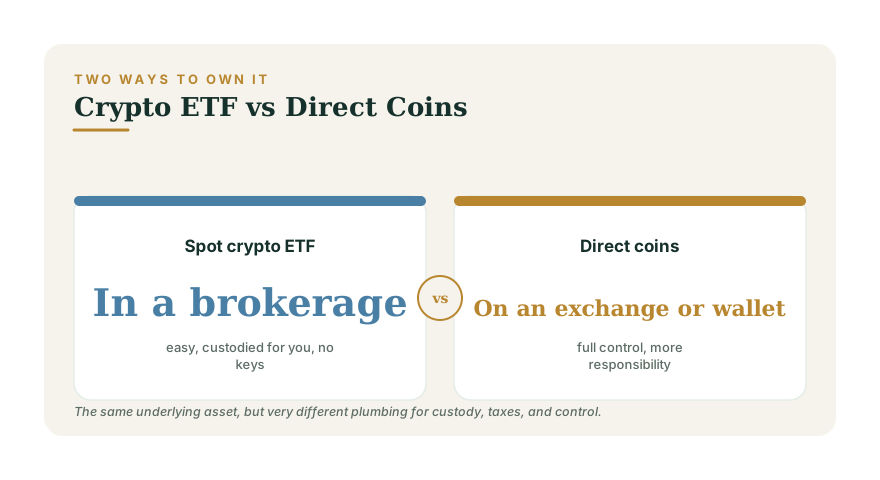
What a spot crypto ETF actually holds
A spot ETF holds the actual coins, with a custodian storing them on the fund's behalf, so the share price closely tracks the market price of the asset. This differs from earlier futures-based products, which held derivatives and could drift from the spot price. When you buy a spot Bitcoin ETF, you own a slice of a pool of real Bitcoin — you just never touch the coins or the keys. If ETFs are new to you, our explainer on how ETFs work under the hood covers the wrapper itself.
Convenience and access: advantage ETF
The ETF wins clearly on ease. It trades during market hours through your existing brokerage, needs no new account or crypto exchange, and shows up on the same statement as the rest of your portfolio. Crucially, it can live inside a tax-advantaged account like an IRA or 401(k) brokerage window, which direct coins generally cannot. For anyone who wants a small allocation without learning wallet mechanics, that simplicity is the whole appeal.
Custody and control: advantage direct coins
Holding coins directly gives you something an ETF never can: actual ownership of the asset and control of the keys. With self-custody you can move coins, spend them, use them in decentralized applications, or hold them entirely outside any institution. The crypto maxim "not your keys, not your coins" captures this — an ETF is a claim on crypto held by a custodian, not crypto you control. The flip side is responsibility: lose your keys or fall for a scam and there is no help desk. That burden is exactly why many casual investors prefer the fund.
Fees: a real, recurring drag on the ETF
ETFs charge an annual expense ratio — a small percentage skimmed every year for as long as you hold. Spot crypto ETFs launched with competitive fees, but any ongoing fee compounds against you over decades, a point we make in how expense ratios destroy wealth. Holding coins directly has no annual management fee, though you pay trading spreads and network fees when you transact, and possibly custody costs if you use a paid service. For a long holding period, the ETF's recurring fee is the clearest cost of its convenience.
Taxes: similar core, different edges
Both routes are taxed as property when you sell at a gain, and both now face tightening reporting. Two differences stand out. First, a crypto ETF held in an IRA defers or shelters the tax entirely, which direct coins in a taxable account cannot match. Second, direct coins give you finer control for tax-loss harvesting and lot selection, and the new broker-reporting regime for coins is covered in Form 1099-DA. Estimate the tax on either with our Capital Gains Estimator.
Which one fits you
- Choose the ETF if you want a small, simple allocation, prefer everything on one statement, or want crypto exposure inside a retirement account.
- Choose direct coins if you value control and self-custody, want to actually use the asset, or want to avoid a perpetual expense ratio and manage tax lots precisely.
Whichever you pick, the more important decision is how much. Crypto is volatile and speculative, and a sober look at the long-run math is in why the crypto and NFT math rarely works. Most balanced investors keep any crypto to a small slice they can afford to lose entirely.
The bottom line
The ETF and direct ownership are two doors to the same volatile room. The ETF trades control for convenience and a small annual fee; direct coins trade convenience for control and responsibility. Decide your allocation first, then let the account you want to use — taxable versus retirement — often decide the wrapper for you. See how a modest crypto sleeve interacts with the rest of your holdings in our Model Portfolios, and sanity-check your risk appetite with the Investor Profile before you buy. Map the whole plan at the planning hub.