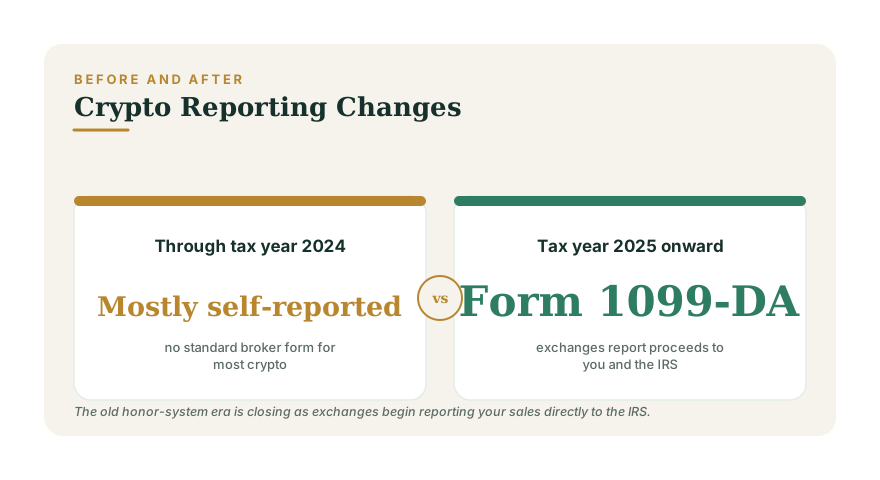
For most of crypto's history, tax reporting ran largely on the honor system. Exchanges did not send a standardized broker form, so it fell to you to track every trade, calculate every gain, and hope your numbers matched what the IRS could piece together. That era is ending. Beginning with the 2025 tax year — the return you file in early 2026 — US digital-asset brokers start issuing a brand-new form, Form 1099-DA, and they send a copy to the IRS at the same time.
This is the single biggest change to crypto compliance in years. It does not change what is taxable — selling, swapping, and spending crypto were already taxable events — but it dramatically changes how visible your activity is. Understanding what the form shows, and where it still falls short, is the difference between a smooth filing and an IRS notice.
What Form 1099-DA actually is
Form 1099-DA (the "DA" stands for digital assets) is the crypto equivalent of the 1099-B that stock brokers have long issued. Custodial exchanges — the centralized platforms where you buy, sell, and hold coins for you — are now treated as brokers and must report your digital-asset dispositions. When you sell, swap, or otherwise dispose of crypto on one of these platforms during 2025, the exchange tallies the gross proceeds and reports them to you and to the IRS. The rules come directly from the IRS under the broker-reporting regulations, and they phase in over a couple of years.
The two-phase rollout: proceeds first, basis later
The rollout is staged, and this detail trips people up. For dispositions in tax year 2025, brokers generally report gross proceeds only — the total dollars from your sales — without your cost basis. Cost-basis reporting is phased in for later years. That matters enormously, because tax is owed on your gain, not your proceeds. If a form shows $40,000 of proceeds but you paid $38,000 for those coins, your taxable gain is $2,000, not $40,000. The IRS, however, initially sees only the big proceeds number. You are responsible for supplying the basis and computing the real gain, which makes your own records more important than ever, not less. Our primer on understanding your cost basis explains how to track it.
Wallet-by-wallet accounting replaces universal pooling
Another shift landed alongside the new form: the IRS now expects basis to be tracked on a per-wallet, per-account basis rather than pooled across everything you own. In practice, you should identify which specific units you are selling from which account, and keep basis records tied to each wallet. If you did nothing to set your accounting method, safe-harbor guidance let holders allocate existing basis across their wallets as of the start of 2025. If you hold crypto in more than one place, confirm your records reflect this wallet-level view.
What the form does not cover
Form 1099-DA is not a complete picture of your crypto taxes, and assuming it is will get you in trouble:
- Self-custody and DeFi. If you trade from your own private wallet or on decentralized protocols, there is generally no broker to issue a form. Those transactions are still fully taxable — you just have no form, so your own logs are the only record.
- Income, not sales. Staking rewards, airdrops, and mining are taxed as ordinary income when received, and that income is not what the 1099-DA sale box captures. See how staking rewards and airdrops are taxed.
- Transfers between your own wallets. Moving coins from an exchange to your own wallet is not a sale, but a naive reading of proceeds forms can create confusion when basis does not travel cleanly with the coins.
How to reconcile your 1099-DA at filing time
Treat the form as a starting point to reconcile against, not gospel. When yours arrives, do this:
- Match the reported proceeds to your own transaction records for that exchange.
- Supply the cost basis the form omits, so you report gain rather than gross proceeds.
- Report gains and losses on Form 8949 and Schedule D, the same forms used for stocks.
- Answer the digital-asset question on the top of Form 1040 truthfully — it appears on every return now.
- Keep the underlying records for years; the form is a summary, not a substitute for your ledger.
You can estimate the tax on a sale with our Capital Gains Estimator, and the broader mechanics of how crypto is taxed as property are in Crypto Taxes, Explained.
The takeaway
The new Form 1099-DA does not raise your tax bill, but it removes the shadows crypto used to hide in. The IRS now sees your exchange sales, so under-reporting is far riskier. Because basis reporting lags proceeds reporting for the first year, your own clean records are the thing that keeps a scary-looking proceeds number from becoming a scary tax bill. Get your accounting straight, reconcile every form, and pressure-test your overall situation with the Tax Health assessment. When you are ready to fit crypto into your wider picture, start at the planning hub.