After years of building a financial life in the United States — 401(k) accounts, Roth IRAs, US brokerage accounts, Social Security credits, a US credit score — returning to India means unwinding all of it, often simultaneously. The complexity is real, but it is manageable with advance planning. The key mistakes are almost always the result of acting at the last minute rather than planning 2–3 years before departure.
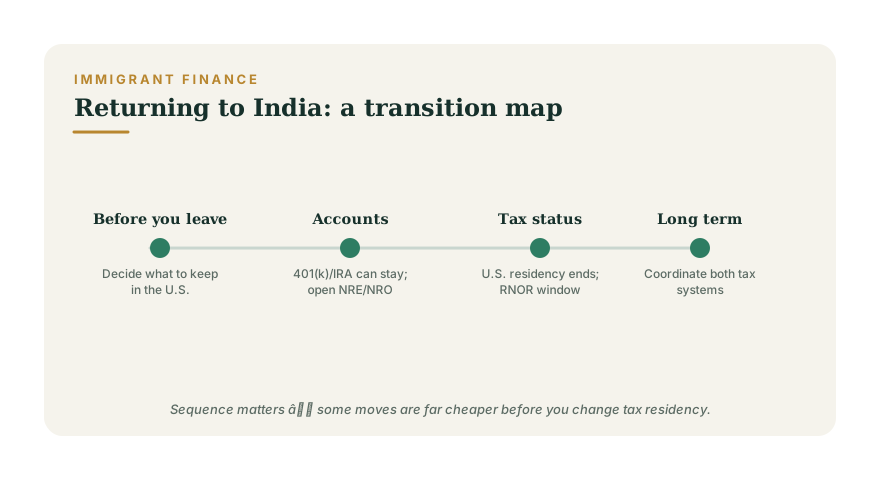
Timeline: When to Start Planning
Most financial transitions from US to India take 18–36 months to execute properly. Starting at least 2 years before your planned return date gives you time to optimize tax decisions, wind down accounts in the right sequence, and establish your Indian financial infrastructure before you need it.
One year out is manageable but tight. Six months out means you will be making rushed decisions that cost money.
US Tax Status After Departure
The day you leave the US, your US tax residency status begins to change. If you leave permanently (no intention to return as a resident), you become a non-resident alien for US tax purposes once you no longer meet the Substantial Presence Test — typically after the year of departure or the following year depending on your exact departure date.
As a non-resident alien, you pay US taxes only on US-sourced income: wages earned in the US, income from US rental property, and some US investment distributions. Importantly, capital gains from US investments may no longer be taxable at the US level once you are a non-resident alien — with important exceptions for US real property and certain other assets.
In your final year, you may file a "dual-status" return (resident for part of the year, non-resident for the rest). This is more complex than a standard return and generally requires professional assistance. The interaction between your US filing status change and Indian tax residency re-establishment has real consequences — plan it carefully.
Your 401(k) and IRA Accounts
You have three options for US retirement accounts when you leave:
Leave them in the US. This is often the simplest option. US retirement accounts can remain at US brokerages indefinitely. You can begin distributions at 59½ without penalty (or 55 for some 401k plans). Distributions will be subject to US withholding tax (typically 30% for non-resident aliens on IRA distributions, unless a tax treaty reduces this — the India-US tax treaty provides some relief). You can file a US non-resident return to potentially recover overwithheld amounts.
Roll over to an IRA before leaving. If you have a 401(k) at an employer you are leaving, roll it to a Traditional IRA at a major brokerage (Fidelity, Vanguard, Schwab) before your departure. These brokerages typically continue to service accounts for non-residents. This consolidates your accounts and gives you more control over investment choices.
Cash out. This is the most expensive option: a 10% early withdrawal penalty (if under 59½) plus ordinary income tax in the withdrawal year plus potential India taxation. For large balances, cashing out is almost never optimal. The only exception might be very small balances where the administrative complexity of maintaining US accounts outweighs the penalty cost.
Roth IRA Considerations
Roth IRAs are particularly complex for returnees. While US law provides that qualified Roth distributions are tax-free, India does not necessarily recognize this treatment. Under Indian tax law, income from foreign sources is generally taxable once you reestablish Indian tax residency (RNOR or ROR status). A qualified Roth distribution that is tax-free in the US may be taxable in India.
Whether this applies depends on your specific Indian resident status (NRI, RNOR, or Resident and Ordinary Resident) and when you take distributions. A chartered accountant in India familiar with international tax matters should review your Roth holdings before you return.
US Brokerage Accounts (Taxable)
Many brokerages restrict services to non-US residents after departure. Fidelity, Schwab, and Interactive Brokers have historically been more accommodating of non-resident clients than others, but policies change. Contact your broker before leaving to understand their policy for non-resident account holders.
Options include: maintaining the account as a non-resident (subject to 30% withholding on dividends and some distributions), liquidating before departure (planning the timing to optimize capital gains treatment), or transferring to an international brokerage with US market access.
Social Security Credits
The US and India have no Social Security Totalization Agreement (unlike the US's agreements with many European countries). This means you cannot count your US Social Security credits toward Indian pension entitlements, and vice versa.
However, if you worked in the US and paid into Social Security, those credits remain yours. If you have at least 40 credits (approximately 10 years of covered employment), you are eligible to receive US Social Security benefits beginning at age 62 (or later at higher amounts). US citizens and residents of India can receive US Social Security payments deposited to Indian bank accounts or to a US bank account maintained for this purpose. Check your credits at SSA.gov.
NRE and NRO Accounts: Repatriation
Before departure, ensure you have established the right Indian bank accounts:
NRE (Non-Resident External) account: Holds funds remitted from outside India. Interest is tax-free in India. Funds are fully repatriable. Ideal for keeping foreign income/savings that you want to repatriate or use in India.
NRO (Non-Resident Ordinary) account: Holds income earned in India (rent, dividends, interest from Indian investments). Subject to Indian tax. Repatriation is limited to $1 million per year.
Once you return to India and re-establish Indian tax residency, your NRE accounts must be converted to regular resident rupee accounts or RFC (Resident Foreign Currency) accounts. RFC accounts allow residents to maintain foreign currency holdings legally.
Building Your Return Corpus
The fundamental financial question for NRIs returning to India is: how much do I need? The answer depends on three variables that interact in complex ways: your cost of living in India, your Indian income sources (employment, business, rental income, investment returns), and currency risk.
A rough framework: estimate your monthly expenses in India in current INR terms, then project them forward to your return date using India's inflation rate (historically 5–6%). Multiply your first-year expenses by 25 (the standard 4% withdrawal rate calculation) to get your required corpus in today's rupees if you intend to fully fund retirement from savings. Adjust downward based on Indian income sources and upward if you have dependents or healthcare cost concerns.
Currency risk is the most underappreciated factor. The INR has depreciated against the USD historically at roughly 2–4% per year. This means a corpus measured in USD will grow in INR terms just from exchange rate movement — but your Indian expenses will also grow with INR inflation. Plan conservatively on both sides.
Use the Return-to-India Planner tool to model your specific numbers across different city cost assumptions and exchange rate scenarios.
What to Do in the Last 12 Months
- Roll any 401(k) accounts to IRA at a US brokerage that accommodates non-residents
- Contact your brokerage about non-resident account policy
- Consult a US CPA on the tax implications of your planned liquidations and account changes
- Consult an Indian CA on re-establishment of Indian tax residency and treatment of US assets
- Open NRE/NRO accounts if not already established
- Close or redirect any US accounts that cannot be maintained by non-residents
- Verify your Social Security credits and estimated benefit at SSA.gov
- Ensure FBAR and FATCA filings are current for the year of departure
- Plan the timing of your departure to optimize your US tax residency status for the departure year
Returning to India after a successful career in the US is achievable with far less financial disruption than most people fear — but it requires planning well ahead of the move, not during it.