Moving to the United States on an H-1B visa changes almost every financial decision you make. Your tax situation becomes more complex. Your career trajectory depends on visa status that can change with an employer relationship. Investments that make sense for permanent residents may not make sense for you. And the question of whether you will eventually stay, return home, or move to a third country shapes every long-term financial plan.
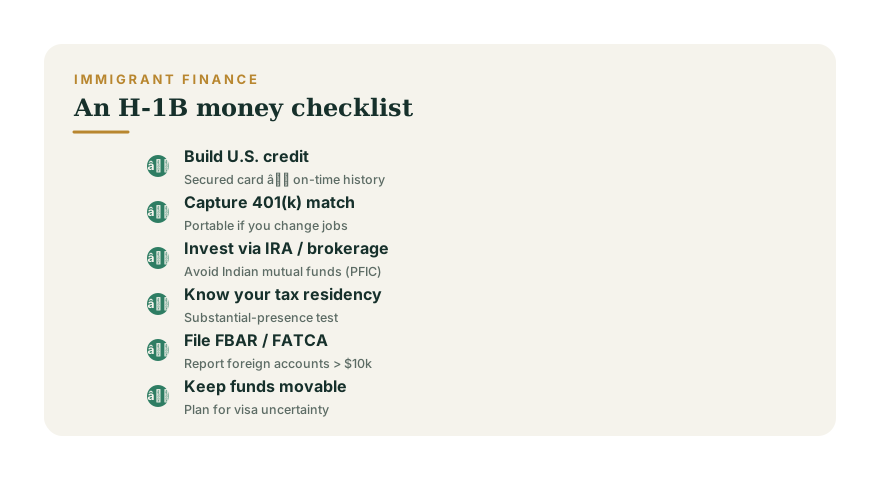
This guide addresses the specific financial planning challenges that H-1B holders face — challenges that standard American personal finance advice typically ignores.
Understanding Your Tax Status
Your US tax obligations depend on whether you are classified as a resident alien or non-resident alien for tax purposes. This is separate from your immigration status.
Most H-1B holders quickly become resident aliens under the Substantial Presence Test: if you are in the US for at least 31 days in the current year and 183 days over the past three years (using a weighted formula), you are a resident alien for tax purposes. Resident aliens pay US taxes on their worldwide income — the same as US citizens.
As a resident alien, you file Form 1040 (not 1040-NR), can claim the same deductions as citizens, contribute to retirement accounts like 401(k) and IRA, and receive the full standard deduction.
The 401(k) Question
Many H-1B holders are hesitant to contribute to 401(k) accounts because they are uncertain about their long-term presence in the US. This hesitation is understandable but often misguided.
You can withdraw from a 401(k) before retirement — with a 10% penalty and ordinary income tax — at any time, including if you leave the country. The 10% penalty, while meaningful, is often less costly than forgoing an employer match (which is free money) and the tax deduction on contributions.
At minimum, contribute enough to capture the full employer match. If your employer matches 4% of salary, that is effectively a 100% guaranteed return on your first 4% of contributions. No investment can reliably match that.
Beyond the match, the decision depends on your estimate of how long you will remain in the US and whether you intend to return. If you are pursuing a green card and expect long-term US residence, maxing your 401(k) and IRA makes as much sense for you as for any US citizen. If you expect to leave within 3–5 years, a more conservative approach (match only, invest the rest in a taxable account) preserves more flexibility.
The Roth IRA Opportunity
Many H-1B holders are unaware that they can contribute to a Roth IRA as resident aliens — and that early career years in the US often represent the ideal time to do so. If you are in your late 20s or early 30s, in the 22% federal bracket, and potentially earning more in the future (especially if you pursue a green card and permanent career), locking in tax-free Roth growth now is extremely valuable.
The 2025 Roth IRA income limits apply: phase-out begins at $150,000 for single filers. Many senior engineers and tech workers hit these limits, making the backdoor Roth (contribute to a non-deductible Traditional IRA, then convert) a relevant strategy.
If you leave the US permanently and withdraw Roth funds, the tax treatment in your home country may differ. India, for example, may not recognize the Roth IRA's tax-free status. This complexity is manageable but worth understanding before you make large Roth contributions with a near-term plan to return.
FBAR and Foreign Financial Account Reporting
If you have financial accounts outside the United States — a savings account in India, investments through an Indian broker, shares in Indian mutual funds — and the aggregate value exceeds $10,000 at any point during the year, you are required to file FinCEN Form 114 (FBAR) by April 15 (automatically extended to October 15).
This applies to: Indian bank accounts (savings, NRE, NRO), Indian brokerage or demat accounts, EPF (Employees' Provident Fund) if it exceeds the threshold, and PPF accounts in some interpretations.
The penalties for willful failure to file FBAR are severe — potentially $100,000 or more per violation. Non-willful failures carry $10,000 per violation. Filing is straightforward through the FinCEN website. Do not skip it because you think your accounts are too small or the requirement does not apply to immigrants.
Additionally, FATCA Form 8938 may be required if your foreign financial assets exceed higher thresholds ($50,000 single / $100,000 married at year-end or $75,000 / $150,000 at any point during the year). This is filed with your regular tax return.
Indian Mutual Funds and the PFIC Problem
Many H-1B holders continue investing in Indian mutual funds after arriving in the US. This is a significant tax trap. Indian mutual funds are classified as Passive Foreign Investment Companies (PFICs) under US tax law, and their treatment is punitive: gains are taxed at ordinary income rates rather than capital gains rates, with an additional interest charge for deferred gains. The annual reporting requirements (Form 8621 for each PFIC) are complex and expensive to comply with correctly.
General guidance: stop investing in Indian mutual funds after establishing US tax residency. Funds held before residency may need to be reported but can often be held. Liquidating existing PFIC positions (paying the tax) may be worth the cost to avoid ongoing compliance complexity. Consult a CPA familiar with Indian-American tax issues before making decisions.
Emergency Fund Sizing for Visa Holders
Standard advice says three to six months of expenses in emergency savings. For H-1B holders, add a visa-specific buffer. If your employer terminates your employment, you have a grace period (currently 60 days) to find a new sponsor, change visa status, or leave the country. An emergency fund of six to nine months of expenses provides meaningful runway to navigate a job transition without making panicked financial decisions.
Additionally, keep enough liquid funds to cover one-way flights home for your family in an absolute emergency. Knowing that option is funded and available reduces anxiety considerably.
Green Card Planning and Its Financial Implications
The green card process can take anywhere from 2–3 years (employment-based EB-1) to 20+ years (for some EB-2/EB-3 applicants from India or China under current backlogs). Your expected timeline should influence your financial decisions.
With a green card pending for many years, maximizing tax-advantaged US accounts (401k, IRA, HSA) makes more sense — your US financial life is effectively long-term. For those with shorter expected timelines or less certainty, maintaining more in taxable brokerage accounts (which transfer internationally more easily) and reducing dependence on US-specific accounts provides more optionality.
Building US Credit as an Immigrant
Most H-1B holders arrive with no US credit history. Banks cannot see your credit file from India, and your US score starts at zero. Building credit takes time but is essential for future housing, car loans, and financial flexibility.
The fastest path: open a secured credit card (which requires a deposit as collateral) and pay it in full every month. After 6–12 months of on-time payments, apply for an unsecured card. Request credit limit increases after consistent positive history. Becoming an authorized user on a spouse's or family member's established US credit account can accelerate score building. Use the Credit Score Simulator to see how different actions affect your score over time.