For charitably minded retirees, one of the most efficient giving tools is also one of the least known. A Qualified Charitable Distribution, or QCD, lets you send money straight from your IRA to a charity so that it never counts as taxable income. In an era when most people take the standard deduction and get no tax benefit from their donations, the QCD quietly delivers a benefit that a normal check to charity cannot.
What a QCD actually is
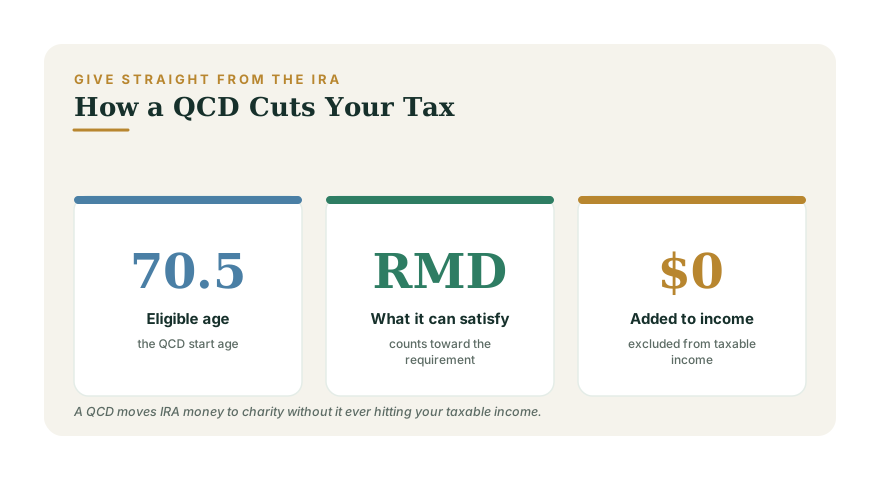
A QCD is a direct transfer of funds from your IRA custodian to a qualified charity. The key word is direct: the money must go straight from the IRA to the charity without passing through your hands. Because it never lands in your bank account, it is excluded from your gross income. You do not deduct it — you simply never report it as income in the first place, which is often more valuable than a deduction. According to the IRS, a QCD is generally available to IRA owners who are age 70 and a half or older, with an annual dollar limit that the IRS now adjusts for inflation. The rules are described at irs.gov/retirement-plans.
The big win: it satisfies your RMD
The headline benefit is the link to required minimum distributions. Once you reach the age at which RMDs begin, the IRS forces you to withdraw a certain amount from your traditional IRA each year and pay tax on it, whether you need the money or not. A QCD can count toward that required distribution — but because it is excluded from income, it satisfies the requirement without raising your taxable income at all. For a retiree who was going to give to charity anyway, this turns a taxable forced withdrawal into a tax-free gift.
Why excluding income beats a deduction
Since most retirees take the standard deduction, a regular donation produces no tax savings — you would have to itemize and clear the standard-deduction threshold to benefit. A QCD sidesteps that entirely by keeping the money out of income. Lowering your reported income can also ripple outward in ways a deduction cannot:
- It can reduce how much of your Social Security is taxed — see How Social Security Is Taxed.
- It can help you avoid Medicare IRMAA surcharges, which are driven by your income.
- It keeps your adjusted gross income lower, which affects a range of other thresholds.
That cascade is why financial planners often favor QCDs over writing a check, even for retirees who could itemize.
The rules to get right
- Age. You must be at least 70 and a half at the time of the transfer — note this is younger than the current RMD start age.
- Source. QCDs come from IRAs. They generally cannot be made directly from a 401(k); you may need to roll funds into an IRA first.
- Direct transfer. The custodian must send the money to the charity, or issue a check payable to the charity, not to you.
- Eligible charity. The recipient must be a qualified public charity. Donor-advised funds and most private foundations do not count.
- Annual limit. There is a per-person yearly cap, which the IRS indexes for inflation.
Reporting it correctly
Your custodian will report the full distribution on Form 1099-R without flagging the QCD portion, so it is on you and your preparer to note the QCD on your return so it is excluded from income. Keep the acknowledgment letter from the charity as you would for any donation. This is a common spot for errors, so confirm the paperwork each year. For the wider menu of giving techniques, see Charitable Giving Tax Strategies and How to Leave Money to Charity.
Making it part of the plan
If you are over 70 and a half, give to charity, and have a traditional IRA, the QCD is close to a free lunch: your charity gets the same gift, and you get a lower tax bill or a satisfied RMD without the income hit. Coordinate it with your required distributions early in the year so you do not accidentally take the full RMD first. Estimate your required withdrawal with the RMD Calculator, weigh giving strategies with the Tax Strategies tool, and pressure-test your plan with the Tax Health assessment before finalizing at the planning hub.