Most people picture Medicare as a single, modest monthly premium. For higher-income retirees, that picture is incomplete. A program called the Income-Related Monthly Adjustment Amount, or IRMAA, adds a surcharge on top of the standard Part B and Part D premiums once your income crosses certain thresholds. It is one of the most common surprises in early retirement, partly because the income it looks at is not this year's income at all.
IRMAA is not a tax in the usual sense, but it behaves like one: it is a cost that rises with income, applied through your Medicare premiums. Understanding it before you enroll can save a household hundreds or even thousands of dollars a year.
What IRMAA actually charges you
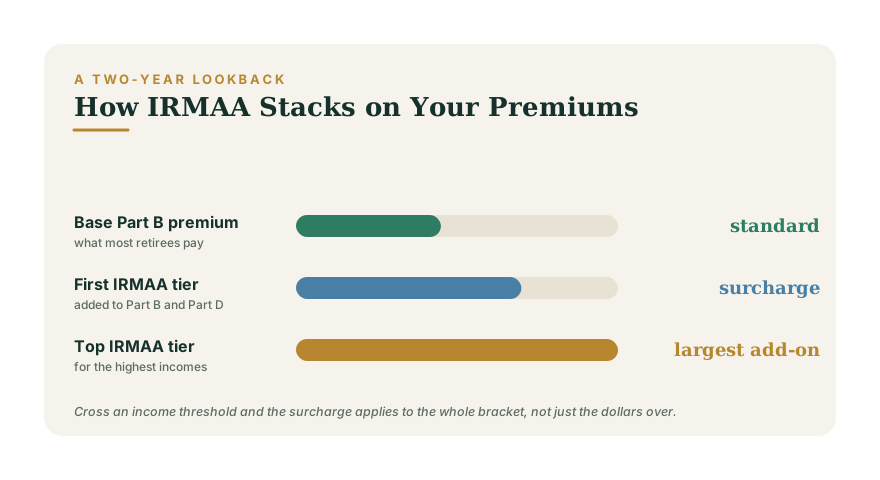
Standard Medicare Part B (outpatient care) and Part D (prescription drugs) each carry a base premium. If your income is above the first threshold, Social Security adds an IRMAA surcharge to both of those premiums. The surcharge climbs through several income tiers, so the highest earners pay a meaningfully larger amount each month than someone on the base premium. Married couples filing jointly have higher thresholds than single filers, but both are subject to the same tier structure.
The exact dollar amounts and bracket lines change every year, so it is best to think of IRMAA in terms of tiers rather than memorizing figures. The principle that matters: more income means a bigger Medicare bill, in steps.
The two-year lookback that catches people
Here is the detail that surprises almost everyone: IRMAA for a given year is based on your modified adjusted gross income (MAGI) from two years earlier. The premium you pay in 2026 is determined by your 2024 tax return. That lag means a one-time income spike — selling a business, a large capital gain, a big Roth conversion, even a year of unusually high wages right before retiring — can raise your Medicare premiums two years later, often in a year when your actual income has dropped.
Because MAGI drives the whole thing, it pays to understand exactly what counts. Tax-exempt interest is added back in, and capital gains and retirement-account withdrawals all flow through. A refresher on the difference between AGI and MAGI is in AGI and MAGI Explained.
Why the cliffs hurt
IRMAA tiers are cliffs, not ramps. Go one dollar over a threshold and the entire higher surcharge applies for the full year — there is no gradual phase-in. For a married couple, both spouses pay the surcharge, so crossing a line can quietly cost a four-figure sum. This makes the income just below each threshold extremely valuable to protect, and it is why careful retirees watch their MAGI in December the way they once watched a tax bracket.
Managing your MAGI to stay under the line
You have more control over IRMAA than it first appears, because you often control the timing of income in retirement. A few levers:
- Do Roth conversions earlier. Converting in your early 60s, before Medicare starts, lets you fill up lower tax brackets without affecting IRMAA. The broader strategy is laid out in The Roth Conversion Strategy Guide.
- Spread out large gains. Selling a property or a concentrated stock position across two tax years can keep a single year from spiking your MAGI over a threshold.
- Use qualified charitable distributions. Once you are subject to required minimum distributions, sending RMD money directly to charity keeps it out of your MAGI entirely.
- Mind tax-exempt interest. Municipal bond interest is added back for IRMAA, so it does not help you duck the surcharge.
Appealing when life changes
Because IRMAA looks back two years, it can charge you based on income you no longer have. If you experienced a qualifying life-changing event — retirement, the death of a spouse, divorce, or loss of a pension — you can ask Social Security to recalculate using your current income instead of the old return. This appeal, filed on Form SSA-44, is widely overlooked, and for many newly retired people it removes the surcharge entirely.
Where IRMAA fits in the bigger picture
IRMAA is really a retirement income-planning problem wearing a healthcare costume. The same withdrawal decisions that affect your taxes — how much to pull from pre-tax accounts, when to convert, when to realize gains — also move your Medicare premiums. Folding it into your overall plan, rather than discovering it at enrollment, is the goal. Start with the foundations in Medicare Basics Before 65, then model how different withdrawal sequences affect your income with the Retirement Planner. A small amount of planning before age 63 — the first year that feeds your age-65 premium — often pays for itself many times over.