Generosity and good tax planning are not in tension. The same dollars you intend to give away can do more — more for the cause and more for your own return — if you choose how you give as deliberately as how much. The catch is that the most common method, writing a check, is often the least tax-efficient. Here are four strategies that quietly upgrade ordinary giving.
The problem these strategies solve
Charitable gifts are only deductible if you itemize, and the standard deduction is now large enough that most people take it instead. If you give a few thousand dollars a year but your total itemized deductions fall short of the standard amount, your giving produces no tax benefit at all — you would have gotten the same deduction by giving nothing. The strategies below are mostly about restructuring giving so it clears that threshold, or sidesteps it entirely. (If you are unsure which side you fall on, start with Standard vs Itemized Deductions.)
Bunching: compress two years into one
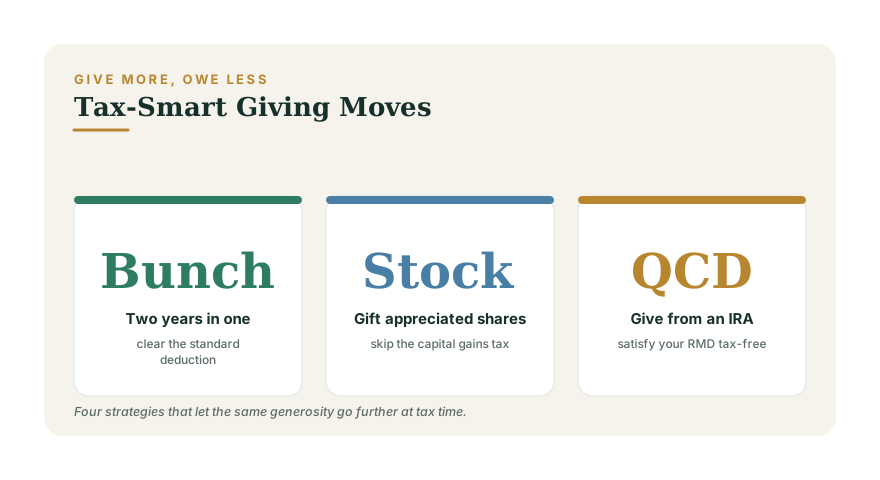
Bunching means concentrating several years of charitable gifts into a single tax year so that, in that year, your itemized deductions exceed the standard deduction — then taking the standard deduction in the off years. Suppose you normally give $8,000 a year and that, by itself, is not enough to make itemizing worthwhile. Give $16,000 in one year (two years' worth) and nothing the next, and the heavy year may clear the itemizing threshold, capturing a deduction you would otherwise have lost — while your total giving over the two years is unchanged. The charities can still receive steady support if you pair bunching with the next idea.
Donor-advised funds: bunch without rushing the charities
A donor-advised fund (DAF) is a charitable account you contribute to now, take the deduction now, and grant out to charities over time. It pairs beautifully with bunching: you can drop two or three years of giving into a DAF in one high-income year — locking in the deduction when it helps most — then recommend grants to your favorite charities on a normal schedule. The money can even be invested while it waits, potentially growing the amount that eventually reaches the cause. DAFs are especially powerful in a year with unusually high income, such as a bonus, a business sale, or a large capital gain.
Gifting appreciated stock instead of cash
This is the move most people overlook, and it is one of the best. If you donate stock or a fund you have held more than a year that has gone up in value, two good things happen at once:
- You deduct the full current market value of the shares (if you itemize), and
- You never pay capital gains tax on the appreciation you would have owed had you sold it.
Compare two ways to give $10,000: sell appreciated stock, pay capital gains tax, then donate what is left — or donate the shares directly and let the charity (which is tax-exempt) sell them tax-free. The direct gift sends more to the charity and saves you the tax. A neat companion move: if you still want to own that stock, use the cash you would have donated to buy it back at today's price, resetting your cost basis higher. This is the giving version of the logic behind capital gains planning.
Qualified charitable distributions: giving straight from an IRA
If you are at the age where required minimum distributions (RMDs) kick in, a qualified charitable distribution (QCD) is one of the most tax-efficient gifts available. You direct money straight from your traditional IRA to a qualified charity — up to an annual limit — and that amount counts toward your RMD but is excluded from your taxable income entirely. That is better than taking the distribution, paying tax on it, and then donating, because lowering your reported income can also help with things like Medicare premiums and the taxation of Social Security. The interaction with mandatory withdrawals is covered in Required Minimum Distributions. Note a QCD goes directly to the charity, not to a donor-advised fund.
Keep the records
Every strategy here depends on documentation. Keep written acknowledgments for gifts of $250 or more, brokerage confirmations for stock gifts, and statements from your DAF or IRA custodian. Give only to qualified organizations, and remember that pledges or volunteered time are not deductible.
Match the method to your year
There is no single best approach — the right one depends on your income, your age, whether you hold appreciated investments, and whether you itemize. A high-income year favors bunching and a DAF; a portfolio with big gains favors gifting shares; the RMD years favor QCDs. Map your situation with the Tax Strategies tool, and run a broader Tax Health check to see where charitable planning fits into your overall picture.