Leaving money to a cause you believe in is one of the more satisfying parts of estate planning, and it is also one of the most tax-efficient. Charities are exempt from income and estate tax, so a dollar left to charity passes through untouched — and the right giving method can lower the tax bill on what your family inherits, too.
The challenge is that there are several ways to give, and they differ a lot in effort, control, and tax efficiency. Picking the wrong one can mean handing the IRS money you meant for a charity or your heirs. Here is how the main methods compare.
The simple bequest in your will
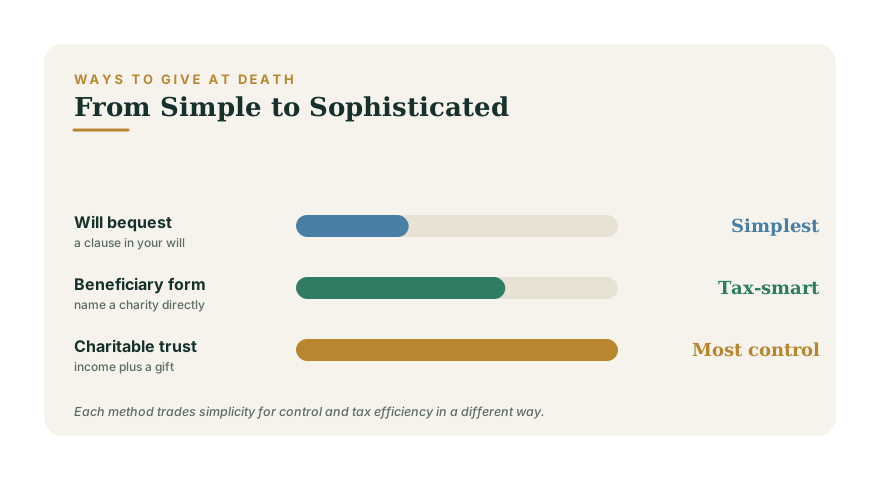
The most familiar method is a bequest — a clause in your will or trust that leaves a charity a specific dollar amount, a percentage of your estate, or whatever is left over after other gifts. It is easy to set up and easy to change. A percentage bequest is often smarter than a fixed dollar amount, because it keeps your charitable intent proportional whether your estate grows or shrinks before you die.
The one limitation: assets passing through your will go through probate, the public court process for settling an estate. That adds time and cost. To understand why many people route assets around probate entirely, see Setting Up a Living Trust, Step by Step.
Beneficiary designations: the most tax-efficient gift
Here is a move that is both simple and unusually smart: name a charity as a beneficiary on a retirement account like an IRA or 401(k). It takes minutes on a form, skips probate entirely, and carries a powerful tax twist.
Money in a traditional retirement account has never been taxed. If your heirs inherit it, they owe income tax as they withdraw it. But a charity pays no income tax, so it receives the full amount. That makes a pre-tax retirement account the single best asset to leave to charity — and it lets you leave other, more tax-friendly assets to your family instead. The flip side is just as important: a beneficiary form overrides whatever your will says, so keep designations current. The pitfalls there are worth knowing — see Estate and Gift Tax: Who Actually Pays for how inherited assets are taxed.
Give appreciated assets, not cash
If you donate during life, the most tax-efficient gift is rarely cash — it is appreciated stock or funds you have held more than a year. When you donate appreciated securities directly to a charity, you avoid the capital gains tax you would owe if you sold them first, and you can generally deduct the full market value. The charity sells them tax-free. You give more, and it costs you less. This and related moves are detailed in Charitable Giving Tax Strategies.
Donor-advised funds: a charitable account you control
A donor-advised fund (DAF) is like a charitable savings account. You contribute assets — ideally appreciated ones — take the tax deduction in the year you contribute, and then recommend grants to charities over time, even years later. The money can be invested and grow tax-free while it waits.
DAFs are popular for a few reasons. They let you "bunch" several years of giving into one high-deduction year. They handle the paperwork of donating complex assets. And in your estate plan, you can leave money to the DAF and let a successor advisor — a child, for instance — continue the giving, passing your philanthropy to the next generation without the cost of a private foundation.
Charitable trusts: income now, a gift later (or vice versa)
For larger gifts, charitable trusts let you support a cause and meet a personal goal at the same time. The two common forms mirror each other:
- A charitable remainder trust pays income to you (or a loved one) for a set period, then gives whatever remains to charity. It is useful when you hold a highly appreciated asset, want an income stream, and want to spread out or reduce the tax hit.
- A charitable lead trust does the reverse: it pays the charity income for a period, then returns the remaining assets to your heirs, often at a reduced gift- or estate-tax cost.
These are powerful but complex; they involve setup costs, ongoing administration, and irrevocable commitments, so they make sense mainly for substantial gifts and warrant professional drafting.
Matching the method to your goal
If you want simplicity, a percentage bequest or a charity beneficiary designation covers most people beautifully — and the beneficiary route is often the most tax-efficient of all. If you want to give while you are alive and stay involved, a donor-advised fund is hard to beat. If you have a large, appreciated asset and want income too, a charitable trust earns its complexity. Whatever you choose, make sure it fits the rest of your plan; the Estate Readiness assessment can help you see where charitable giving fits alongside your family's needs.