There is one budgeting idea that survives almost every personality, income level, and messy month: pay yourself first. The phrase sounds like a slogan, but it describes a specific mechanical change. Instead of spending your paycheck and saving whatever happens to be left, you move a fixed amount into savings the moment you get paid — before rent, before groceries, before anything — and live on the rest.
It is a small reordering with an outsized effect, because it stops relying on the one resource that always runs out at the worst time: willpower.
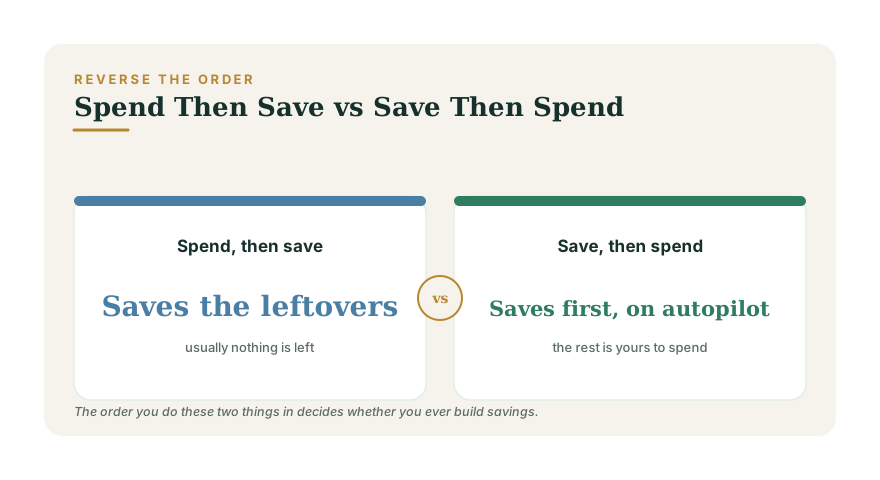
Why "save the leftovers" never works
The traditional budget treats saving as the last step: pay all your bills and spending, then deposit whatever remains. The problem is that spending expands to fill whatever money is available. There is always one more thing to buy, and by month's end the "leftover" is a rounding error. This is not a discipline failure — it is a design failure. A plan that depends on having money left over at the end is a plan that quietly produces zero savings.
Pay yourself first solves it by making savings a bill — the first one. When the money is gone before you can spend it, your remaining cash is, by definition, the amount you are free to spend without guilt.
This is reverse budgeting
Pay yourself first is the engine behind what people call reverse budgeting. A normal budget starts by tracking and limiting every spending category. Reverse budgeting flips it: decide your savings number first, automate it off the top, and then spend the rest however you like without tracking each latte. For people who find detailed category budgets exhausting, this is liberating — you only have to get one decision right (the savings amount) instead of a hundred small ones every week.
It pairs naturally with a simple framework. The budget that actually works only needs three buckets — needs, savings, and wants — and pay yourself first guarantees the middle bucket gets filled before the third one eats it.
Why it beats willpower
Behavioral research keeps landing on the same point: the easiest way to do a hard thing consistently is to remove the decision. Every payday, "should I save this month?" is a fresh negotiation you can lose. Automate the transfer once, and you never have that argument again. The default does the work.
This is also why automatic saving feels painless after a month or two. You adjust your spending to the money that lands in checking, not the money in savings you never see. The savings simply stop being part of your mental "available" balance.
How to set it up in fifteen minutes
- Pick a number. Start with whatever is realistic — even 5% beats nothing. You can raise it later. A common target is 15–20% of gross pay across all savings and retirement, but begin where you can.
- Open a separate account. Keep savings out of your checking account so it is not in your spending field of view. A high-yield savings account works well; see high-yield savings and CD ladders.
- Automate the transfer for payday. Schedule it for the day after your paycheck lands so the money leaves before you touch it.
- Capture the 401(k) match first. Money pulled from your paycheck into a retirement plan is the original pay-yourself-first move — and an employer match is free money. See how to start investing for the order of operations.
Direct each dollar to a job
"Pay yourself" does not mean one giant anonymous pile. The strongest version splits the automatic transfer across labeled goals — emergency fund, a car, a trip — so each has its own target. That is the logic behind sinking funds, and it turns a vague "save more" into visible progress bars you actually watch.
Raise it without feeling it
The quiet superpower of automation is that you can grow your savings rate invisibly. Every time you get a raise, increase the automatic transfer by a chunk of it before lifestyle creep absorbs the rest. You keep some of the raise, your savings climb, and your day-to-day budget never feels squeezed. This is the cleanest defense against lifestyle creep.
Put it on autopilot today
Pay yourself first works because it asks for one decision instead of a thousand. Pick a percentage, automate it for payday, label the destination, and let the system carry it. To find a savings number that fits your real take-home pay, run your figures through the Budget Analyzer and check the result against your Financial Wellness Score.