You have some money left over after covering the essentials, and a familiar tension appears: send it to your student loans and get out of debt faster, or invest it and let it compound? Both are good uses of money, which is what makes the choice genuinely hard. In 2026, with repayment rules in flux and markets doing what markets do, it helps to reduce the decision to a few clear factors rather than a gut feeling.
This article covers general principles, not personalized advice, and the tax and program details it references can change. Confirm loan specifics at studentaid.gov and tax rules at irs.gov.
The core comparison: guaranteed vs expected return
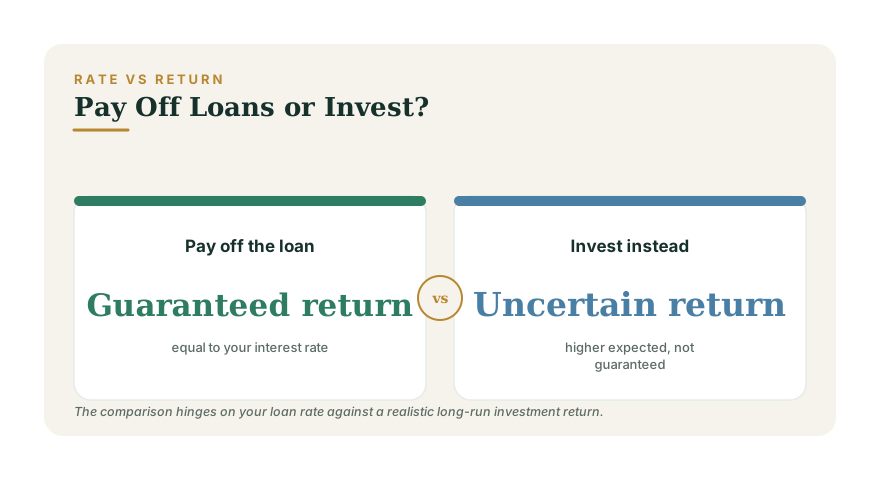
At its heart, paying off a loan gives you a guaranteed return equal to the loan's interest rate — every dollar you prepay saves you that rate in future interest, risk-free. Investing offers a higher expected return over the long run, but not a guaranteed one; markets fall as well as rise. So the raw math is: if your loan rate is well below a realistic long-run investment return, investing tends to win in expectation. If your loan rate is high — near or above what you could reasonably earn — paying it down is the smarter, surer move. This same logic applies to any debt, as laid out in Should You Pay Off Debt or Invest?.
The things that override the raw math
Before you optimize the spread between two percentages, handle the factors that beat it outright:
- Capture the full employer 401(k) match first. A match is an immediate, often 50 to 100 percent return on the money — larger than any loan rate. Always take the full match before extra loan payments. And if your employer matches student-loan payments into your 401(k), you may not have to choose at all, as explained in Employer Student-Loan Repayment Benefits.
- Build a starter emergency fund. Without a cash cushion, one surprise expense can push you into high-interest credit-card debt, undoing any progress. See Emergency Fund vs Investing.
- Kill high-interest debt. Credit-card balances almost always outrank both student loans and investing.
- Account for forgiveness. If you are genuinely pursuing PSLF or income-driven forgiveness, aggressively prepaying federal loans can be counterproductive — you would be paying down a balance the government may erase. In that case, investing the surplus usually makes more sense. See PSLF in 2026: Where It Stands.
Certainty has value too
The math is not the whole story. A guaranteed return carries no anxiety, and being debt-free has a psychological and flexibility payoff that a spreadsheet cannot fully capture. Some people rationally choose to pay off loans faster even when investing might win on paper, because the peace of mind and the freedom to change jobs or take risks are worth it to them. There is no wrong answer here as long as the high-priority items above are handled — this last slice is genuinely about your temperament.
Tax details that tilt the scale
Two tax points matter. Student-loan interest may be partially deductible depending on your income, which slightly lowers the effective cost of the loan — check current rules at irs.gov. And investing inside tax-advantaged accounts (a 401(k), IRA, or HSA) boosts your effective return through tax savings, strengthening the case for investing the surplus once the match and emergency fund are in place. Neither factor usually flips the decision on its own, but both nudge it.
Build your order of operations
A sensible sequence for most borrowers: capture the full employer match, build a starter emergency fund, wipe out high-interest debt, then split the remainder between extra loan payments and investing based on your loan rate and your appetite for certainty. If your rate is low and you are not chasing forgiveness, lean toward investing; if it is high, lean toward payoff. Run the two paths side by side with the Opportunity Cost Calculator and the Debt Payoff Planner, and if you are still deciding whether to keep federal loans at all, read Refinance or Stay Federal?.
Make it a plan, not a debate
The pay-off-or-invest question feels philosophical, but it resolves cleanly once you rank the guaranteed wins first and then let your loan rate and your comfort with risk settle the rest. Model your specific numbers, decide your split, and automate it so you are not relitigating the choice every month. Put it all together at the planning hub and gauge your footing with the Financial Wellness assessment.