For years, the two big claims on a young professional's paycheck — student loans and retirement saving — competed directly. Every dollar toward the loan was a dollar not invested, and vice versa. A newer category of workplace benefit is starting to ease that conflict: employer student-loan assistance. If your employer offers it and you are not using it, you may be leaving real money on the table.
The rules that govern these benefits, including the tax treatment and contribution limits, are set by federal law and adjusted over time. Confirm the current specifics with the IRS at irs.gov and with your own HR department, since not every employer structures the benefit the same way.
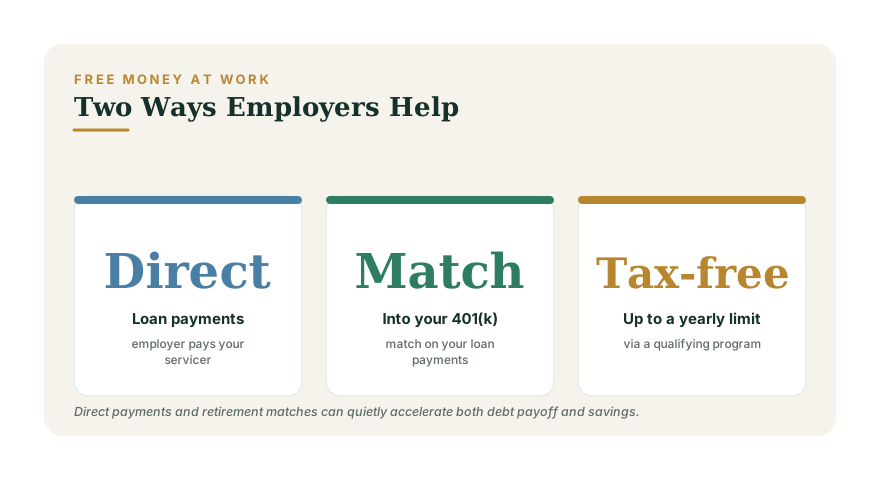
The two main forms of help
Employer student-loan assistance generally shows up in one of two ways, and some employers offer both:
- Direct loan repayment. The employer sends money to your loan servicer each month or year, on top of your salary, reducing your balance faster. Amounts vary widely, often a few thousand dollars a year with a lifetime cap.
- Retirement match on loan payments. A more recent option lets employers treat your student-loan payments as if they were retirement contributions and match them in your 401(k) or similar plan. This means you can pay down debt and still capture the employer match you would otherwise miss — solving the old either-or problem directly.
The tax angle
Under federal rules, an employer can provide a limited amount of educational assistance — which has been allowed to include student-loan repayment — on a tax-free basis each year, up to an annual cap the IRS sets. Money provided under a qualifying program up to that limit generally is not counted as taxable wages to you, which makes it more valuable than an equivalent raise you would be taxed on. This treatment has had scheduled expiration dates that Congress has extended before, so its future is not guaranteed — another reason to confirm the current status at irs.gov and use the benefit while it is available. Amounts above the cap, or benefits offered outside a qualifying program, may be taxable.
How to capture every dollar
Treat these benefits like any employer match — as compensation you have to claim:
- Read your benefits guide. Many employees never realize the benefit exists. Ask HR specifically about student-loan repayment assistance and any 401(k)-match-on-loan-payments feature. A broader walkthrough of what to look for is in First-Job Benefits, Explained.
- Enroll and certify correctly. These programs usually require you to register and, for the retirement-match version, to self-certify your loan payments each year. Miss the paperwork and you miss the match.
- Do not stop paying yourself. If your employer matches loan payments into your 401(k), make sure you are actually making qualifying loan payments at the level needed to trigger the full match.
- Mind vesting and tenure rules. Some direct-repayment benefits require you to stay a certain length of time or vest over a schedule. Know the strings before you count on the money.
Fit it into the bigger picture
Employer help changes the math on the classic question of whether to prioritize debt or investing — sometimes you no longer have to choose. Once you know what your employer offers, revisit the trade-off in Pay Off Student Loans or Invest? and confirm you are on the right federal repayment plan per Student-Loan Repayment Plans, Explained. Use the Debt Payoff Planner to see how employer contributions shorten your timeline.
Ask the question
Employer student-loan benefits are one of the rare wins where paying debt and building retirement savings stop competing. The catch is that they are opt-in and underused. Ask HR what is available, enroll properly, keep your certifications current, and fold the benefit into your overall plan. Start at the planning hub and see where your workplace benefits leave gaps with the Financial Wellness assessment.