You have an extra few hundred dollars a month. Should it go toward your debt or into the market? This is one of the most common questions in personal finance, and the unsatisfying-but-true answer is "it depends." The good news is that it depends on a small number of specific factors, and once you know them you can build a clear order of operations rather than agonizing every month.
Step zero: the things that come before either
Before you optimize between debt and investing, two foundations come first. Keep a small starter emergency fund so a surprise expense does not push you back onto a credit card, and never miss minimum payments on any debt — a missed payment costs more in fees and credit damage than any return you could earn. With those in place, the framework begins.
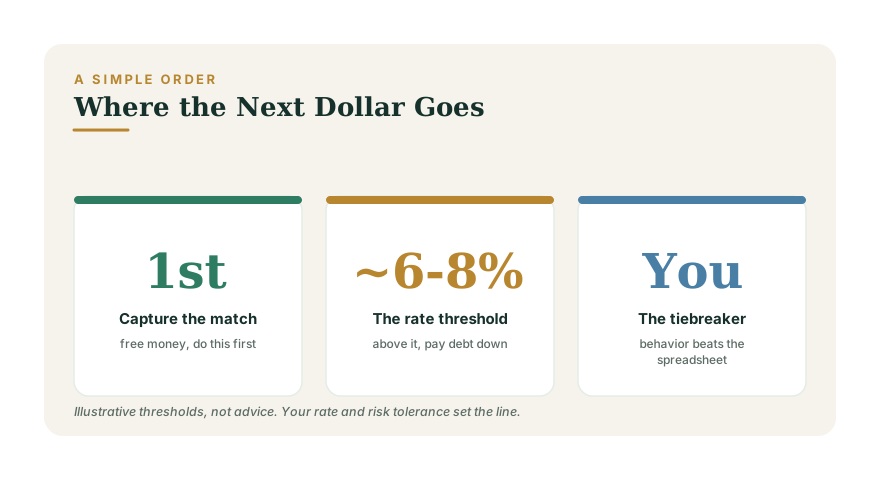
Capture the employer match first — always
If your job offers a 401(k) match, contributing enough to get the full match is the highest-priority use of a spare dollar, ahead of almost any debt. A typical match is an instant 50% or 100% return on your contribution — a guaranteed gain that no interest rate on normal debt can beat. Walking away from a match to pay down a 6% loan a little faster is leaving free money on the table. Grab the full match, then continue down the framework. The mechanics are in How to Start Investing.
The interest-rate threshold
After the match, the decision mostly comes down to one comparison: the interest rate on your debt versus the return you can reasonably expect from investing. Paying off a debt is a guaranteed, risk-free return equal to its interest rate. A diversified stock portfolio has a higher expected return over the long run, but it is uncertain and can fall for years at a time.
- High-rate debt (think credit cards, often well into double digits) — pay it off aggressively before investing beyond the match. No reliable investment beats a guaranteed return that high. Start with How to Actually Pay Off Credit Card Debt.
- Low-rate debt (think many mortgages and some federal student loans) — the expected return from long-term investing usually exceeds the interest you are saving, so investing the dollar often wins on the math. This is also why aggressively prepaying a low-rate mortgage can be a mistake; see The Hidden Cost of Paying Off Your Mortgage Early.
- The murky middle (roughly 6–8%) — here the math is close enough that it is genuinely a toss-up, and other factors decide it.
Those thresholds are illustrative, not gospel. The exact line shifts with your tax situation, the type of debt, and how you feel about market risk. But the principle holds: compare the guaranteed return of paying down debt against the uncertain return of investing.
The behavioral case for each side
Spreadsheets ignore the most important variable: you. The "optimal" answer only matters if you actually follow through, and humans are not spreadsheets.
The case for paying off debt even when the math says invest: debt is a psychological weight. Many people sleep better, take more career risks, and feel genuinely freer once a debt is gone — and that peace of mind is worth giving up a little expected return. Guaranteed progress also feels more real than uncertain market gains, which keeps people consistent.
The case for investing even when you carry low-rate debt: time in the market is the one advantage you cannot get back later. Years of compounding lost while you over-prioritize a 4% loan can dwarf the interest you saved. For someone who will reliably keep investing, starting earlier is powerful.
Neither answer is "wrong." The best plan is the one you will actually stick to for years, which is why your own temperament is a legitimate tiebreaker, not a cop-out.
Putting it together
For most people the order looks like: (1) starter emergency fund and all minimum payments, (2) full employer match, (3) crush high-interest debt, (4) full emergency fund, then (5) split between investing more and paying down lower-rate debt according to the rate threshold and your own comfort. It is a framework, not a formula — but it turns a monthly agonizing decision into a settled routine.
Run your own numbers
The cleanest way to settle the close calls is to see them side by side. Plug in a specific debt's rate and balance, an honest estimate of investment returns, and the time horizon, and the difference between the two paths often turns out to be smaller than the worry it generates. The Opportunity Cost Calculator lets you compare paying down a specific debt against investing the same dollars, so you can make the call with your real rates instead of rules of thumb. Whichever side wins, the bigger victory is having a settled routine — a default for where the next dollar goes — so you stop relitigating the decision every payday. Build the winning choice into your overall plan and let it run.