Many NRIs feel a strong pull to keep some of their wealth invested in India — for family reasons, for growth in a fast-growing economy, or simply because it feels like home. Doing it well is more complicated than opening a US brokerage account, because you are threading through Indian regulations, product restrictions, and a US tax code that treats foreign investments harshly. A newer option, GIFT City, has changed the landscape, so it is worth understanding both the traditional route and the new one.
The traditional route: investing through Indian accounts
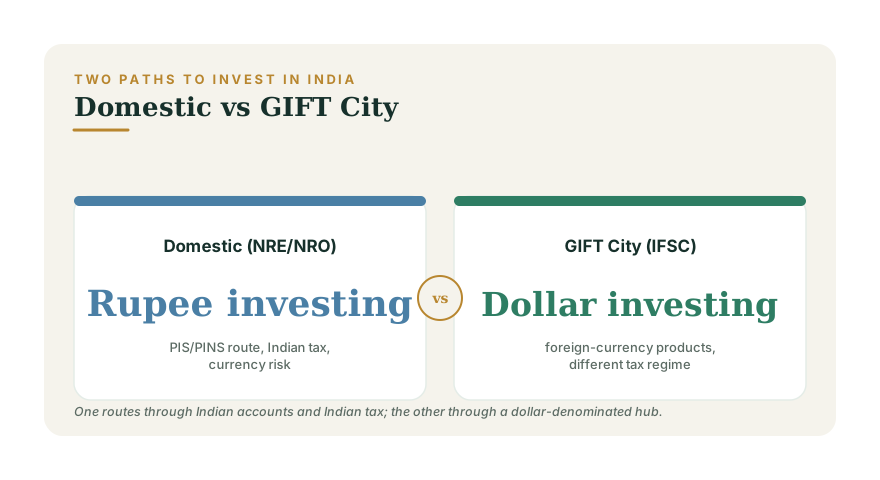
The classic way an NRI invests in India is through the accounts covered in NRE vs NRO Accounts. Fixed deposits, direct stocks (through a regulated portfolio-investment route), and Indian mutual funds are all reachable, funded from your NRE or NRO balance. The appeal is direct exposure to Indian growth; the drawbacks are real. Everything is in rupees, so a weakening rupee can quietly eat your dollar returns. Some products are simply off-limits to NRIs or to US-resident NRIs specifically, because Indian fund houses often refuse US persons to avoid FATCA burdens. And the Indian tax and paperwork add friction on top.
What GIFT City actually is
GIFT City — Gujarat International Finance Tec-City — houses India's International Financial Services Centre (IFSC), a special zone designed to bring offshore-style financial activity onshore. For NRIs the important point is that products offered through the IFSC are typically denominated in foreign currency (often US dollars) and operate under a distinct, more offshore-friendly regulatory and tax regime than mainland India. In practice this can mean investing in India-linked funds and products without converting to rupees, and with tax treatment intended to be competitive with other global financial hubs. It has become a genuine third path between "invest in the US" and "invest through rupee accounts back home."
Why the dollar angle matters
Investing through GIFT City in dollars sidesteps one of the biggest frustrations of home-country investing: currency risk on the way in and out. When you invest rupees through a domestic account and later repatriate, two exchange conversions and any rupee weakness sit between you and your dollars. A dollar-denominated IFSC product keeps your capital in the currency you actually spend, removing that layer. The offshore-oriented tax framework can also be more favorable on certain income than the mainland route — though the specifics shift as rules evolve, so verify current treatment before committing.
The US tax angle that changes everything
Here is the part that trips up almost every NRI, and it applies regardless of which route you choose. As a US person, most pooled foreign investments — Indian mutual funds, and quite possibly certain IFSC fund structures — are treated by the IRS as PFICs (Passive Foreign Investment Companies). PFIC treatment is deliberately punishing: unfavorable tax rates, an interest charge on deferred gains, and heavy annual reporting on Form 8621. The IRS lays out the regime for shareholders of these funds (IRS, Form 8621). The full mechanics and how to avoid the worst of it are in The PFIC Tax Trap. The practical takeaways:
- Direct stocks are generally safe from PFIC rules; foreign funds usually are not. Owning individual Indian shares does not create a PFIC problem the way an Indian mutual fund does.
- Do not assume GIFT City escapes PFIC. A fund is a fund to the IRS wherever it is domiciled — confirm the specific product's US treatment before buying.
- Report your foreign accounts. Whichever route you use, FBAR and FATCA still apply — see FBAR and FATCA, Explained.
How to think about it
For most US-based NRIs, the sensible default is to build the core of your portfolio in low-cost, US-domiciled funds that carry no PFIC baggage, and to treat Indian exposure as a deliberate, well-documented satellite. If you want that exposure, direct stocks or carefully vetted GIFT City products often make more US-tax sense than mainland mutual funds. Above all, decide based on the after-US-tax return, not the headline Indian return — the PFIC drag can erase an apparent advantage. This planning is doubly important if you might eventually move back; see the Returning to India guide and A Financial Checklist for New Green-Card Holders.
Invest across borders with your eyes open
India is a legitimate place to invest, but the wrapper you use and the US tax code around it matter more than the underlying asset. Favor structures that avoid PFIC treatment, keep clean records, and always compare on an after-tax, after-currency basis. Model how an India allocation fits your overall plan with the Model Portfolios tool and the Return-to-India Planner, and confirm your foundations with the Immigrant Financial Readiness check before mapping it all at the planning hub.