The moment your status changes to non-resident Indian, a small but important piece of housekeeping is waiting back home. Under Indian foreign-exchange rules, a resident savings account is meant only for residents. Once you settle abroad, you are expected to convert or close it and move to the accounts built for non-residents: the NRE and the NRO. Most NRIs end up needing both, and confusing the two causes real problems when you try to move money.
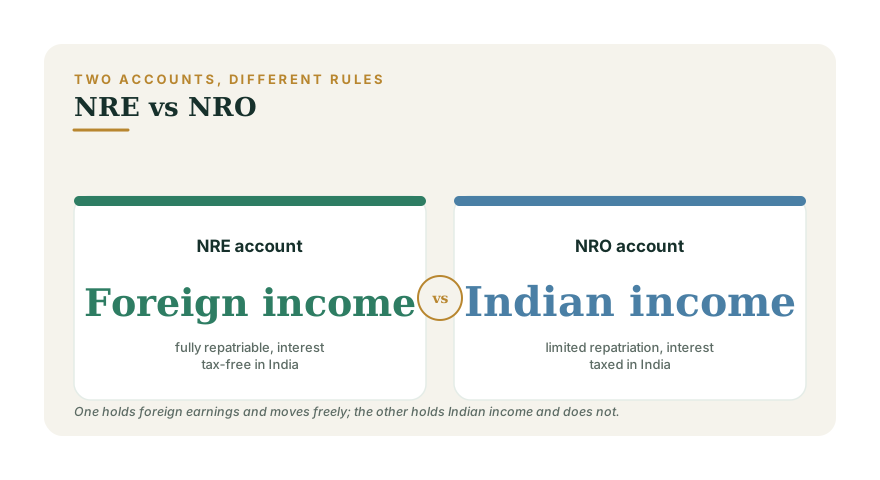
The distinction is simpler than the acronyms suggest. An NRE (Non-Resident External) account is for money you earn abroad and bring into India. An NRO (Non-Resident Ordinary) account is for money that arises inside India — rent, dividends, a pension, the sale of an old asset. Where the money comes from decides which account it belongs in, and that in turn decides how it is taxed and how freely you can send it back out.
The NRE account: your foreign earnings, parked in rupees
An NRE account holds money you earned outside India and remitted in. You deposit US dollars (or another foreign currency), the bank converts to rupees, and the balance sits in rupees. Its two headline features make it the workhorse for most NRIs. First, it is fully repatriable — you can send the entire balance, principal and interest, back out to your US account whenever you like, no permission needed. Second, the interest is exempt from Indian income tax while you remain an NRI. The trade-off is currency risk: because the balance is in rupees, a weakening rupee erodes the dollar value even as the rupee balance grows.
The NRO account: your Indian-source income
An NRO account is where India-origin money lands. If you own a flat that earns rent, hold shares that pay dividends, or receive a pension or the proceeds from selling an inherited asset, that money must generally flow through an NRO account. Two features are the mirror image of the NRE. First, the interest is taxable in India, and the bank withholds tax at source on it. Second, repatriation is limited — you can send out a large amount per financial year subject to conditions and paperwork, but not with the free hand an NRE gives you. The NRO is not a disadvantage; it is simply the correct home for income that legally arises in India.
Repatriation: the practical difference that matters most
When NRIs get frustrated, it is almost always about moving money out. From an NRE account, sending funds back to the US is routine. From an NRO account, larger transfers typically require a certificate from a chartered accountant confirming the tax position, and they count against an annual repatriation ceiling. Plan around this: if you know you will want money back in the US soon, keeping fresh foreign earnings in the NRE side keeps your options open. The mechanics, limits, and US tax angle of actually sending money across the corridor are covered in Sending Money Home: Remittances, Limits, and Taxes.
Do not forget the US side
Whichever account you hold, remember that as a US person these are foreign financial accounts. If your combined foreign balances cross the threshold at any point in the year, you owe an FBAR to the Treasury, and possibly Form 8938 with your return — the details are in FBAR and FATCA, Explained. Just as important: NRE interest is tax-free in India, but the US taxes its residents on worldwide income, so that same interest is generally taxable on your US return. The IRS is explicit that US residents and citizens must report income from all sources inside and outside the country (IRS, International Taxpayers). Many newcomers assume "tax-free in India" means tax-free everywhere; it does not.
A quick decision guide
- Money earned abroad that you want to move freely? NRE account.
- Rent, dividends, pension, or sale proceeds from India? NRO account.
- Want to invest in Indian markets or deposits with foreign money? Usually funded from the NRE side.
- Planning to move back permanently? You will eventually re-designate these as resident accounts — see Returning to India: A Financial Guide.
Set it up once, correctly
For most NRIs the answer is not one account or the other — it is both, each doing its job. Open an NRE for your foreign earnings and an NRO for anything India generates, keep the two streams separate, and remember that Indian tax treatment does not erase your US reporting duty. Map how these accounts fit your cross-border plan at the planning hub, and use the Return-to-India Planner to see how the pieces connect if a move home is on the horizon. If you are still finding your footing in the US system, the Immigrant Financial Readiness check is a good place to spot gaps.