You moved to the US on an H-1B, kept the Indian mutual funds you had been diligently investing in for years, and assumed you would sort out the taxes later. Later arrives, and you discover those funds are PFICs, that they are taxed at the highest ordinary rate plus an interest penalty, and that each one needs its own special tax form. This is not a niche edge case. It is one of the most common and most expensive surprises for immigrants in the US tax system, and almost nobody warns you in advance.
This article is general education, not tax advice. The PFIC rules are genuinely complex and cross-border situations are individual, so the right move is to understand the trap here and then bring it to a qualified cross-border tax professional.
The Honest Truth: Your Old Funds Are Now a Problem
A PFIC is a Passive Foreign Investment Company. In plain terms, almost any pooled foreign investment fund, an Indian mutual fund, a UK unit trust, a European UCITS ETF, counts as a PFIC for US tax purposes. If you are a US tax resident (on an H-1B or other qualifying visa once you meet the substantial presence test, a green card holder, or a citizen), the US taxes your worldwide income, and these foreign funds fall squarely into the PFIC regime.
The default treatment, Section 1291, is deliberately harsh. The idea was to stop wealthy taxpayers from parking money in offshore funds to defer US tax. The rules do not care that you are an ordinary salaried immigrant who simply never sold your home-country investments. They apply just the same.
Follow the Money: Why the Rules Are So Punitive
Congress designed PFIC rules to remove any advantage from holding investments through foreign funds instead of US ones. So the regime strips away the benefits you would get from a US fund: there is no long-term capital gains rate, and there is an extra interest charge meant to claw back the value of any deferral. The system is intentionally unfriendly, and the paperwork burden is part of the deterrent.
The result is that a perfectly sensible investment in your home country becomes one of the worst possible things to own once you are a US taxpayer. Not because the fund is bad, but because of how the US chooses to tax it.
The Math: How Bad It Gets
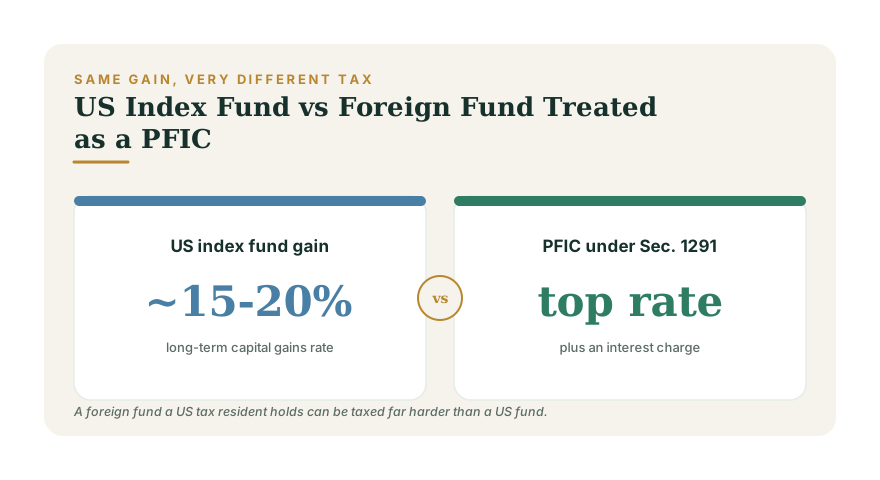
Under the default Section 1291 method, when you sell a PFIC or receive an "excess distribution," the gain is spread back across every year you held it, taxed at the highest ordinary income rate in effect for each of those years, and then hit with an interest charge for the deferral. Compare the outcomes on a $40,000 gain:
- US index fund, held long term: taxed at the long-term capital gains rate, often 15%, so roughly $6,000.
- Same gain in a PFIC under Section 1291: taxed at the top ordinary rate (37%) rather than 15%, then an interest charge added on top for each year of deferral. The effective hit can climb well past $15,000 and, on long-held positions, can approach or exceed the entire gain.
On top of the tax, you must file Form 8621 for each PFIC, each year you meet the filing thresholds. Own five Indian mutual funds and that can be five separate forms with detailed calculations. Miss them and you risk penalties and an open statute of limitations.
The Elections, and Why They Are Not a Free Pass
There are two ways to escape the brutal 1291 default, but both have catches:
- QEF (Qualified Electing Fund): lets you be taxed annually on your share of the fund's income, often at better rates. The catch: it requires the fund to provide a detailed annual PFIC statement, and most foreign funds simply do not produce one, so QEF is frequently unavailable.
- Mark-to-market: lets you report the fund's annual gain as ordinary income each year, avoiding the interest charge. The catch: you pay tax on paper gains you have not sold, at ordinary rates, and it generally only works cleanly for funds traded on a qualifying exchange.
Both are better than the 1291 default in many cases, but both add complexity and neither makes a foreign fund as efficient as simply owning a US fund.
How to Protect Yourself
- Hold US-domiciled funds instead. A US-listed total-market index fund or ETF is not a PFIC and gives you broad market exposure with normal capital gains treatment.
- Inventory your foreign holdings the moment you become a US tax resident: mutual funds, ETFs, ULIPs, and many foreign pension or insurance-linked investment products can all be PFICs.
- Consider acting before you trigger the trap. The treatment can differ depending on timing relative to when you became a US resident, which is exactly the kind of thing to plan with a professional.
- Do not forget the related filings. Foreign accounts may also require FBAR and Form 8938 reporting, which are separate from the PFIC rules.
- Get a cross-border tax pro. This is not a DIY area. The cost of good advice is small next to a mishandled PFIC.
Your Decision Rule
- If you are a US tax resident, assume any foreign pooled fund you own is a PFIC until a professional confirms otherwise.
- For new investing while in the US, default to US-domiciled index funds and ETFs.
- If you already hold foreign funds, do not sell blindly; the timing and method of unwinding change the tax, so plan it.
- File the required forms; the penalties and open statute for missing them are not worth the risk.
The Honest Recommendation
If you are building wealth as a US tax resident, keep your investments in US-domiciled funds and avoid the PFIC regime entirely. If you already own foreign mutual funds or ETFs, treat it as a priority to map your exposure and get cross-border tax help before you sell or file. The trap is expensive precisely because so few people hear about it until the bill lands.
If you are new to the US system, our articles for H-1B and returning-resident finances walk through the setup step by step, you can sketch a US-domiciled investing plan in your plan, and our tools can help you compare the long-run cost of getting the structure right versus wrong.