Receiving a green card is a life milestone, and it quietly rewires your financial life the day it takes effect. As a lawful permanent resident you are treated for tax purposes essentially like a US citizen — which brings both new freedoms and new obligations. The good news is that the work is finite and orderly. Here is the checklist to move through in your first year, roughly in priority order.
1. Understand your new tax residency
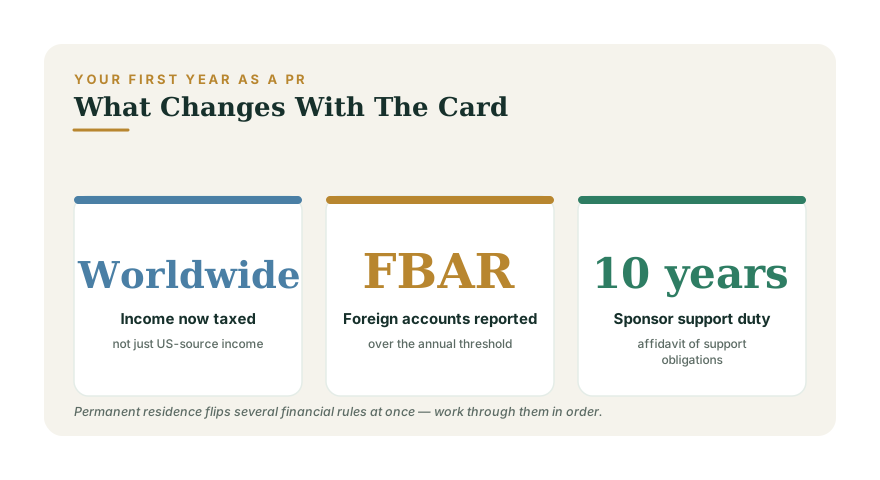
A green card makes you a US tax resident under what the IRS calls the "green card test," effective from the day you become a permanent resident (IRS, Green Card Test). The most important consequence: you are now taxed on your worldwide income, not just US-source income. Salary, interest, dividends, rent, and capital gains from your home country are all reportable on your US return, even if you never bring them into the US. If you got the card partway through the year you may have a dual-status first year — the broader rules are in Green Cards and Tax Residency.
2. Inventory and report your foreign accounts
This is the step that trips people up most. As a US person you must file an FBAR if your combined foreign financial accounts exceed the threshold at any point in the year, and possibly Form 8938 under FATCA with your return. These are informational and usually create no tax, but the penalties for skipping them are severe. Make a complete list of every account you hold abroad — checking, savings, NRE, NRO, brokerage, provident-fund style accounts — and check the thresholds. Start with FBAR and FATCA, Explained. If you are Indian, restructuring resident accounts into NRE/NRO accounts is part of this cleanup — see NRE vs NRO Accounts.
3. Watch for foreign-investment traps
Home-country investments that were perfectly sensible can become US tax landmines. Foreign mutual funds and many pooled products are treated as PFICs, which carry punishing tax and reporting — explained in The PFIC Tax Trap. Before you keep, add to, or sell such holdings, understand the US treatment. Often the clean move is to shift new investing into ordinary US brokerage accounts and low-cost index funds, which you can now open freely as a resident.
4. Max out the accounts you can now use fully
Permanent residence removes the uncertainty that made some people hesitate to save in US retirement accounts. Capture your full employer 401(k) match first — it is the highest-return move available — then consider an IRA, and use an HSA if you have a high-deductible health plan. These accounts travel with you even if you later leave. If you came the H-1B route, much of this overlaps with The H-1B to Green Card Financial Checklist.
5. Rebuild or deepen your US credit and insurance
If your credit file is still thin, keep building it deliberately with a card paid in full each month — you can model habits with the Credit Score Simulator. Review your insurance, too: health coverage, plus term life and disability if people depend on your income, which matter more now that you are planting long-term roots.
6. Know your sponsor's support obligation
Many green cards come with an affidavit of support signed by a sponsor, who accepts a legally enforceable duty to support you financially until you have worked about ten years or naturalize. This is worth understanding on both sides of the relationship — it can affect eligibility for certain benefits and the sponsor's own finances.
7. Update your estate basics
With permanent status and possibly US-based assets, put the basics in place: beneficiary designations on your retirement and bank accounts, and at minimum a simple will. Note that the estate-tax rules for non-citizen spouses differ from those for citizens, so if your spouse is not a US citizen, get that reviewed.
Work the list, then relax
None of these steps is hard on its own; the mistake is ignoring the reporting ones until a problem surfaces. Get your tax residency and foreign-account reporting right first, defuse any PFIC holdings, then build wealth in the accounts now fully open to you. Run your numbers and sequence the work at the planning hub, and use the Immigrant Financial Readiness assessment to make sure nothing on this checklist slips through.