Every mutual fund and ETF publishes a short summary — usually called a fact sheet or summary prospectus — that fits on a page or two. It is free, it updates regularly, and it contains most of what you need to decide whether a fund deserves your money. Yet most people buy funds off a name, a star rating, or a recent return, and never read it.
Learning to scan a fact sheet takes a few minutes and protects you from expensive mistakes. Here is exactly what to look at, and what each item is quietly telling you.
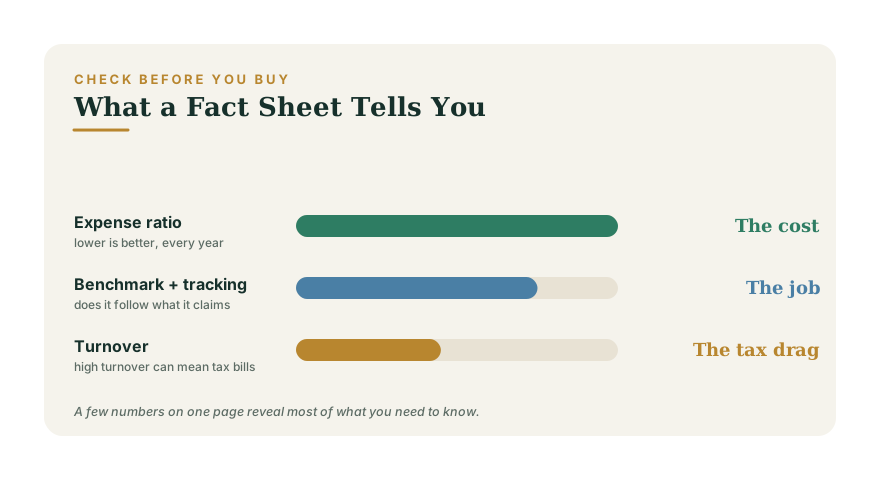
The expense ratio: start here, always
The expense ratio is the percentage of your money the fund charges every year to operate — and it is the single most predictive number on the page. A 0.05% fund costs $5 a year per $10,000; a 1.0% fund costs $200 for the same balance and often the same exposure. That difference looks small but compounds relentlessly against you over decades, as we show in how expense ratios quietly destroy wealth.
Cost is one of the very few reliable predictors of fund performance, and it points the right way: lower-cost funds tend to win. Make this the first number you read, and let it disqualify anything overpriced before you look further.
The benchmark: what is the fund trying to beat?
Every fund is measured against a benchmark — a market index that represents its slice of the market, such as the S&P 500 for large U.S. stocks. The benchmark tells you two things: what the fund actually invests in, and the bar it should be judged against. A "growth" fund that quietly benchmarks to a broad index may just be the index in disguise, while charging more. Always check that the benchmark matches what you think you're buying.
Performance vs benchmark, and tracking
The fact sheet shows returns over 1, 3, 5, and 10 years, alongside the benchmark's returns. Two cautions. First, ignore the temptation to chase the highest recent number — past performance is a famously weak predictor, the core lesson of why most active mutual funds underperform index funds. Second, look at the relationship to the benchmark over the longest period available. For an index fund, you want returns that closely track the benchmark, falling short only by roughly the expense ratio. A large or erratic gap is a red flag.
Top holdings and concentration
The fact sheet lists the fund's largest positions and its breakdown by sector or region. Use this to check for two things: whether the fund actually delivers the diversification you want, and whether it overlaps with what you already own. Two "different" funds that both hold the same handful of giant companies give you less diversification than you think. A quick glance at the top ten holdings tells you whether you're really spreading risk or just doubling down.
Turnover: the hidden tax drag
Turnover measures how much of the portfolio the fund buys and sells in a year. A 100% turnover means it replaced its entire portfolio over twelve months. High turnover matters for two reasons: it adds trading costs you don't see directly, and in a taxable account it can generate capital gains distributions that hand you a tax bill even in a year you didn't sell a thing. Broad index funds typically have very low turnover, which is part of why they're so tax-friendly — a key point in index funds vs ETFs.
Yield and distributions
The fact sheet shows the fund's yield — the income (dividends or interest) it pays as a percentage of price. This matters more for bond and income funds. A useful caution: a higher yield is not automatically better. Reaching for the highest-yielding fund often means taking on more risk, and in a taxable account those distributions are taxed as you receive them whether you wanted the income or not.
A quick pre-purchase checklist
- Expense ratio — as low as possible for the exposure you want. ✅
- Benchmark — matches the market segment you intend to buy. ✅
- Tracking — long-term return closely follows the benchmark. ✅
- Top holdings — genuinely diversified and not redundant with what you own. ✅
- Turnover — low, especially in a taxable account. ✅
- Yield — understood, not chased. ✅
Run any fund through those six lines before you buy and you'll avoid the great majority of bad fund decisions. When you're ready to assemble several funds into a coherent whole, the portfolio builder helps you see how they fit together — and confirm you're not paying twice for the same exposure.