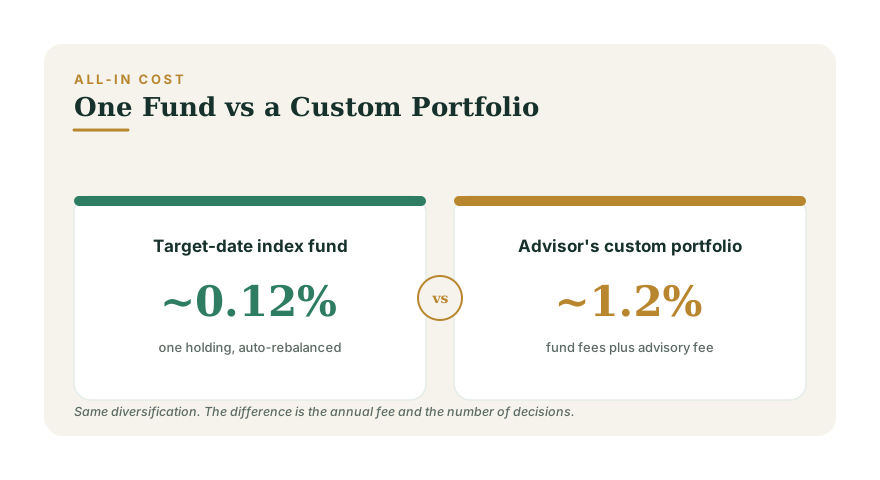
There is a quiet status game in investing where a "custom, personalized portfolio built around your unique situation" sounds obviously better than buying one boring fund off the shelf. For the vast majority of savers, it is not better. It is the same diversification, dressed up, sold back to you at roughly ten times the price.
The honest truth: most people do not need a bespoke portfolio
A target-date fund is a single fund holding a globally diversified mix of stock and bond index funds, set to your approximate retirement year. It does three things on autopilot that an advisor would otherwise charge you to do by hand:
- Diversification. Thousands of US and international stocks plus bonds, in one ticker.
- Glide path. It automatically shifts from mostly stocks when you are young toward more bonds as you near retirement, so you do not have to remember to de-risk.
- Rebalancing. It quietly trims winners and tops up losers to hold your target mix, without you logging in or paying a transaction fee.
That is the entire job of a standard portfolio. A target-date index fund does it for one decision, made once.
Follow the money
If the target-date fund does the job, why do so many advisors steer you into a custom mix of ten or fifteen funds? Because a single, cheap, self-managing fund is very hard to bill against. A custom portfolio justifies an ongoing advisory fee, usually around 1% of your assets every year, by making the work look complicated and ongoing. Frequent "tactical adjustments" and "tax-aware tilts" create the appearance of active management, which makes the fee feel earned. Often the underlying funds also carry higher expense ratios than a plain index, and sometimes they pay the advisor's firm. The complexity is not a bug. It is the product, because complexity is what you can charge for.
The math
Suppose you have 250,000 dollars and both options earn the same 7% gross return for 25 years.
- Target-date index fund at 0.12% all-in: net return about 6.88%. After 25 years, roughly 1,300,000 dollars.
- Custom portfolio at 1.2% all-in (0.4% fund fees plus a 0.8% advisory fee, or commonly a full 1% advisory fee on top): net return about 5.8%. After 25 years, roughly 1,015,000 dollars.
That is a difference of nearly 285,000 dollars, and the custom portfolio did not take less risk or deliver more diversification to earn it. The extra 1-plus percent a year is almost pure cost. For that gap to be worth paying, the advisor would have to beat the market by more than a full percentage point every year, after their own fee, which the long-run evidence says is extraordinarily rare.
It is worth being honest about what the custom portfolio usually is under the hood. Crack open most "personalized" portfolios and you find a handful of the same broad index and bond funds you could have bought yourself, sliced into more pieces. The slicing creates the impression of careful engineering, but the underlying exposure is nearly identical to a single target-date fund. You are not paying for a different engine. You are paying for a custom paint job and a quarterly report that makes the fee feel justified.
When a custom portfolio is actually justified
This is not "custom is always wrong." There are real situations where a tailored, often taxable-account, approach earns its keep:
- Tax management in a large taxable account. Target-date funds can throw off capital-gains distributions you did not choose, which is fine in a 401(k) or IRA but messy in a taxable account. A custom mix of individual index funds can be more tax-efficient and allow tax-loss harvesting.
- A concentrated position. If a big chunk of your net worth sits in one stock (say, employer equity), you may need a deliberate plan to diversify out of it over time without a huge tax hit.
- Genuinely complex situations. Multiple income sources, a business sale, estate-planning needs, or cross-border taxes can warrant real, fee-justified advice.
Notice these are mostly tax and life-complexity problems, not "the advisor will pick better funds" problems.
How to decide
- Add up your portfolio's all-in annual cost: fund expense ratios plus any advisory or wrap fee. Write down one number.
- Compare it to a target-date index fund at roughly 0.08% to 0.15%.
- If your money is mostly in retirement accounts and your situation is straightforward, the target-date fund almost certainly wins.
- If you have a large taxable account, a concentrated stock position, or genuine tax complexity, a custom approach (or a flat-fee, fee-only advisor) may be worth it. Pay for the tax work, not for fund picking.
- Never pay an ongoing percentage-of-assets fee just to be put into a portfolio a single fund could replicate.
The honest recommendation
If you want a fully diversified, automatically managed portfolio and you do not have unusual tax complexity, a low-cost target-date index fund is one of the best decisions in all of personal finance: one holding, one choice, set it and largely forget it, at around a tenth of the cost of the typical advised portfolio. Choose the one closest to your expected retirement year and let the glide path and rebalancing do the work.
Start by calculating your current all-in cost, then compare it head to head against a target-date fund using the wealth simulator. If you want a sanity check on whether your situation is genuinely complex enough to need a custom build, map it out in your plan and review your scores first. Simple usually wins, and here it usually wins by a lot.