When you get pre-approved for a mortgage, the bank hands you a number that feels official: this is how much house you can buy. It is worth understanding what that number actually represents. It is the maximum a lender is willing to risk on you, calculated to keep their default rate low — not a budget designed to keep your life comfortable. The two are rarely the same, and treating the bank's ceiling as your target is how new homeowners end up "house poor."
A better question than "how much will they lend me?" is "how much monthly payment can I carry without crowding out everything else I care about?" Here is how to answer it.
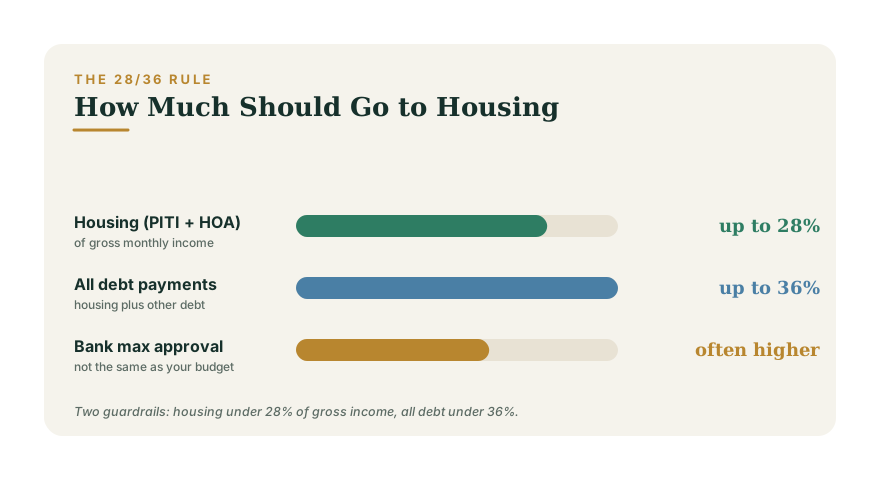
The 28/36 rule, explained
The classic affordability guideline has two parts. The front-end ratio says your total monthly housing cost should stay at or below 28% of your gross (pre-tax) monthly income. The back-end ratio says all of your monthly debt payments combined — housing plus car loans, student loans, credit-card minimums, and the like — should stay at or below 36% of gross income.
If you earn $7,000 a month before taxes, the 28% front-end limit is about $1,960 for housing, and the 36% back-end limit is about $2,520 for all debt combined. If you already pay $400 a month on a car and student loans, your housing budget under the back-end rule shrinks to roughly $2,120 — and the lower of the two limits is the one that governs.
"Housing cost" means more than the mortgage
The single biggest mistake buyers make is comparing a rent payment to a bare mortgage principal-and-interest figure. The real number is PITI: Principal, Interest, property Taxes, and homeowners Insurance. Lenders escrow taxes and insurance into your monthly payment, so they are part of what you owe every month whether you think about them or not.
On top of PITI, add HOA or condo dues if the property has them, and private mortgage insurance (PMI) if you put down less than 20%. A $2,000 principal-and-interest payment can easily become a $2,600 all-in monthly obligation once taxes, insurance, HOA, and PMI are stacked on. Those add-ons are exactly the costs covered in the true cost of owning a home beyond the mortgage — and PMI specifically is covered in PMI explained, and how to drop it.
Why the bank's maximum is not your budget
Lenders qualify you on gross income and known debts. They do not see your retirement savings rate, your childcare costs, your travel habits, the repairs an older home will need, or how much margin you want against a job loss. A payment that fits the 36% rule on paper can still leave you with nothing left to invest or absorb a surprise.
Many financially healthy buyers deliberately aim below the limits — closer to 25% of gross income on housing — to protect their ability to keep funding retirement and an emergency fund. The lower your housing percentage, the more resilient your finances are when something goes wrong.
Don't forget the down payment and closing costs
Affordability is not only a monthly question. You also need cash up front for the down payment and for closing costs, which typically run 2% to 5% of the loan. Draining every dollar of savings to maximize the down payment, then moving in with no cushion, is a recipe for stress the first time the water heater fails. Keep a real emergency reserve after closing, not before.
Run your own numbers
Start from your take-home pay and your goals, not the lender's ceiling. Decide what monthly housing payment still leaves room for saving, then work backward to a price range. The Home Affordability Calculator applies the 28/36 framework with taxes, insurance, and HOA built in, and the Buy vs Rent Calculator helps you sanity-check whether buying beats renting in your situation at all. If you are early in the process, the Mortgage Readiness assessment shows where your finances stand before you talk to a lender. Decide your number first; let the bank confirm it, not set it.