If you buy a home with less than 20% down on a conventional loan, you will almost certainly pay for private mortgage insurance, or PMI. It is one of the most misunderstood line items in homeownership, partly because it protects someone other than the person paying for it.
PMI does not protect you. It protects the lender if you default. You pay the premium; they get the coverage. That sounds unfair, but it serves a purpose: it lets you buy a home years earlier than you could if you had to save a full 20% down. The key is understanding what it costs and, just as important, how to make it go away.
Why PMI Exists
Lenders consider a borrower with little equity riskier, because if home values dip and the borrower defaults early, the lender can lose money on the sale. The 20% equity cushion absorbs that risk. When you put down less, PMI fills the gap. In exchange, you get access to homeownership without a six-figure down payment. For many buyers that trade is worth it, but only if you treat PMI as temporary.
What It Costs
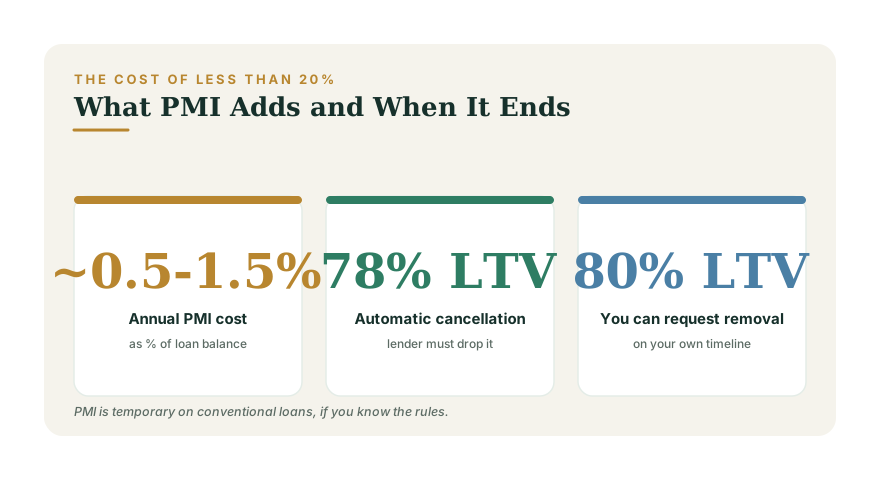
PMI typically runs somewhere around 0.5% to 1.5% of the loan balance per year, paid monthly. On a $320,000 loan, that is roughly $1,600 to $4,800 a year, or about $130 to $400 a month. The exact rate depends on your down payment size and credit score; a bigger down payment and stronger credit both lower it. Over several years that adds up to real money, which is why getting rid of it matters.
How to Cancel PMI on a Conventional Loan
The good news about conventional PMI is that it is designed to end. There are three paths:
- Automatic termination. By law, your lender must automatically cancel PMI once your loan balance reaches 78% of the home's original value, as long as you are current on payments. This happens on its own based on your amortization schedule.
- Borrower-requested cancellation. You do not have to wait for 78%. Once you reach 80% loan-to-value, you can formally request cancellation. The earlier you reach it, the more you save.
- Cancellation based on appreciation. If your home's value has risen, you may hit 80% equity faster than scheduled. You can request removal based on a current appraisal, though lenders set their own seasoning and documentation rules for this.
To speed things up, you can make extra principal payments to reach the threshold sooner, or, if your area has appreciated, pay for an appraisal and request removal. Just confirm your lender's exact requirements first.
Lender-Paid PMI
Some loans offer lender-paid PMI, where instead of a separate monthly premium, the cost is baked into a slightly higher interest rate. The monthly payment can look lower, but there is a catch: a higher rate lasts the life of the loan, while borrower-paid PMI can be canceled. Lender-paid PMI mainly makes sense if you expect to refinance or move before you would have hit 80% equity anyway. Otherwise, the cancelable version usually wins over time.
FHA Loans Play by Different Rules
This is where many buyers get tripped up. Government-backed FHA loans do not carry PMI; they carry a mortgage insurance premium, or MIP, and it works differently:
- FHA charges both an upfront premium at closing and an annual premium paid monthly.
- Crucially, for most FHA loans made with a low down payment, MIP lasts the life of the loan. It does not automatically fall off at 78% the way conventional PMI does.
- The usual way to escape FHA MIP is to refinance into a conventional loan once you have at least 20% equity.
This difference matters enormously. An FHA loan can be easier to qualify for, but its insurance can stick around for decades. If your credit and finances let you choose between FHA and conventional, factor in the very different exit path for the insurance.
The Bottom Line
- PMI lets you buy sooner; treat it as a temporary cost, not a permanent one.
- On conventional loans, request cancellation at 80% LTV rather than waiting for automatic removal at 78%.
- Track your equity, and watch for appreciation that gets you there faster.
- Understand that FHA MIP often lasts the life of the loan and may require a refinance to escape.
Mortgage insurance is not a reason to avoid buying with less than 20% down. It is a cost to manage deliberately. Run the numbers on how quickly you would reach 80% equity, and see how the savings fit your goals, using our wealth simulator.