You saved for the down payment. You budgeted for the monthly mortgage. Then, days before closing, you got a Closing Disclosure with a final cash-to-close number thousands of dollars higher than you expected. That gap is closing costs, and they surprise buyers every day.
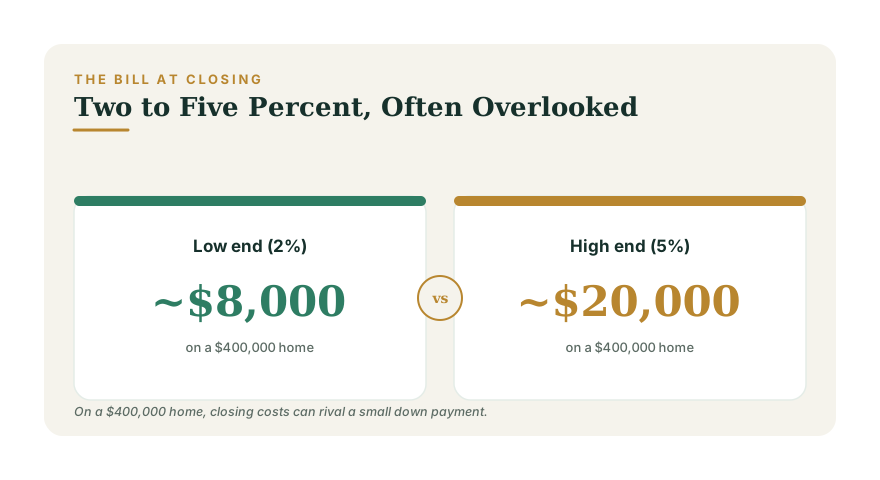
Closing costs typically run roughly 2% to 5% of the purchase price. On a $400,000 home, that is somewhere between about $8,000 and $20,000 on top of your down payment. Knowing what is inside that number lets you plan for it and, in many cases, reduce it.
The Lender's Fees
These come from your mortgage company for creating the loan.
- Origination charge. The lender's fee for processing and underwriting your loan, often a percentage of the loan amount.
- Discount points. Optional. Each point costs about 1% of the loan and buys a slightly lower interest rate. Worth it only if you keep the loan long enough to recover the upfront cost.
- Application, underwriting, and processing fees, which may be bundled into the origination charge or listed separately.
Third-Party Service Fees
These pay outside parties the lender requires.
- Appraisal. A few hundred dollars to confirm the home's value.
- Title search and title insurance. The search confirms the seller can legally sell; title insurance protects against ownership claims surfacing later. There is a lender's policy you usually must buy, and an optional owner's policy that is generally worth it.
- Credit report, flood certification, and similar small fees.
Prepaids and Escrow
This category confuses people because it is not really a "fee," it is money you would owe anyway, collected early.
- Prepaid interest covering the days between closing and your first payment.
- Property tax and homeowners insurance reserves deposited into an escrow account so the lender can pay those bills on your behalf when they come due.
- Your first year of homeowners insurance, often paid at closing.
Because escrow reserves depend on timing and local tax due dates, this is where the total can swing by thousands.
Government and Recording Fees
Recording fees pay the local government to register the new deed and mortgage in public records. Many areas also charge transfer taxes when a property changes hands, which can be a notable amount in high-tax jurisdictions. Who pays the transfer tax, buyer or seller, varies by region and is sometimes negotiable.
Who Pays What
Buyers carry most of the loan-related and prepaid costs. Sellers typically pay the real estate commissions and, in many areas, a share of transfer taxes. But almost everything is negotiable. In a buyer's market, you can ask the seller for seller concessions, a credit toward your closing costs in exchange for, say, a slightly higher price. This is one of the most underused tools first-time buyers have.
How to Reduce Your Closing Costs
- Shop your loan. Lender fees vary widely. Get loan estimates from at least three lenders and compare the itemized costs, not just the rate.
- Negotiate seller concessions, especially when the home has sat on the market.
- Compare title and settlement providers. You often have the right to choose some of these services rather than accepting the lender's default.
- Ask about lender credits, where you accept a marginally higher rate in exchange for the lender covering some costs. This is the reverse of paying points and can make sense if you plan to refinance or move within a few years.
- Close near the end of the month to reduce prepaid interest, a small but easy saving.
Read the Closing Disclosure Carefully
By law you receive your Closing Disclosure at least three business days before closing. Use that window. Compare every line to your original loan estimate. Fees in certain categories are not supposed to change much; if they have, ask why. Errors are common, and the time to catch them is before you sign, not after.
Closing costs are not a scam or a hidden trap, they are real services with real prices. They only hurt when they are a surprise. Budget 2% to 5% from the start, and see how that cash outlay fits your bigger picture using our tools before you make an offer.