A fixed-rate mortgage has a quietly clever design: you pay the exact same amount every month for the whole loan, yet what that payment is doing changes constantly behind the scenes. Understanding that mechanism — called amortization — explains why your balance barely moves at first, and why an extra payment early on is worth so much.
Every payment has two jobs
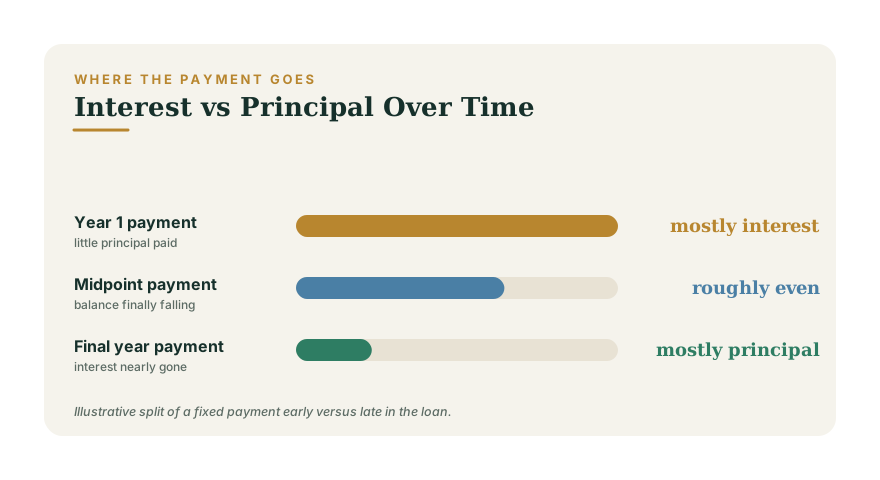
Each monthly payment is split into two parts: interest, the rent you pay the lender for borrowing, and principal, the part that actually reduces what you owe. Interest is calculated on your current balance. So in the first month, interest is charged on the entire loan amount — which is enormous — leaving only a sliver of your payment to chip away at principal.
As the balance shrinks, the interest charged on it shrinks too. Because the total payment stays fixed, every dollar of interest that disappears gets reassigned to principal. Month by month, the principal portion grows and the interest portion falls. This is amortization: the same payment, slowly tilting from mostly-interest to mostly-principal.
Why early payments are mostly interest
On a typical 30-year loan, it can take more than a decade before half of your monthly payment goes to principal. In the early years, you are mostly paying for the privilege of having borrowed, and the balance crawls down. This is not a trick — it is simple arithmetic of charging interest on a large balance — but it surprises new homeowners who expected to "own more" faster. It is the mirror image of compound interest: when you are the borrower, time works against you instead of for you.
What an amortization schedule shows you
An amortization schedule is a row-by-row table for the life of the loan, listing each payment's interest, principal, and remaining balance. It is worth looking at once, because it makes two things vivid: how slowly the balance falls early on, and how much total interest you pay over 30 years — often a sum approaching the home's price itself. Seeing that total is also what motivates many people to choose a shorter term or a larger down payment.
What an extra payment actually does
Here is where amortization becomes useful. When you pay extra and tell the lender to apply it to principal, you skip ahead on the schedule. That dollar permanently removes itself from the balance, so it never accrues interest again for the rest of the loan. An extra payment in year two erases far more future interest than the same payment in year twenty, because it has more years left to compound against.
- Extra principal early shortens the loan and can save a large amount of total interest.
- The effect shrinks the later you do it, since less interest remains to avoid.
- Always confirm the extra is applied to principal, not held as a prepaid future payment.
But "pay it off fast" is not always the best move
The interest savings are real, yet they are not the whole picture. That money could instead capture an employer match, build an emergency fund, or be invested for a potentially higher return. Whether prepaying beats investing depends on your interest rate and your other priorities — a genuinely close call that we break down in the case against rushing to pay off your mortgage and in paying off debt vs investing. The choice of loan type and term shapes this too.
See it on your own numbers
The fastest way to make this concrete is to model your actual loan. Plug in a balance, rate, and term and watch how a small extra payment reshapes the schedule using our planning tools at the planning hub, or estimate what you can comfortably borrow first with the Home Affordability Calculator. Once you can see the interest you are avoiding, the math stops being abstract and starts guiding real decisions.