Paying off your mortgage early feels unambiguously responsible. No debt, no monthly payment, full ownership of your home. It is one of the most emotionally satisfying things you can do with money. But satisfaction and optimization are not the same thing, and if your mortgage rate is low, throwing extra money at it can quietly cost you a large amount of long-term wealth and leave you dangerously short on cash you might need.
The honest truth: prepaying is an investment with a known return
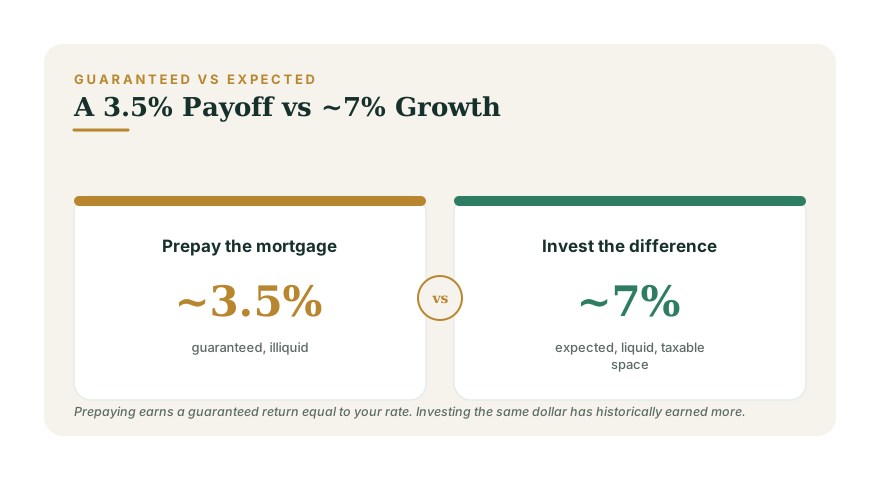
Every extra dollar you put toward your mortgage principal earns you a guaranteed return exactly equal to your interest rate. Prepay a 3.5% mortgage and you have effectively earned a risk-free 3.5%, because that is the interest you no longer have to pay. That is a real, certain return, and certainty has value. The question is whether 3.5% is the best you can do with that dollar, and historically the answer for long time horizons has been no.
Follow the math
Suppose you have a 300,000 dollar mortgage at 3.5% and 1,000 dollars a month you could either use to prepay or to invest. Prepaying gives you a guaranteed 3.5%. Investing that 1,000 dollars a month in a low-cost, diversified index fund has historically returned something closer to 7% a year over long stretches, after inflation it is lower, but we are comparing to a nominal mortgage rate so the nominal comparison is fair.
Run 1,000 dollars a month for 20 years. At a 3.5% guaranteed return from prepaying, you would save roughly 60,000 to 70,000 dollars in interest, a great outcome. But invest that same 1,000 dollars a month at 7% for 20 years and it grows to roughly 520,000 dollars, of which about 280,000 dollars is growth on top of your contributions. Even after subtracting the mortgage interest you chose not to eliminate, the investing path comes out well ahead over a long horizon. The wider the gap between your mortgage rate and expected returns, the bigger the cost of prepaying.
There is a second, hidden cost: lost tax-advantaged space. Every year you have contribution room in a 401(k), IRA, or HSA that you cannot get back once the year passes. A dollar you bury in your mortgage is a dollar you did not shelter from taxes, and the tax-free or tax-deferred growth you forfeited compounds for decades. Filling those accounts first is almost always a better use of spare cash than prepaying a cheap mortgage.
Follow the liquidity
Here is the danger the spreadsheet barely captures. Money in an index fund can be sold in two days if you lose your job, face a medical bill, or hit an emergency. Money you have poured into your home equity is locked up. You cannot pay the grocery bill with a paid-down mortgage. To get that equity back out, you have to sell the house or qualify for a loan, and banks are least willing to lend exactly when you need it most. Prepaying converts flexible, accessible cash into illiquid equity, which makes you feel richer while leaving you more fragile.
The emotional case is valid too
None of this means prepaying is wrong. The peace of mind from a paid-off home is real, and for many people it is worth giving up some expected return. If carrying a mortgage keeps you up at night, the guaranteed emotional payoff of being debt-free can outweigh the theoretical investment edge. Money decisions are not only math decisions. The point is to make the choice on purpose, knowing what you are trading, rather than assuming prepaying is automatically the responsible move.
A decision framework
- Compare the two returns directly. Your mortgage rate is your guaranteed return from prepaying. If it is well below what you reasonably expect from diversified investing, investing usually wins over a long horizon.
- Fill tax-advantaged accounts first. Capture any 401(k) match, then max out IRAs and HSAs before sending extra dollars to a cheap mortgage. That space does not come back.
- Protect your liquidity. Keep a solid emergency fund and accessible savings. Do not turn cash you might need into equity you cannot reach.
- Higher rate changes the answer. If your mortgage is at 6.5% or 7%, prepaying becomes much more attractive, because the guaranteed return now rivals or beats expected investment returns. The whole calculus depends on the rate.
- Weigh the emotional value honestly. If debt-free peace of mind genuinely matters to you, it is a legitimate reason to prepay even when the math leans the other way. Just price it consciously.
The honest recommendation
If your mortgage rate is low, do not reflexively prepay. First capture every tax-advantaged dollar and keep generous liquidity, then compare the guaranteed return of prepaying against the expected return of investing. For a sub-4% mortgage and a long time horizon, investing the difference has usually built more wealth and kept you more flexible. For a high-rate mortgage, prepaying makes far more sense. And if the certainty of owning your home outright is what lets you sleep, that is a perfectly good reason to choose it anyway.
Before you send the bank an extra dollar, model both paths. Compare the guaranteed return of prepaying against investing the same amount in the wealth simulator, check how it fits the rest of your goals in your plan, and read more on compounding and getting started in our articles. The right answer is the one you choose with your eyes open.