When people say "getting a mortgage," they are really choosing among a handful of distinct loan programs, each with its own rules for down payment, credit, and who qualifies. Picking the right one can change your monthly payment, the cash you need up front, and even whether you qualify at all. Here is a plain-English tour of the five main types.
Conventional loans: the default
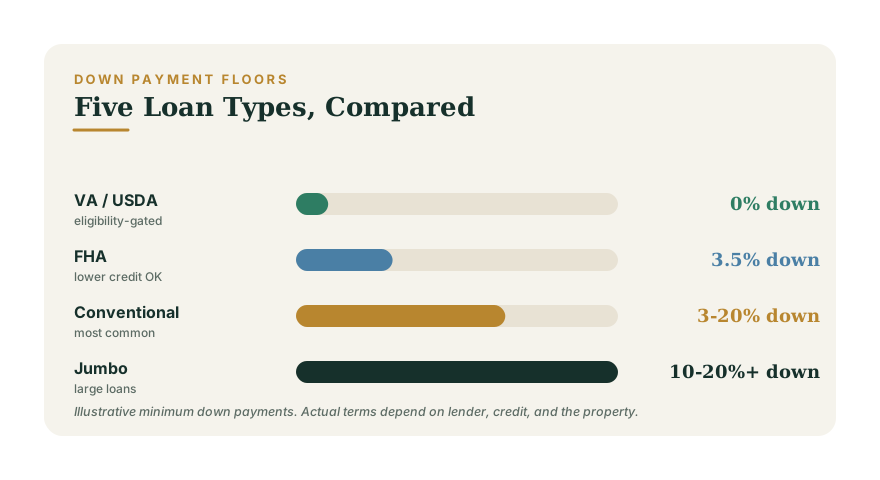
A conventional loan is any mortgage not backed by a government program. It is the most common type and the benchmark everything else is measured against. Conventional loans that meet limits set each year by Fannie Mae and Freddie Mac are called conforming, which generally means better rates. You can sometimes put as little as 3% down, though anything under 20% triggers private mortgage insurance (PMI) — an extra monthly cost you can later cancel. Lenders typically want a solid credit score and a manageable debt load. If your finances are reasonably strong, this is usually the cleanest path.
FHA loans: built for lighter credit and smaller down payments
An FHA loan is insured by the Federal Housing Administration and designed to make buying accessible to people with lower credit scores or limited savings. You can often qualify with a credit score well below what conventional loans require, and the minimum down payment is around 3.5%. The trade-off is mortgage insurance: FHA loans carry both an upfront and an ongoing insurance premium, and on most FHA loans that monthly premium does not fall off the way conventional PMI does — many borrowers eventually refinance into a conventional loan to shed it. FHA is a strong on-ramp, not always the long-term home.
VA and USDA loans: zero down, but gated
Two programs can let qualified borrowers buy with no down payment:
- VA loans are for eligible veterans, active-duty service members, and certain surviving spouses. They offer no down payment, no monthly mortgage insurance, and competitive rates — one of the best deals in lending. There is a one-time funding fee, which some borrowers are exempt from.
- USDA loans support buyers in eligible rural and many suburban areas, subject to income limits. They also allow zero down and tend to carry lower fees than FHA.
Both are excellent if you qualify, but eligibility — not your finances — is the gate.
Jumbo loans: when the price tag is large
A jumbo loan is one that exceeds the conforming limit, used for higher-priced homes. Because they cannot be sold to Fannie or Freddie, lenders take on more risk and ask for more: stronger credit, larger down payments (often 10-20% or more), bigger cash reserves, and tighter documentation. Rates are not always higher, but the approval bar is. If you are shopping above your area's conforming limit, expect a more demanding process.
Fixed vs adjustable applies to all of them
Separate from the program is the question of how your rate behaves over time. A fixed-rate loan locks your interest rate for the life of the loan; an adjustable-rate mortgage (ARM) starts lower but can change later. That choice cuts across every type above, and it is worth understanding before you commit — see Fixed vs Adjustable-Rate Mortgages.
How to choose the one that fits
Start from your constraints. Limited savings or a thinner credit file points toward FHA. Military service opens the VA door. A rural target and modest income may make USDA the cheapest option. Strong credit and a meaningful down payment favor conventional, which keeps insurance costs lowest and most flexible. A high purchase price pushes you into jumbo territory and a stricter file. Many buyers qualify for more than one and should compare the all-in cost — not just the rate.
Before you fall in love with a house, get clear on what you can comfortably borrow and which program fits. Run the numbers with our Home Affordability Calculator, then map out the rest of the journey in the first-time homebuyer roadmap. The right loan type is the first lever; everything else builds on it.