A green card is a milestone worth celebrating, but it carries a financial consequence many new residents do not fully grasp: from the moment you become a US tax resident, the United States taxes your worldwide income. Not just your US salary — your foreign rental income, your home-country interest, your overseas investment gains, all of it. Planning around this shift, ideally before it happens, can save you from expensive surprises.
This article connects the dots between residency, foreign investments, and the rules that catch immigrants off guard. We touch the same themes as our deeper pieces on the PFIC tax trap and the returning to India financial guide, so use this as the map and those as the detail.
When Do You Become a Tax Resident?
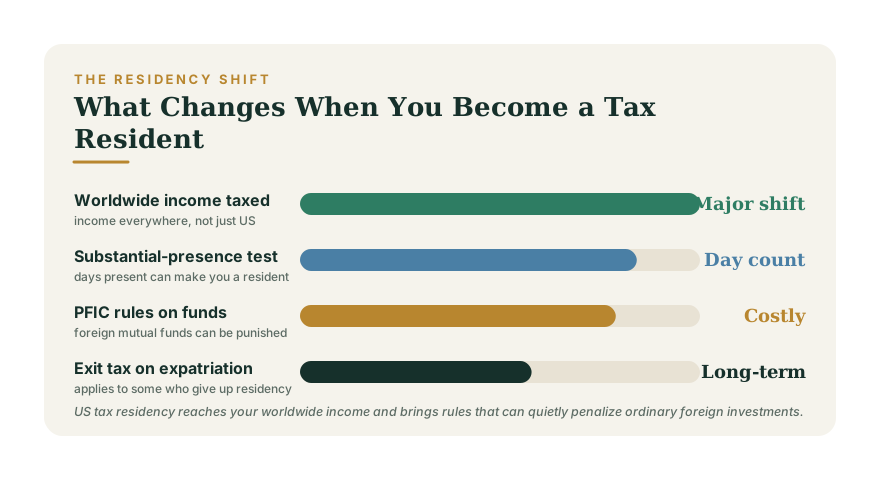
There are two main ways. The first is the green card test: holding a green card generally makes you a US tax resident, even if you spend time abroad. The second is the substantial-presence test, a day-counting formula that can make even visa holders tax residents based on how many days they spend in the US over a three-year window. You can be a tax resident without being a citizen or permanent resident, which surprises many people.
Worldwide Income, Worldwide Reporting
Once you are a resident, you report income from everywhere on your US return, and you take on the foreign account reporting we cover in our FBAR and FATCA guide. Tax treaties and the foreign tax credit can prevent you from being fully taxed twice on the same income, but they do not erase the reporting obligations. Coordinating your home-country and US filings becomes an annual habit.
The PFIC Pitfall on Foreign Funds
Here is the trap that catches the most immigrants. Many ordinary foreign investments — non-US mutual funds, certain ETFs, some insurance-linked savings products — are classified as Passive Foreign Investment Companies, or PFICs, under US law. PFICs face punitive tax treatment and burdensome reporting that can wipe out much of their value to a US taxpayer. A perfectly sensible mutual fund in your home country can become a tax headache the day you become a US resident.
- Review foreign funds early. You may be better off restructuring before you become a resident.
- Favor US-domiciled investments for new money once you are resident.
- Do not assume a "retirement" label protects you — treatment varies by country and account type.
The Exit Tax Concept
The rules also work on the way out. Long-term green card holders (broadly, those who have held a green card for a number of years) and citizens who give up their status can be treated as "covered expatriates" and face an exit tax — essentially a tax as if they sold their worldwide assets the day before leaving. Not everyone is affected; it depends on net worth, average tax liability, and compliance history. But if you might someday leave the US permanently, the length of time you hold a green card matters, and this is worth understanding well in advance.
Coordinating Your Accounts
Practical planning around residency usually includes a few moves:
- Inventory every account and asset in every country before residency begins.
- Simplify foreign holdings that would become PFICs or reporting burdens.
- Keep clean records of cost basis and balances across currencies.
- Decide intentionally whether to keep, close, or restructure home-country investments.
Get Help Where the Stakes Are High
Cross-border tax law is genuinely complicated, and the penalties for getting it wrong are real. Treat the big decisions — pre-residency planning, PFIC restructuring, and any thought of expatriation — as a job for a qualified cross-border tax professional, not a do-it-yourself project. Use this guide to know what questions to ask, then start mapping your own situation with our free tools.