The moment you drive for a rideshare app, deliver groceries, or take on freelance clients, the tax system stops treating you like an employee and starts treating you like a small business. Nobody withholds taxes from your pay, nobody sends them in for you, and at tax time the bill can be a genuine shock. The work is simpler than it looks once you understand three things: how 1099 income differs from a W-2, what self-employment tax is, and which deductions are quietly waiting to lower your bill.
1099 income vs a W-2 paycheck
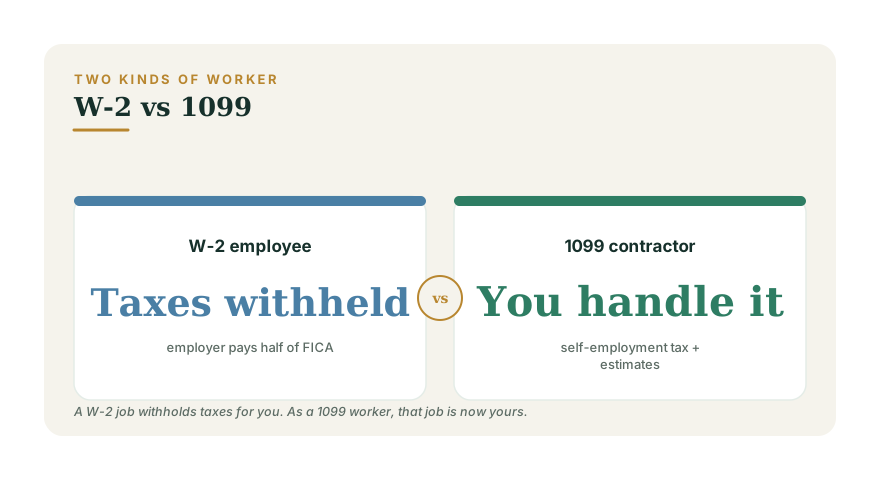
On a W-2 job, your employer withholds federal and state income tax plus your share of Social Security and Medicare from every check, and sends it in for you. As a gig worker, your platform or client pays you the full amount and reports it on a 1099 form (often a 1099-NEC or 1099-K). No tax is held back. That money looks great in your account, but a chunk of it already belongs to the IRS — you just have not paid it yet. If you want the mechanics of the form itself, see Understanding 1099 Forms.
One trap: you owe tax on your income even if a platform never sends you a form. The reporting thresholds change, but your legal obligation does not. Track every dollar you earn, not just the dollars that show up on a 1099.
Self-employment tax: the surprise that gets everyone
When you are an employee, you pay 7.65% of your wages toward Social Security and Medicare, and your employer quietly pays a matching 7.65%. When you work for yourself, you are both the employee and the employer, so you owe both halves — roughly 15.3% on your net self-employment earnings. This is on top of regular income tax.
That is why a freelancer who "earned" $40,000 can be startled to owe far more than a W-2 worker who made the same. The good news: you can deduct the employer half of that self-employment tax when figuring your income tax, and your taxable profit is income after expenses, not your gross deposits. Deductions matter more here than almost anywhere else.
Quarterly estimated taxes
Because nobody is withholding for you, the IRS expects you to pay as you earn — in four quarterly estimated installments rather than one lump at filing. Skip them and you can owe an underpayment penalty even if you pay in full in April. A simple system that works for most new gig workers: open a separate savings account and move a fixed percentage of every payment into it — many people set aside somewhere between a quarter and a third of each deposit — then pay your estimates from that bucket. The full mechanics, including the safe-harbor rules that protect you from penalties, are in Quarterly Estimated Taxes Explained.
The deductions gig workers miss
Your taxable income is profit, not revenue, so every legitimate business expense lowers what you owe. The ones people overlook:
- Mileage. For rideshare and delivery, this is usually the single largest deduction — the business miles you drive can be worth far more than receipts for gas. Tracking it properly is its own skill, covered in Tracking Business Expenses and Mileage for Taxes.
- Phone and data. The business-use portion of the phone plan you rely on for the app is deductible.
- Supplies. Delivery bags, a phone mount, car cleaning, hot bags, and similar gear used for the work.
- Platform and payment fees. The cut a marketplace or payment processor takes is a business expense.
- Home office. If you freelance from a dedicated space used only for work, a portion of rent and utilities may qualify.
- Health insurance and retirement. Self-employed people can often deduct their own health premiums, and contributions to a self-employed retirement plan lower taxable income too.
For a broader catalog, see Self-Employed Tax Deductions. Keep records as you go — reconstructing a year of expenses in April is miserable and shaky if audited.
Build the habit, then build the buffer
The whole game is converting a chaotic stream of payments into clean numbers: total income, total deductible expenses, the profit in between, and the tax set aside against it. Do that monthly and tax season becomes a non-event. Estimate what you will owe and pressure-test your set-aside rate with the Self-Employed Hub, and when you are ready to see how your whole tax picture looks, run the Tax Health assessment. Treat taxes as a recurring bill you pre-fund, and the April surprise disappears for good.