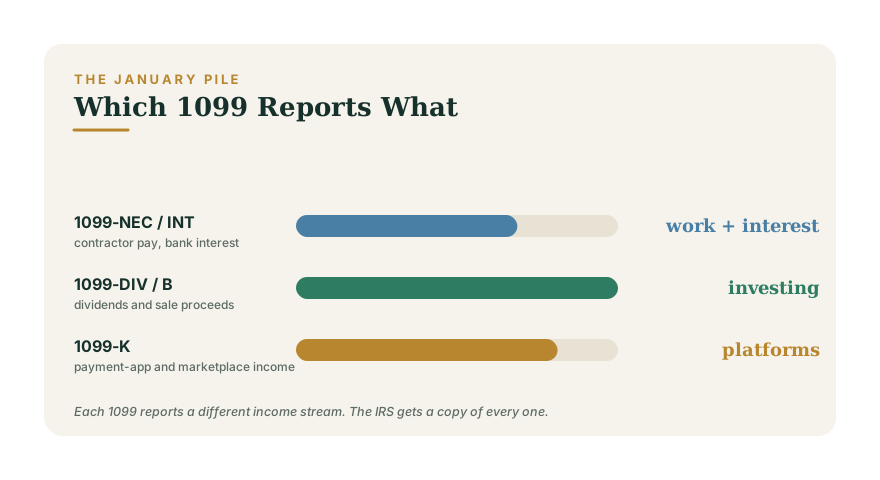
If a W-2 reports your salary from an employer, the 1099 family reports nearly every other kind of income you might receive — freelance pay, bank interest, investment dividends, proceeds from selling stock, and money that flows through payment apps. Each variety has a letter suffix, and each lands on a different line of your tax return. The single most important thing to know: the IRS gets a copy of every 1099 you do, so leaving one off your return is a fast way to trigger a notice.
1099-NEC: nonemployee compensation
If you did freelance, contract, or gig work and earned $600 or more from a client, they send you a 1099-NEC reporting what they paid you. This is self-employment income: it flows onto Schedule C, and unlike a W-2, no taxes were withheld — you are responsible for income tax and self-employment tax yourself. That is why contractors often owe more than W-2 employees expect, and why quarterly estimated payments exist.
1099-INT: interest income
Banks, credit unions, and bond issuers send a 1099-INT for interest they paid you — from savings accounts, CDs, money-market accounts, and bonds. Interest is taxed as ordinary income at your regular bracket. With higher savings rates in recent years, plenty of people are surprised to receive one of these for the first time.
1099-DIV: dividends and distributions
If you own stocks or funds in a taxable brokerage account, you get a 1099-DIV reporting dividends and capital-gains distributions paid out during the year. It separates qualified dividends (taxed at the lower long-term capital-gains rates) from ordinary dividends (taxed at regular rates) — a distinction that matters, as explained in Capital Gains vs Ordinary Income Tax. Note: dividends inside a 401(k), IRA, or Roth do not generate a 1099-DIV, because nothing is taxed while it stays in those accounts.
1099-B: proceeds from selling investments
When you sell stocks, funds, or other securities in a taxable account, your broker sends a 1099-B listing the proceeds, your cost basis, and the resulting gain or loss for each sale. This is the form that drives your capital-gains tax. Modern brokers usually report your cost basis directly, which makes filing far easier — but always check it, because incorrect or missing basis is a common source of overpaying.
1099-K: payment apps and marketplaces
The 1099-K is the one causing the most confusion lately. Payment platforms and marketplaces — think gig apps, online sales platforms, and peer-to-peer payment services — issue it to report the total payments you received for goods and services. The reporting threshold has been changing, so more people are receiving these than ever.
The catch: a 1099-K reports gross flow, not taxable profit. Money from friends splitting dinner or reimbursing you is not income; selling a used couch at a loss is not taxable. The form does not know the difference, so you may need to reconcile it on your return rather than treating the whole number as income.
Matching them to your return
Because the IRS matches every 1099 against what you file, the goal is simple: account for all of them. A quick approach:
- Gather every 1099 before you file — many arrive late, and brokers sometimes issue corrected versions in February or March.
- Map each to its place: NEC to Schedule C, INT and DIV to Schedule B, B to Schedule D, K reconciled against your actual income.
- If a form is wrong, contact the issuer for a correction rather than guessing.
- If you never received an expected 1099, you still owe the tax — the income is reportable whether or not the paper arrives.
Leaving one out is among the most common tax-filing mistakes, and it is entirely avoidable.
Stay ahead of the pile
The forms are easier when you are not seeing them for the first time at the deadline. Keep a running folder as they arrive, and if you have freelance or investment income, set money aside through the year. Get a read on whether your withholding and estimates are on track with the Tax Health assessment, and if you are self-employed, the Self-Employed Hub walks through what each form means for you.