The single most common freelance mistake is taking your old salary, dividing it by 2,080 working hours, and using that as your hourly rate. It feels logical and it is badly wrong, because a salary came bundled with things an employer paid for that you must now cover yourself: half your payroll taxes, health insurance, retirement contributions, paid time off, and every hour you spend on work that nobody pays you for. Price like an employee and you will work harder than you ever did and somehow end up with less. Here is how to set a rate that actually leaves you better off.
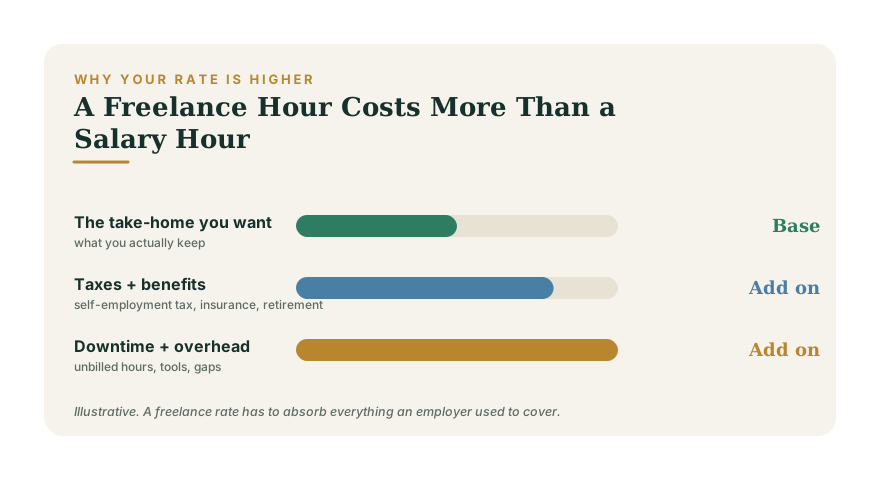
Start from what you need to keep, then build up
Work backward from the take-home income you actually want, then layer on everything that has to come out before you reach it:
- Self-employment tax. You now owe both halves of Social Security and Medicare — roughly 15.3% of profit — plus income tax. Your rate has to fund that before you see a dollar. The full picture is in The Gig Worker's Tax Guide.
- Benefits you now buy yourself. Health insurance, disability coverage, and retirement contributions were partly or fully an employer's job; now they are a line item in your rate. See Retirement Savings for Gig and Contract Workers for the retirement piece.
- Overhead. Software subscriptions, equipment, a coworking space, accounting, professional insurance — the cost of being in business.
The hours you can actually bill
This is the number freelancers forget, and it is the most important one. A year has roughly 2,080 working hours on paper, but you cannot bill all of them. You will spend large chunks on unbillable work — finding clients, sending proposals, invoicing, email, admin — plus vacation, sick days, holidays, and dry spells between projects. Realistically, many freelancers bill only half to two-thirds of their available hours.
That changes the math completely. If you want to earn the equivalent of a salary but can only bill, say, 1,000 hours, your rate per billable hour must be roughly double the naive salary-divided-by-2,080 figure — and that is before adding taxes, benefits, and overhead. Skip this step and you have priced yourself into working full time for part-time pay.
Hourly vs project pricing
Once you have a true hourly cost, you can decide how to present it:
- Hourly is transparent and fair for open-ended or unpredictable work, but it caps your income at your hours and quietly penalizes you for getting faster and better.
- Project (fixed) pricing ties your fee to the value you deliver rather than the time you spend. It rewards efficiency, gives the client a known total, and is usually more profitable for well-defined work — as long as you scope it carefully and charge change fees for scope creep.
Many experienced freelancers quote projects but calculate the price using their hourly cost as a floor, so they never accept work below what their time is worth. Either way, your true hourly cost is the foundation underneath the number you say out loud.
Raising rates over time
Your first rate should not be your forever rate. Costs rise, your skills compound, and a rate set as a nervous beginner will feel painfully low in two years. A few principles:
- Raise rates for new clients first. Quote higher to every new prospect; it is the lowest-friction way to lift your average.
- Give existing clients notice. A simple, professional heads-up that rates will increase on a future date is standard and expected. Good clients rarely leave over a reasonable bump.
- Let demand be your signal. If you are fully booked and turning work away, you are underpriced. Raise until you occasionally hear "no" — that is the market telling you that you found the ceiling.
- Re-price as you specialize. Niche expertise commands more than generalist hours; as you narrow, your rate should climb.
Tie it back to the cash flow
A good rate is only half the job; the income still arrives unevenly, so the other half is managing the lumpiness. Set your rate from real costs, save aggressively in strong months, and smooth the rest — the system for that is in Budgeting on an Irregular Income. To pressure-test whether your rate actually covers taxes, benefits, and downtime, run the numbers through the Self-Employed Hub and check your overall footing with the Financial Wellness Score. Price for the whole cost of being your own employer, and freelancing pays what it should.