Your 30s are the decade where goals stop arriving one at a time and start competing. You may be saving for a house, thinking about kids, trying to raise your retirement contributions, and paying down student loans — all in the same month. Income is usually rising too, which is good, but the pressure shifts from "how do I start?" to "how do I do everything at once without dropping a ball?"
The answer is not to fund every goal equally. It is to protect the foundation, sequence the rest, and raise your savings rate as your income grows.
Raise your savings rate as your income climbs
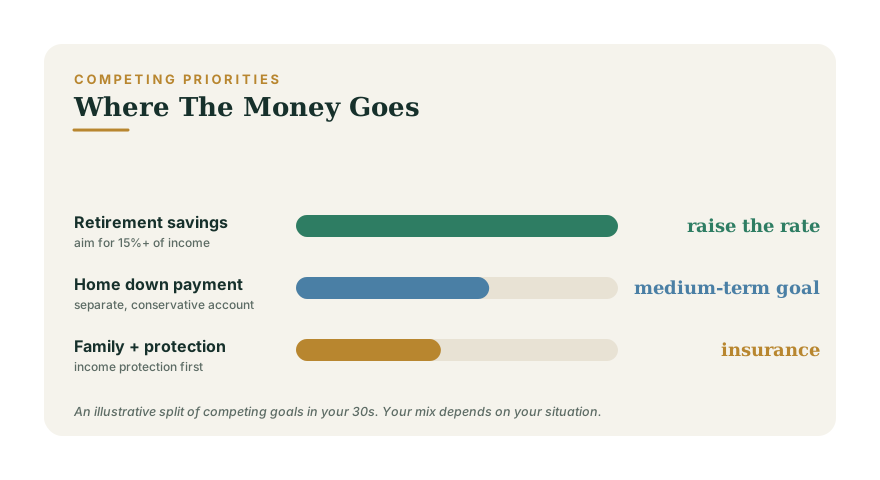
The biggest lever in your 30s is your savings rate — the percent of income you keep. A common target is to be saving around 15% of gross income toward retirement, including any employer match. If you are not there yet, close the gap gradually: every time you get a raise, send half of it to savings before your lifestyle absorbs it. Fighting lifestyle creep is what lets a rising income actually translate into wealth rather than just a fancier version of paycheck-to-paycheck. You can model how today's rate shapes your retirement with the Retirement Planner.
Protect your income — this is the decade it matters most
In your 30s, your ability to earn is almost certainly your largest asset, and other people may now depend on it. Two kinds of insurance deserve a hard look:
- Disability insurance replaces a chunk of your income if illness or injury stops you from working. It is the most overlooked coverage relative to how likely a long disability is during a working career. See Disability Insurance: The Coverage Most People Ignore.
- Term life insurance matters the moment anyone relies on your income — a partner, a child, a co-signed mortgage. Term is cheap, simple, and the right tool; avoid whole-life policies sold as investments.
The home question
Buying a home is a common 30s goal, but it is a medium-term one, so the down payment belongs in a separate, conservative account — not the stock market and not mixed in with your emergency fund. Before you stretch for a purchase, run the honest comparison. Renting is not "throwing money away," and an overpriced house with a big mortgage can crowd out retirement saving for years. Pressure-test the decision with Rent vs Buy: The Real Math and the Home Affordability calculator.
If kids enter the picture
Children reorder priorities fast. A few moves matter: add or increase life and disability coverage, name guardians and update beneficiaries, and decide how aggressively to save for college. One rule worth repeating — fund your retirement before your child's college. Your kid can borrow for school; you cannot borrow for retirement. A 529 plan is a fine vehicle once your own retirement is on track. The prep checklist lives in Preparing Your Finances for a Baby.
Sequence the goals instead of splitting yourself thin
When several goals compete, a sane order keeps you from stalling on all of them: keep a full emergency fund, capture the entire employer match, knock out any high-interest debt, then raise retirement savings toward your target, and only then layer on the down payment and college funds. Trying to half-fund six goals usually means none of them reach the finish line. The financial order of operations turns this into a clear sequence.
The mindset shift
Your 30s reward systems over willpower. Automate every goal into its own labeled account, review the plan when life changes, and resist the urge to chase hot investments to "catch up." Steady contributions to low-cost funds, plus protection against the big risks, is what carries you into your 40s ready to accelerate — the subject of Financial Planning in Your 40s. Map your competing goals in one place at the planning hub.