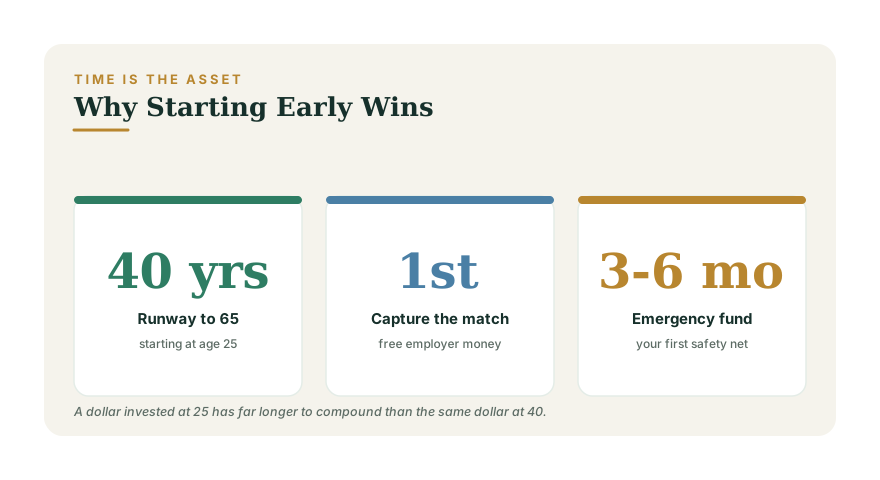
Your 20s rarely come with a big income, but they come with the one thing money cannot buy back: time. A modest amount invested now has decades to compound, which means the habits you build in this decade matter far more than the dollar amounts. The goal is not to get rich quickly; it is to set up a foundation that quietly works for the next forty years.
You do not need a complicated plan. You need a handful of things in the right order.
Build a budget you will actually follow
Everything else sits on top of knowing where your money goes. You do not need a spreadsheet that tracks every coffee — you need a simple framework that splits your take-home pay into needs, wants, and savings. A starting point like the 50/30/20 rule is plenty for most people in their 20s. The point is awareness, not perfection: once you can see the shape of your spending, you can redirect a slice of it toward goals. Walk through the mechanics in How to Build a Budget That Actually Works.
Set up credit on purpose
Credit is one of the few things that genuinely rewards starting early, because length of history is part of the score. Open a single no-annual-fee card, put a small recurring charge on it, and pay the statement in full every month. That alone builds a clean record. Never carry a balance to "build credit" — that is a myth that just hands the bank interest. A solid credit score in your 20s makes your first car loan, apartment, and eventually mortgage meaningfully cheaper.
Fund an emergency cushion before you invest aggressively
Before you pour money into the market, build a buffer of three to six months of essential expenses in a high-yield savings account. This is what keeps a surprise car repair or a job loss from turning into credit-card debt that undoes your progress. Start with a small $1,000 starter fund, then build it up over time. The full playbook is in the Emergency Fund Guide, and you can size yours with the Emergency Fund Calculator.
Start investing — time is doing most of the work
The single highest-value move in your 20s is to start investing early, even with small amounts. If your employer offers a 401(k) match, contribute at least enough to capture all of it — that is an instant, guaranteed return you cannot get anywhere else. Beyond the match, a Roth IRA is often ideal in this decade: you are likely in a low tax bracket now, so paying tax on contributions today and withdrawing tax-free later tends to work in your favor. Keep the investments boring — broad, low-cost index funds — and let compounding do the heavy lifting. See How to Start Investing to get the first account open.
Handle debt without drama
Not all debt is equal. High-interest debt — credit cards, payday loans — should be attacked aggressively, because no investment reliably beats a 20%-plus interest rate. Low-interest debt like federal student loans can usually be paid on schedule while you also invest. The mistake is either ignoring high-interest balances or obsessing over a 4% loan while skipping free 401(k) match money. If you carry balances, sort out the order using Should You Pay Off Debt or Invest?
Avoid the traps aimed at young people
Your 20s attract a lot of bad financial products: get-rich-quick trading apps, crypto pitches, whole-life insurance sold as an "investment," and lifestyle inflation that eats every raise. The defense is simple. Keep investing in low-cost diversified funds, skip anything promising fast or guaranteed high returns, and each time your income rises, send part of the increase to savings before it disappears into a nicer apartment or newer car.
Your 20s checklist
- Budget your take-home pay so saving happens on purpose.
- Open one credit card and pay it in full every month.
- Build a three-to-six-month emergency fund.
- Capture the full employer match, then fund a Roth IRA.
- Keep investments simple and low-cost; ignore the hype.
Do these few things and you enter your 30s with momentum instead of catch-up anxiety — which is exactly what the next decade, covered in Financial Planning in Your 30s, is built to handle. To see where you stand right now, take the Financial Wellness assessment.