A baby changes your finances in three directions at once: your monthly budget grows, your insurance needs jump, and — for the first time for many people — your estate plan actually matters. None of it is complicated individually, but the newborn months are a terrible time to think clearly, so the trick is to handle as much as possible before the due date and keep the rest to a short list.
Know the real first-year costs
The viral "it costs a fortune" headlines lump in eighteen years of expenses. The first year is more contained, and most of it is predictable. The big buckets are: medical (prenatal care and delivery, which depend heavily on your insurance deductible and out-of-pocket max), childcare (often the single largest line once parental leave ends, and wildly location-dependent), and ongoing supplies (diapers, formula or feeding gear, clothes the baby outgrows in weeks). Gear like the crib and stroller is largely one-time.
The practical move is to estimate childcare early, because it can rival a mortgage payment and it dictates whether one parent stays home. Build the new monthly reality into your budget while you still have spare attention, and pad your emergency fund toward the higher end before the birth — a child reduces your flexibility to cut costs.
Review insurance and your HSA before the birth
Open enrollment or the birth itself (a qualifying life event) lets you adjust your health plan, so review it deliberately. A pregnancy and delivery year often justifies a richer plan with a lower deductible than you would otherwise pick; run the math on your expected out-of-pocket max. If you are on a high-deductible plan with an HSA, front-load contributions — you will use that tax-free money on delivery costs, and the triple tax advantage makes it the most efficient dollar to spend on care.
Add the new baby to your health plan within the enrollment window after birth (often 30 days), and update your FSA elections if you have one, since childcare FSAs exist too.
Get life insurance and update your will — the part people delay
This is the most important and most postponed step. The day you have a dependent, someone relies on your income, so term life insurance becomes essential for any working parent — and even for a stay-at-home parent, whose unpaid labor would cost real money to replace. Term is cheap, especially when you are young and healthy, and a simple level-term policy covering many years is usually all a family needs. How much is covered in Term Life Insurance: How Much Do You Actually Need?, and you can size it with the Insurance Calculator. Do not forget disability insurance, which protects the income your child now depends on.
Just as important: a will. Without one, a court decides who raises your child if both parents are gone. A basic will lets you name a guardian — the single most important reason new parents need one — and direct your assets. Set up beneficiary designations on your retirement and life-insurance accounts too, since those override your will. Start with Estate Planning Basics Everyone Needs.
Start a 529 — but only after the essentials
College is far away, and that distance is the advantage: a 529 plan grows tax-free and comes out tax-free for qualified education costs, so money invested at birth has eighteen years to compound. Even small, automatic monthly contributions add up meaningfully over that horizon. Grandparents can contribute too, which makes a 529 a great answer to "what does the baby need?" The details and pitfalls are in 529 Plans Explained.
One ordering note: fund a 529 only after your own emergency fund, retirement savings, and life insurance are in place. There are loans for college; there are none for your retirement. Pace it with the College Planner.
Plan around parental leave honestly
Parental leave is where many new-parent budgets quietly break, because the United States has no guaranteed paid federal leave, so what you actually receive depends on your employer, your state, and any short-term disability coverage you carry. Find out the specifics before the birth: how many weeks are paid, at what percentage of salary, and how the unpaid portion is structured. Then save deliberately for the gap. If you expect, say, six weeks at partial pay followed by unpaid time, that shortfall is a known number you can set aside for in the months beforehand rather than discovering it mid-leave.
Coordinate leave between partners where possible, and check whether staggering it extends your coverage of the newborn period without childcare. Treat the leave shortfall as its own savings goal, separate from your emergency fund, so dipping into it does not feel like raiding your safety net.
Take the tax credits and accounts that help
A child unlocks real tax benefits worth understanding. The Child Tax Credit reduces your tax bill directly, and a Dependent Care FSA or the child-care tax credit can offset some childcare costs with pre-tax or credited dollars. You will also add the child as a dependent and may want to revisit your W-4 withholding so your paychecks reflect the new situation. None of this is large on its own, but together it eases the first-year squeeze, and it costs nothing but a little attention at tax time.
Do it on a calm timeline
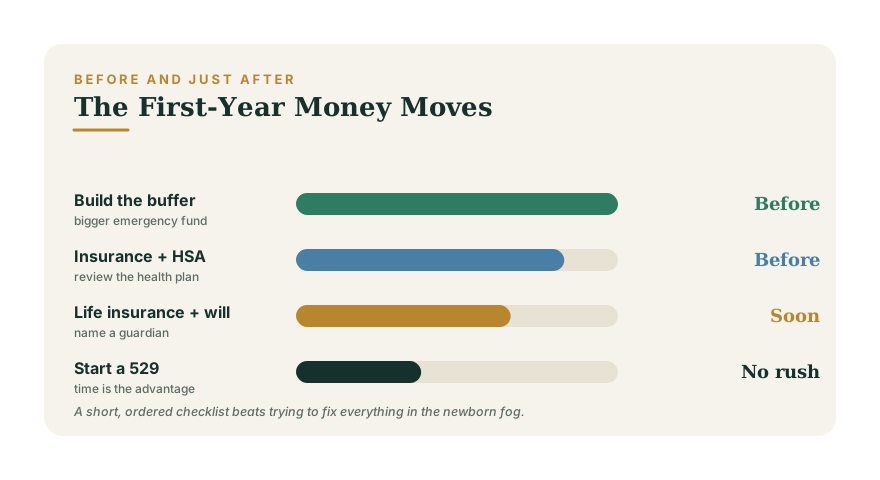
Spread these moves out: budget and insurance review before the due date, life insurance and the will in the weeks around birth, the 529 whenever the essentials are funded. Handle them one at a time and the newborn months stay about the baby, not the paperwork. Pull the whole picture together on the life events hub.