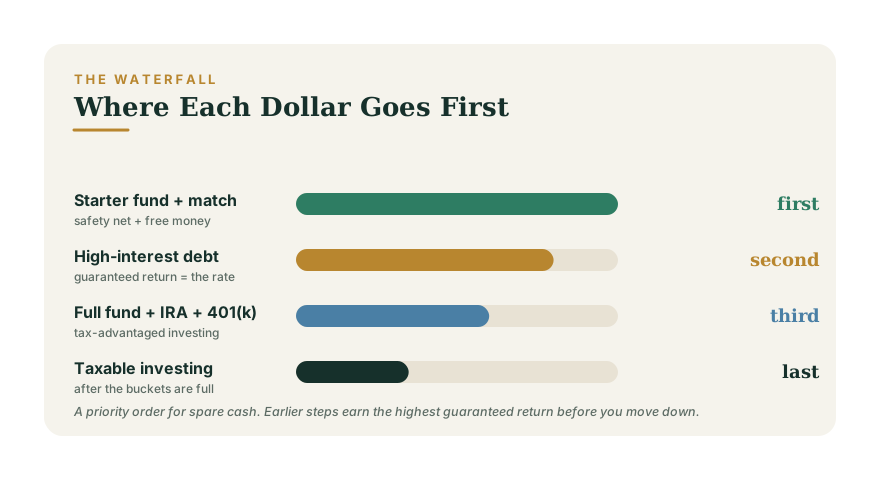
One of the most common money questions has a surprisingly clear answer: when you have an extra dollar, where should it go? People agonize over whether to pay off the car loan, invest, or build savings — and often do a little of everything, which means none of it gets done well. There is a better way. Financial planners use a rough priority order, sometimes called the financial order of operations or the waterfall, that puts each dollar where it earns the highest guaranteed return first, then flows down to the next step.
The logic: chase the highest guaranteed return
The order is not arbitrary. At each step you are comparing returns. An employer 401(k) match is an instant 50% or 100% return. Paying off a 22% credit card is a guaranteed 22% return. A long-term index fund might average 7% over decades but with no guarantee. So you take the guaranteed high-return moves first, then move to the uncertain-but-valuable ones. Follow the steps roughly in order; you do not need to fully complete one before starting the next, but resist skipping ahead to lower-return steps while a higher one sits unfunded.
Step 1: A small starter emergency fund
Before anything else, set aside a modest cushion — often about $1,000, or a bit more if your life is more complex. This is not your full emergency fund; it is a buffer so the first flat tire or medical copay does not land on a credit card and undo your progress. It comes first because it protects every step that follows. The full version comes later; the starter version comes now.
Step 2: Capture the full employer match
If your job offers a 401(k) match, contribute at least enough to get all of it. This is the only step where you can earn an immediate, guaranteed 50–100% return, and it sits this high precisely because nothing else competes. Skipping the match to pay down a 6% loan is leaving free money on the table. If your benefits package is new to you, start with your first job's benefits explained.
Step 3: Kill high-interest debt
Next, attack debt above roughly 7–8% — credit cards, payday loans, some personal loans. Paying off a 22% balance is a risk-free 22% return; no investment reliably beats that. Knock these out aggressively before investing beyond the match. Lower-rate debt (a mortgage, most student loans, a cheap car loan) does not belong here — it can wait, because your invested dollars likely earn more than the loan costs. For the payoff mechanics, see debt avalanche vs snowball.
Step 4: Finish the full emergency fund
With high-interest debt gone, build the starter cushion up to a real 3–6 months of essential expenses, held in a high-yield savings account. This is the foundation that lets you invest for the long term without being forced to sell investments at the worst possible moment. How much you need and where to keep it is covered in the emergency fund guide.
Step 5: Fund an IRA
Now move into long-term tax-advantaged investing. An IRA usually comes before maxing the 401(k) because you control it and can choose low-cost funds, often with better options than a workplace plan. For many people a Roth IRA is ideal — you pay tax now and withdraw tax-free in retirement. Which flavor fits depends on your tax situation; see Roth vs traditional IRA.
Step 6: Max out the 401(k)
After the IRA, return to your 401(k) and contribute beyond the match, up to the annual limit if you can. These are large tax-advantaged buckets, and the dollars you shelter here compound for decades. If you have an HSA-eligible health plan, the HSA also belongs around this stage — it is the only triple-tax-advantaged account and quietly doubles as a retirement account.
Step 7: Taxable investing and everything else
Once the tax-advantaged buckets are full and high-interest debt is gone, invest additional money in a regular taxable brokerage account, and turn to lower-priority goals: extra mortgage payments, a bigger house, or other dreams. There is no tax shelter here, but there are no contribution limits or withdrawal restrictions either. New to this part? Start with how to start investing.
Adjust the order to your life
This is a default, not a law. If your job is shaky, you might build a bigger cash cushion before investing. If your only debt is a low-rate mortgage, you might skip straight from the match to investing. The principle — highest guaranteed return first, foundation before growth — is what matters; the exact steps flex to fit you. Map your own version and see how the sequence plays out over time with the Lifetime Wealth Simulator, then build the full picture at the planning hub.