The most common way people decide whether to rent or buy is also the most misleading: they compare a monthly rent check to a monthly mortgage payment, see that the numbers are close, and conclude that buying is the obvious win because "at least you build equity." That comparison leaves out roughly a third of what owning actually costs.
Buying a home can be a great financial decision. So can renting. Which one wins for you depends on numbers most calculators gloss over, and on a single variable almost everyone underestimates: how long you will stay.
Let us build the honest version of the comparison, line by line, and then find the point where buying actually pulls ahead.
The Costs of Owning That Rent Doesn't Have
When you rent, your monthly check is close to your total housing cost. When you own, the principal-and-interest payment is just the beginning. Add these:
- Property taxes. Typically somewhere around 0.5% to 2.5% of the home's value per year depending on where you live. On a $400,000 home that can be anywhere from roughly $170 to $830 a month.
- Homeowners insurance. Often a few hundred dollars a month, and rising fast in many regions.
- Maintenance and repairs. A useful rule of thumb is roughly 1% of the home's value per year. On a $400,000 home that is about $4,000 annually, or $330 a month, averaged over time. Some years it is nothing; the year the roof or HVAC fails, it is brutal.
- HOA or condo fees, where applicable, which can run from modest to several hundred dollars a month.
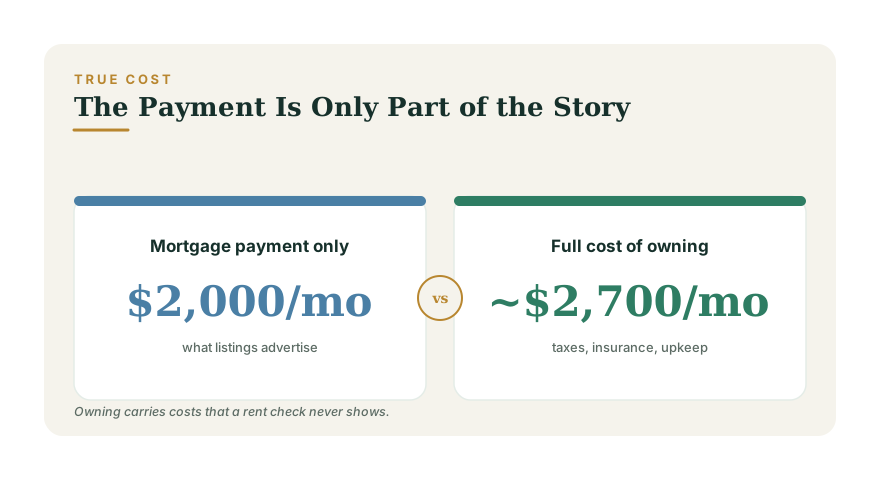
Stack those on top of principal and interest and a "$2,000 mortgage" is often a $2,700 housing cost. Renting that same home might genuinely cost less per month.
The Two Costs Almost Everyone Forgets
Two more numbers belong in the comparison, and they are the ones that flip many decisions.
Closing costs. Buying a home costs roughly 2% to 5% of the price in fees you cannot recover. Selling costs even more, frequently 6% or more once you account for agent commissions and transfer taxes. Together, a typical round trip of buying and later selling can erase something like 8% to 10% of the home's value. You need appreciation just to break even on those costs.
Opportunity cost of the down payment. The money you sink into a down payment is money that is no longer invested. If you put $80,000 down, that is $80,000 not compounding in a diversified portfolio. At a reasonable long-run return, the forgone growth is real money every year, and it belongs on the ownership side of the ledger. You can model this trade-off directly with our wealth simulator.
The 5-Year Rule and Break-Even Horizon
Because buying and selling are so expensive, owning only pays off if you spread those one-time costs over enough years. The common guideline is the five-year rule: if you are not reasonably sure you will stay put for at least five years, renting is usually the safer financial choice.
The real break-even depends on your local mix of rent, prices, taxes, and how fast homes appreciate. In a high-cost market with steep prices and modest appreciation, break-even might be seven or eight years. In an affordable market with strong rent inflation, it might be three. The point is the same: the longer you stay, the more the upfront friction of buying gets diluted, and the more ownership tends to win.
When Renting Actually Wins
Renting is not "throwing money away" any more than buying groceries is. You are paying for shelter and flexibility. Renting is often the smarter financial move when:
- You might move within a few years for work, family, or lifestyle reasons.
- Home prices in your area are very high relative to rents, so the cost of owning dwarfs the cost of renting the same place.
- You would have to drain your emergency fund or stop investing to afford the down payment.
- You value not being responsible for repairs, or you simply do not want to be tied to one location.
A renter who invests the difference between renting and owning can build just as much wealth as an owner. Equity is not magic; it is forced savings plus leverage, and you can replicate the savings part on your own.
How to Run Your Own Numbers
Skip the rules of thumb and do the comparison properly:
- Add up the full monthly cost of owning: principal, interest, taxes, insurance, maintenance at about 1% per year, and any fees.
- Compare that to the rent for a similar home, not a worse one.
- Account for the down payment's lost investment growth.
- Estimate how many years until cumulative ownership costs plus closing costs are offset by equity and appreciation.
- Be honest about how long you will stay.
Done this way, the rent-versus-buy question stops being a slogan and becomes arithmetic you can actually trust. If you want to see how a home purchase fits alongside your broader savings and retirement goals, run the scenario through our tools before you commit.