Most personal-finance advice quietly assumes a couple — two incomes, a spouse who inherits by default, someone to make medical decisions if you cannot. If you are single, whether by choice or circumstance, the standard playbook has gaps. Planning as a solo adult is not harder, but it is different: you carry all the risk on one set of shoulders, and you have to build deliberately the safety nets that couples get by default. The upside is real too — you answer to no one and can optimize entirely around your own goals.
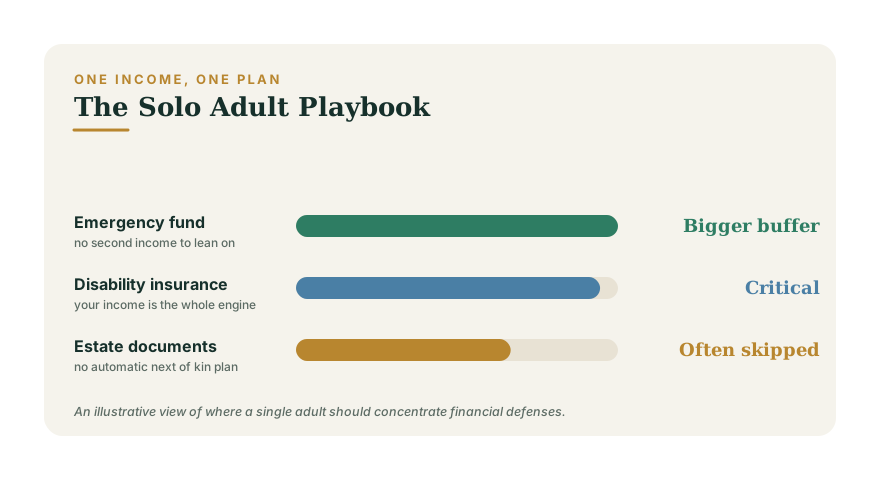
A bigger emergency fund
When a couple loses one job, the other income often keeps the lights on. When you are single and lose your job, income drops to zero. That single point of failure is the defining feature of solo finances, and it means your emergency fund should sit at the larger end of the usual range — closer to six months of expenses than three, and more if your income is variable. This is your substitute for a second earner. Build it before you invest aggressively, using the framework in The Emergency Fund Guide.
Protecting your income
Your income is the entire engine of your financial life, with no backup, which makes disability insurance unusually important for single people — see How Much Disability Insurance You Need. If a couple loses one earner to illness, the household bends; if you lose yours, it can break. Life insurance, by contrast, is often less urgent for a single person with no dependents, since its purpose is to replace income for people who rely on you. If no one depends on your paycheck, you may need little or none — a nuance covered in Do You Need Life Insurance?.
Retirement on a single income
You are saving for retirement without a spouse's savings, a spousal Social Security benefit, or a partner to share future costs — so your own contributions have to carry the full load. The advantage is control: no negotiating priorities, no compromise on risk tolerance. Maximize tax-advantaged space in order — capture the full employer match, then an IRA, then more — and lean on automation so the saving happens without willpower. Project whether your single-income path reaches your target with the Retirement Planner, and remember that as a single filer your tax brackets differ from a married couple's, which affects Roth-versus-traditional decisions.
The estate gap single people ignore
This is the most overlooked part of solo planning. For a married person, many defaults point to the spouse — assets, medical decisions, guardianship. For a single person, there is no automatic backstop, and the law's defaults may send your assets to relatives you would never choose. Two documents are non-negotiable:
- A durable power of attorney and healthcare directive, naming who makes financial and medical decisions if you are incapacitated — because there is no spouse to assume it. See Power of Attorney and Healthcare Directives.
- A will and beneficiary designations, so your assets go where you intend rather than to a state formula. Start with Estate Planning Basics Everyone Needs.
Naming beneficiaries on your retirement and bank accounts is especially powerful for single people, because those designations pass money directly and skip a slower court process.
Building your support network
Solo does not mean alone. Cultivate a trusted circle — a friend or family member who could step in during an emergency, a fee-only planner for big decisions, and clear instructions so someone can find your accounts and documents if needed. Organizing your paperwork now, as in How to Organize Important Documents, is a gift to whoever helps you later.
The solo advantage
Planning alone means carrying all the risk, but also keeping all the control. Build the bigger buffer, insure your income, save relentlessly for a retirement that is entirely yours to design, and close the estate gap that single people so often ignore. Go deeper with Financial Planning When You Are Single, check your footing with the Financial Wellness assessment, and map your one-person plan at the planning hub.