Most personal-finance advice quietly assumes a couple: two incomes, two people to share risk, an automatic next-of-kin to step in. If you are single — never married, divorced, widowed, or simply living solo for now — that assumption does not fit your life, and following it unadjusted can leave real gaps. Being single is not financially worse; in many ways it is simpler, with no one else's debts or spending to manage. But it does concentrate risk on one person, and a few parts of the plan need extra weight to account for that.
Your emergency fund needs to be bigger
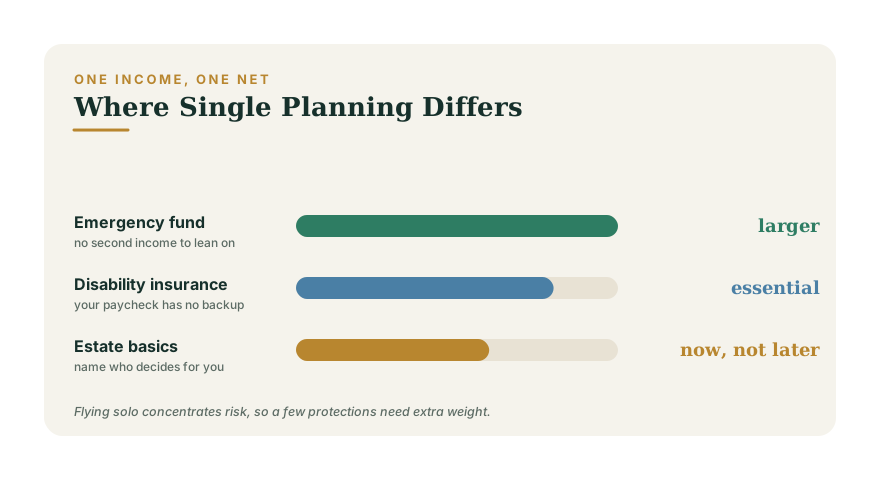
The standard guidance — three to six months of expenses — is built around the idea that if one earner loses a job, a second income keeps the lights on. On a single income there is no second paycheck to fall back on, so the cushion has to do more work. Aim toward the higher end of the range, often six months or more, and lean larger still if your income is variable, your field hires slowly, or you rent in an expensive area. The same logic applies to surprise costs: when the car and the water heater both fail in one month, you are the only one covering it. A deeper buffer is not excess caution here — it is the substitute for the partner you do not have. Start with The Emergency Fund Guide and size yours toward the top of the range.
Disability insurance is non-negotiable
Early and mid-career, your single biggest asset is not your savings — it is your ability to earn, the stream of all future paychecks. For a couple, a disabling injury or illness is a severe hardship softened by a second income. For someone single, it can be financially catastrophic, because the one income supporting everything stops. That makes long-term disability insurance one of the most important and most overlooked protections you can carry. Check what your employer offers first, since group coverage is cheaper, and consider topping it up with an individual policy if the group amount is thin. It is the single most ignored line of defense — exactly the case made in Disability Insurance: The Coverage Almost Everyone Ignores.
Build a support network on purpose
Couples have a built-in backup for the non-financial emergencies that quickly become financial ones — someone to drive them home from a procedure, feed the cat during a hospital stay, or simply talk through a big decision. Single people have to assemble this deliberately. That means cultivating a few trusted friends or family members you could lean on in a pinch, and it means being clear-eyed that you may need to pay for services a partner might otherwise provide. Practically, keep a short list of who to call in a crisis, make sure at least one trusted person knows where your important documents live, and consider professional help — a fee-only advisor, an accountant — as your sounding board for the big calls you would otherwise make alone. A network is part of a financial plan, not separate from it.
Estate basics: do them now, not someday
Estate planning sounds like something for the wealthy or the elderly, but for single adults a couple of documents are genuinely urgent — because the default legal answers are worse for you. If you become incapacitated, who makes your medical and financial decisions? For a married person, a spouse is the obvious answer; for a single person, without paperwork it may fall to a court or a relative you would not have chosen. Two documents fix this:
- Durable power of attorney — names someone you trust to handle finances if you cannot.
- Healthcare directive (and medical power of attorney) — names who makes medical decisions and records your wishes.
Add a simple will so your assets go where you intend rather than by a default formula, and — this is the part people miss — update the beneficiary designations on your retirement accounts and life insurance, since those override your will entirely. The essentials are walked through in Estate Planning Basics Everyone Needs.
The upside of going solo
It is worth saying plainly: single finances have real advantages. You answer to no one on spending, you can take career risks and relocate freely, and your goals are entirely your own to set and change. The job is simply to convert that freedom into security by deliberately covering the risks a partnership would otherwise share. Cover the bigger emergency fund, the disability policy, the support list, and the estate documents, and you turn flying solo from a vulnerability into genuine independence. To pressure-test where you stand, take the financial resilience assessment and map the rest at the planning hub.